
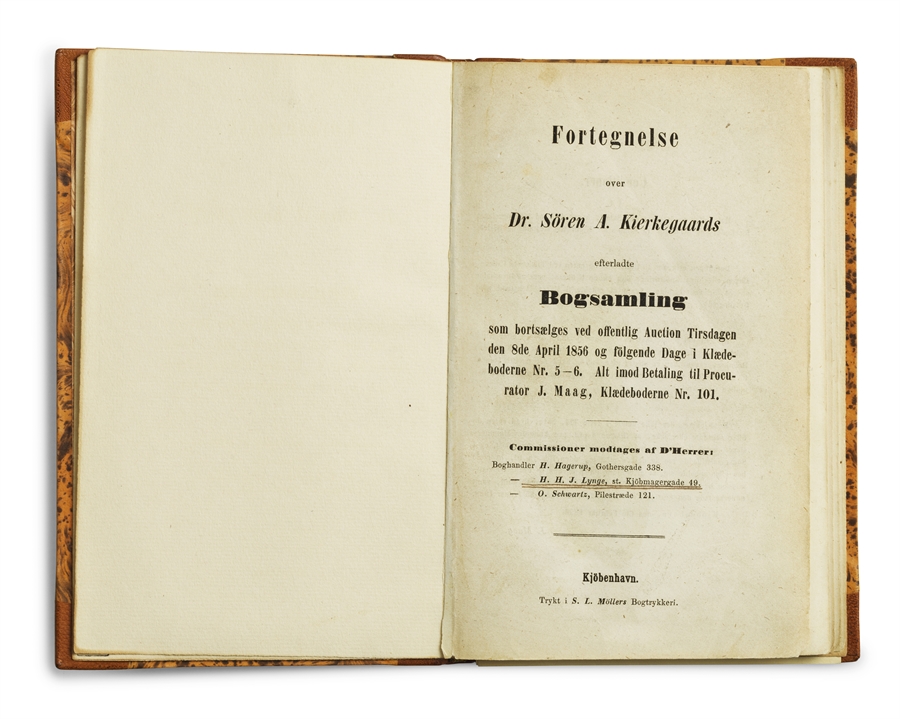
Kjöbenhavn, S.L. Möller, (1855).
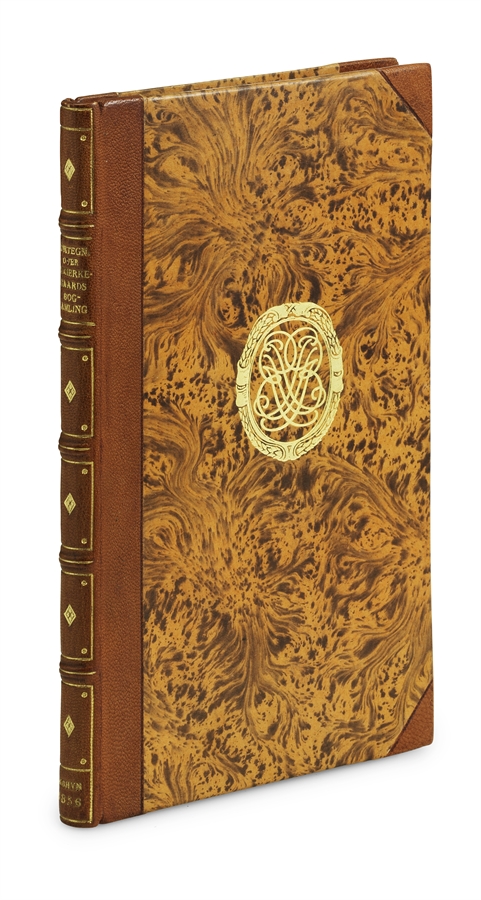
8vo. Bound in an exquisite later light brown half calf binding with elegant gilding and five raised bands to spine (bound by renowned Swedish bookbinder Hedberg). With the gilt super ex libris of the great Swedish collector Gustav Bernström to front board. First and last leaf recto and verso respectively dusty, as they act as self-wrappers. Otherwise very nice and clean. (2), 87, (1) pp.
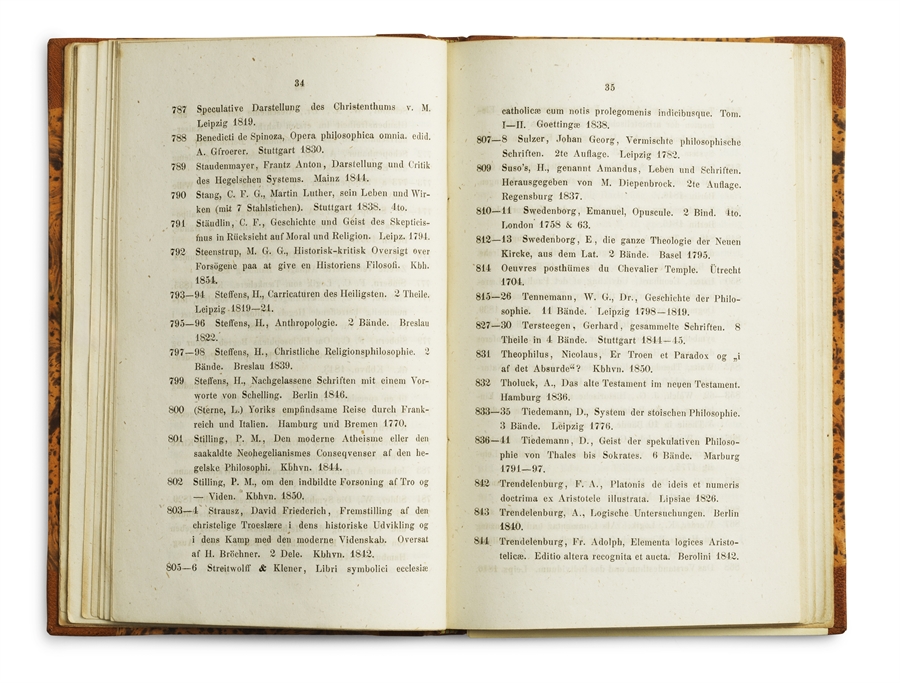
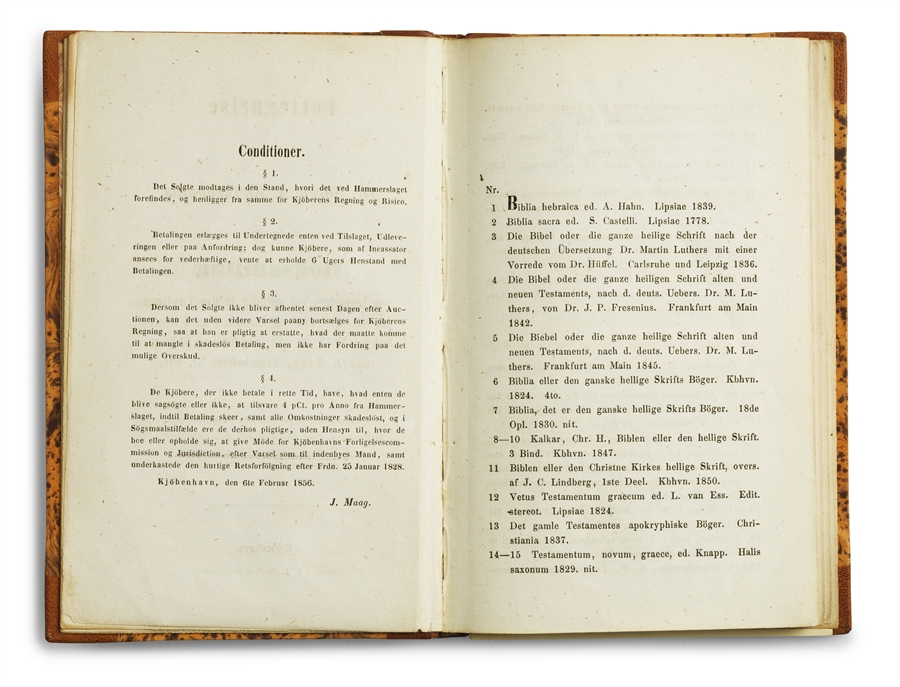
The exceedingly scarce first printing of the auction catalogue of Kierkegaard’s book collection, sold shortly after his death. The catalogue is of the utmost scarcity with merely 10 copies or so still known to exist. The auction catalogue is one of the most important works for the understanding of Kierkegaard. It is a pivotal testament to the way Kierkegaard worked, collected, published, and was inspired, and it provides a wealth of information about the great philosopher. It is an indispensable tool for anyone interested in Kierkegaard, both his life and work, and it has played a significant role in Kierkegaard scholarship since the time of his death. “The catalogue has long served as one of the most valuable tools in Kierkegaard studies and has been actively used by commentators, translators, and researchers. Scholars quickly recognized the potential importance of this catalogue primarily for tracing the various sources of Kierkegaard’s thought.” (Nu, Schreiber, & Stewart: The Auction Catalogue of Kierkegaard’s Library, p. (vii) ). The catalogue was printed in 278 copies, but as always with this kind of document, only very few copies survived. We have only ever had one other copy (the one kept in the shop, as it was made by Herman H.J. Lynge), and the original printing has only been on the market very few times. According to Plesner, merely 10 copies still exist, which fits with the infrequency with which we have seen it. “Søren Kierkegaard died on the 11th of November 1855. Only a few months later, at the beginning of April 1856, his books were put up for sale. There was not much time to list the collection, and it is evident that the printed catalogue was got together in haste. It was probably Herman H.J. Lynge, the best known second-hand bookseller of that time, who compiled the catalogue, as the placard announcing the sale stated that the catalogue “was obtainable” at his shop. The sale was an event which created stir among scholars all over Denmark. People came long distances to make their own bids and to satisfy themselves of the condition of the books. Seldom before or afterwards has a book sale in Denmark been advertised so widely. From the 8th of March there were ten advertisements alone in the “Adresseavisen” until the big advertisement on the front of the paper on the 8th of April. The sale which lasted three days from the 8th to the 10th of April 1856, was held in Søren Kierkegaard’s flat in 5-6 Klædeboderne, the present 38 Skindergade… The event drew crowds… Bidding was lively and the average price for the single items was nearly a rix-dollar a very high price for that time. Lynge was completely overwhelmed by the high bids. In a letter of the 22nd of May (The Royal Library, Recent Letters, D.) to the famous collector F.S. Bang…, he wrote: “At the sale of Dr. Søren Kierkegaard’s books everything went at very high prices, especially his own works, which brought 2 or 3 times the published prices”.” (Rohde Auction Catalogue, p. LVIJ). People came from near and far to get a piece of the recently deceased legend. Many authors, philosophers, and scholars were present in the auction room, which was completely full, as was the Royal Library, who bought ca 80 lots (though Rohde says ca 50). Some of the lots were withdrawn from the catalogue before the auction, by the heirs, namely those of his own books that had annotations, markings or notes by Kierkegaard himself in them. “Many of the books, not only his own, were paid for with much higher prices than in the book shops; especially such writings about which one thought that he had used them frequently, were much desired and paid for with high prices, but even more so were the books, in which he had noted some remark, however small, until in the end these were excluded from the sale, as the heirs prohibited them being sold.” (In Morgenposten no. 99, 30. April 1856, written by “P.”, translated from Danish). It was not customary at the time to report on sales in the papers, but contrary to tradition, Morgenposten (The Morning Post, a paper sympathetic to the peasant movement), three weeks after the auction sale, issued a lengthy report taking up almost the entire front page. It is evident from this that Kierkegaard through his last struggle – the Church Feud (see XXXII in Section I) – continued directly affecting the Danish population after his death. The Morning Post is clearly on Kierkegaard’s side in the fight against the official Christendom and interprets the crowds of people interested in the auction sale of his books as evidence of the immense influence he exercised and the many people he made see the truth. After having attacked the clergy, the Morning Post continues “Though thank god, the sale – and that is the reason for its mention – gave many important and gratifying indications that Kierkegaard has not lived, has not suffered and struggled in vain, but that his words have penetrated many hearts and that during his lifetime he opened the eyes of many to the false and demoralizing effects of lethargy and self-glorification of the clergy…” The article vividly describes the ambience in the sales room, where the audience was primarily present in order to obtain a relic from the deceased “saint”. Kierkegaard had a comprehensive library, but it did not count among the largest private libraries of the period. It was necessary for him to have a wide selection of especially philosophical and theological works, but he did not want it to be too large. As Johannes the Seducer says in Either-Or, “One must limit oneself – that is a primary condition for all pleasure”. But Kierkegaard was also a collector, and he also let himself be tempted by books he did not need, but merely desired or for some reason was attracted to. Theological works constitute the main part of his book collection and make up approximately half of the collection he left behind when he died; but he had a wide range of philosophy, Greek and Latin classics, literature – most well represented is Danish and German literature –, and he had a solid collection of bibliographical and other reference works. Throughout his life, he has owned more than the ca. 2.000 books that he had in his collection when he died, but these books, registered in the auction record, are the only ones we know for certain that he had, and the auction record is an invaluable source of knowledge about the books that Kierkegaard owned and read. In fact, this auction record is the basis of a wealth of knowledge about Kierkegaard, his reading habits, his collecting habits, his book binding habits, and his relation to his own books. It is one of the most frequently used tools in Kierkegaard research and is an indispensable bibliographical work. In 1957, Niels Thulstrup issued the catalogue anew, with an introduction. He did not include the appendices, however. It is still disputed whether the books listed in the appendices belonged to Kierkegaard or not, but they were part of the original catalogue and are certainly worth considering. Furthermore, contrary to what Thulstrup states in the preface, not all the numbers of the original auction catalogue are in fact included in the new edition. Thulstrup simply omitted some of the numbers that he did not find relevant. Thus, this new edition was by no means complete, and in 1967, a new edition appeared. This edition of the catalogue was made by H.P. Rohde, has an excellent preface in both Danish and English, and contains all the information from the original printing. Furthermore, Rohde has added all available information about the individual copies that he could find as well as the auction protocol’s registration of the buyers of the individual books. “Today it [the original printing] is a very rare book. According to the auction protocol, it was merely printed in 278 copies, and most of these seem to be lost. It was therefore very commendable of the Søren Kierkegaard-Society when some years ago it decided to effect a new edition. Everyone with an interest in Kierkegaard has need of that. … What one expects from such an edition is first and foremost that it simply replaces the original catalogue, which is now unobtainable.“ (Rohde, Fund og Forskning VIII, 1968, p. 85). “[T]he catalogue represents an invaluable point of departure for any deeper understanding of Kierkegaard and his sources.” (Nun, Schreiber, & Stewart, p. xvi). Himmelstrup 3133 The present copy is no. 98 in Girsel's "Kierkegaard" (The Catalogue) which can be found here.
Order-nr.: 63668