
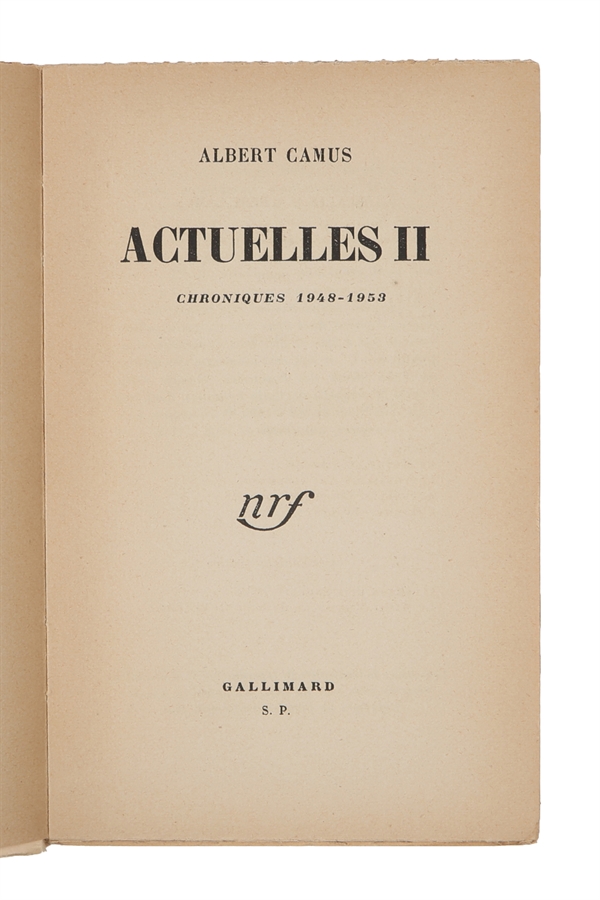
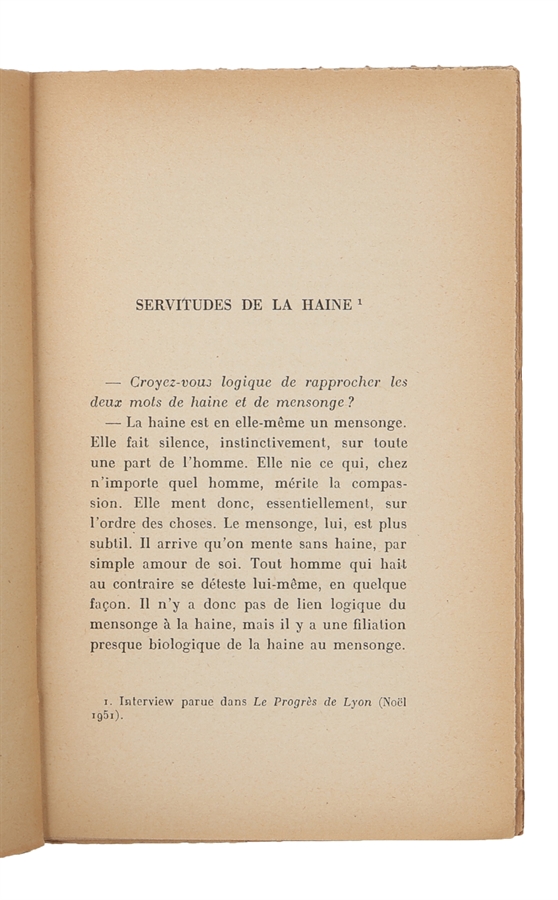
(Paris) Gallimard (1953).
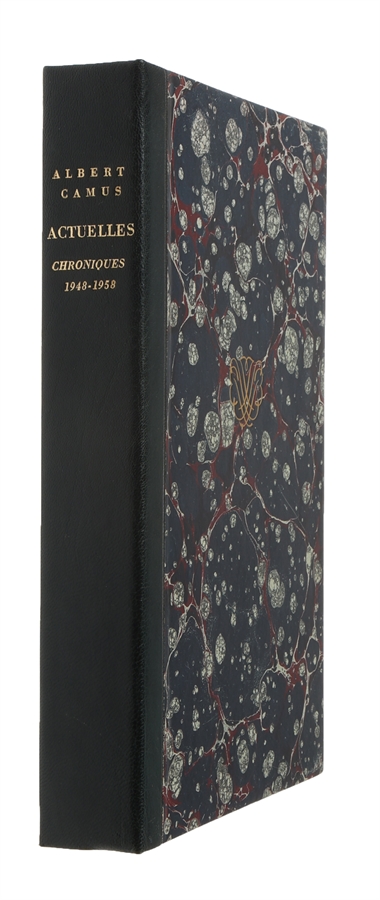
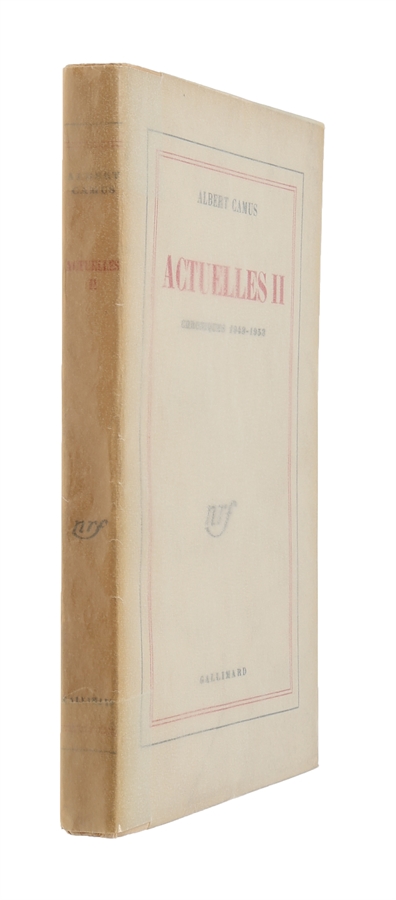
8vo. Uncut in the original printed wrappers. An excellent, fresh copy (evenly browned througfhout as always, due to the quality of the paper). 186, (1). Housed in an exquisite dark blue half morocco box with blue marbled paper and gilt lettering to spine (Henning Jensen). Gilt super ex libris to front board.
Some browning to pages, otherwise neat and clean. In half calf box with marbled boards, gilt title to spine and gilt ex libris on the top. Some wear to edges.
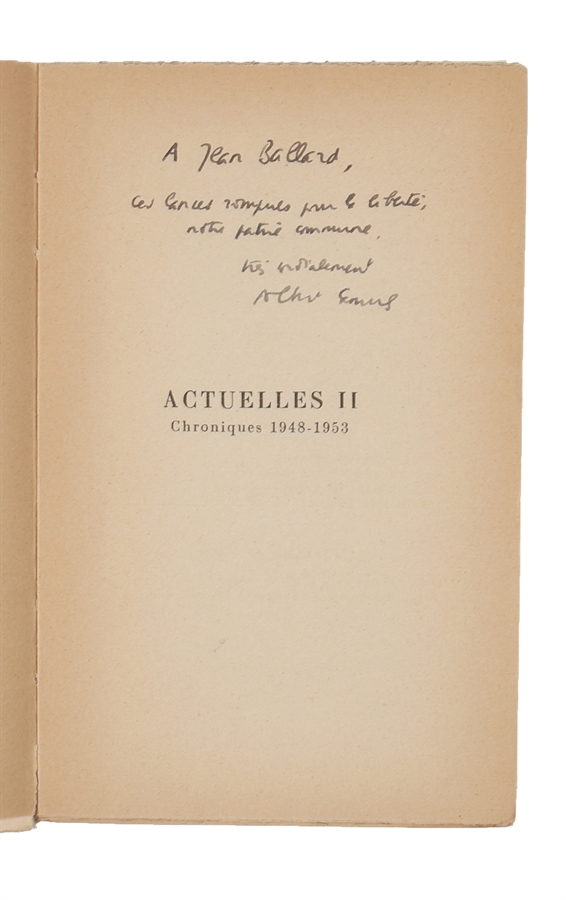
Signed copy dedicated to Jean Ballard (1893-1973).
First edition, presentation-copy, inscribed to Jean Ballard, of Camus' second collection (of three published betweeen 1950 and 1958) of chronicles. Camus started preparing this second volume in 1953, which brings togther articles, interviews, polemical letters, etc., dealing with world affairs since 1948, the cut-off point of the first volume. Actuelles II covers the troubling moments of the Cold War, from the Prague coup (1948) to Stalin's death (1953) (see Vanney). In this volume, he summed his hopes in a brief preface: "The new world, true liberation, was not yet just around the corner, but nihilism was a thing of the past, and creation, always possible, now became more than ever necessary. A long section of Actuelles II looked backward [...]. But a final section, entitled 'Création et Liberté,' was an attempt to demonstrate the continuing need for art. 'It's not enough to criticize one's times, one must also try to give them a form, and a future.'" (Lottman: 521) Camus completed the reading of the proofs in Thonon-les-Bains, "at the last moment adding the speech he had recently delivered at Saint Etienne". This speech was delivered in May 1953 at the Labor Exchange, where a group of labor organizations had called a meeting. Camus "denounced threats to freedom in Western societies as well as Eastern ones, pleaded for freedom as the one good, the one heritage of the great revolutionary conquests of two centuries." (Lottman: 522) Actuelles II is also strongly tied to his book-long essay L'homme révolté (EN: The Rebel), published in 1951. According to Vanney, "The book's significance can be gauged, if necessary, by the sheer volume of commentary and criticism it generated from both the right and the left." [own translation]. In 1952, Camus had written a defense of his work, but decided not to publish it, and instead prepared the current volume, of which seven out of sixteen texts revisit his controversial book. "Since Camus had decided against publishing Défense de L’Homme révolt, written in the wake of these polemics, reading them becomes essential to understanding the nuances and interpretations he brings to his essay. Apart from an interview with Pierre Berger, they are presented in epistolary form and therefore should be read alongside the criticisms that prompted them." ([own translation], see Vanney) After WWII, Albert Camus (1913-1960) became, as a novelist and playwright, moralist and political theorist, "the spokesman of his own generation and the mentor of the next, not only in France but also in Europe and eventually the world" (Cruickshank 2026). Jean Ballard (1893-1973) was a French actor, poet and editor. Between 1925-66, he ran the publisher Les Cahiers du Sud (“The Southern Notebooks”). Aronson, Ronald. (Winter 2022 Edition). Albert Camus. In Edward N. Zalta & Uri Nodelman (eds.), The Stanford Encyclopedia of Philosophy. https://plato.stanford.edu/archives/win2022/entries/camus/ Cruickshank, J. (2026, July 31). Albert Camus. Encyclopedia Britannica. https://www.britannica.com/biography/Albert-Camus Lottman, H. R. (1979). Albert Camus: A biography. Weidenfeld & Nicolson. Todd, O. (1998). Albert Camus: A life (B. Ivry, Trans.). Vintage. Vanney, Philippe. (n.d.). Actuelles II (1953). Société de Éstudes Camusiennes. https://www.etudes-camusiennes.fr/actuelles-ii-1953/
Sources and further reading:
Order-nr.: 63533