
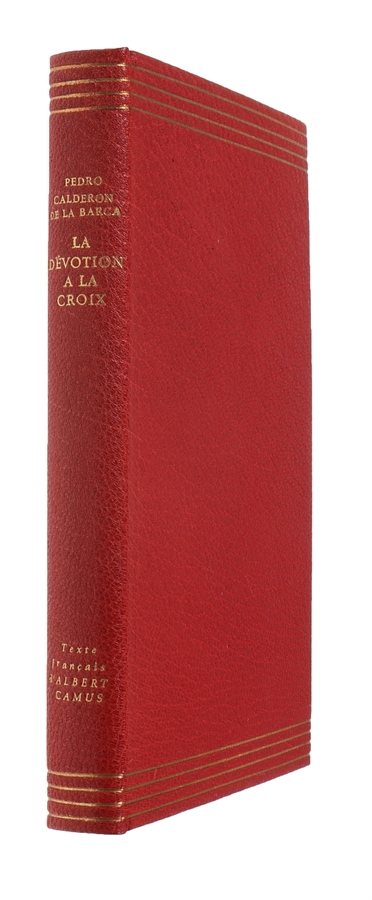
(Paris) Gallimard, 1953.
8vo. Bound uncut with the original printed wrappers in an exquisite full red morrocco binding with quadruple gilt lines over boards and spie and gilt lettering to spine (bound by Henning Jensen and gilt by Hagel Olsen). Top edge red. Gilt super ex libris to inside of front board. A splendid, near min copy in a wonderful, elegant binding. 169, (4).
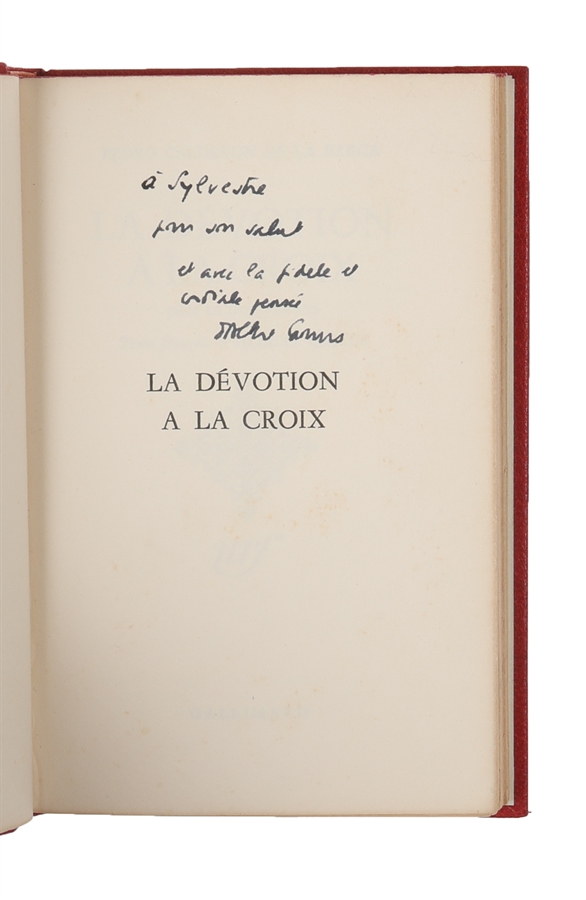
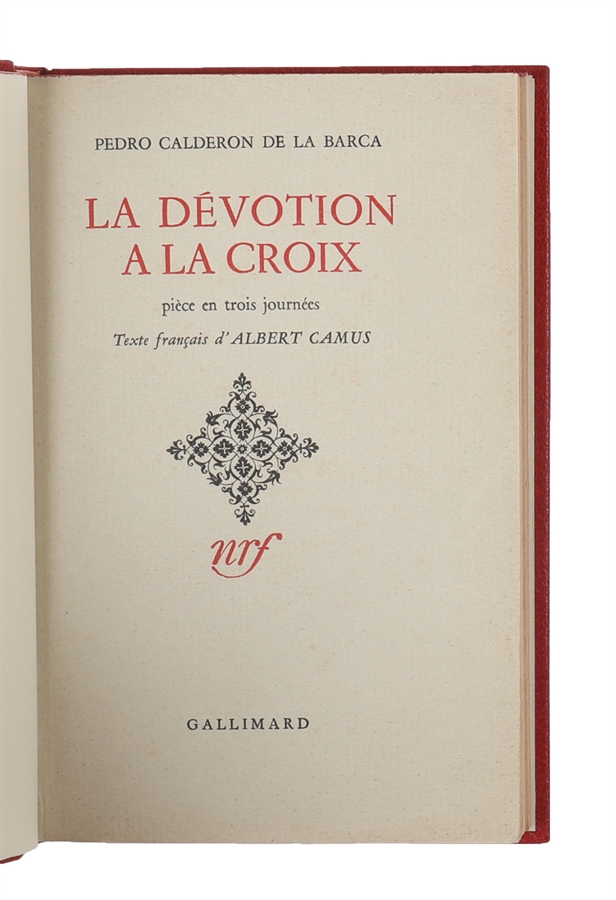
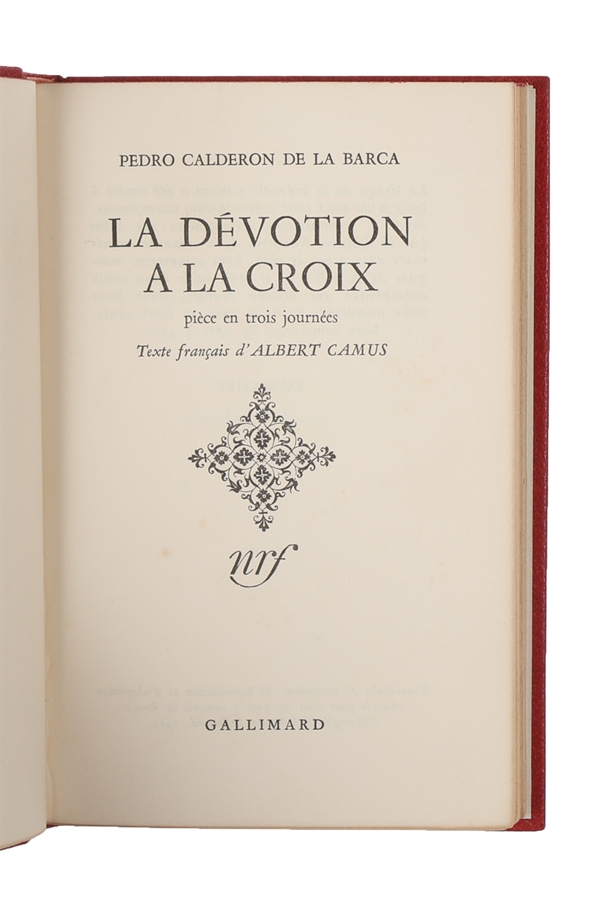
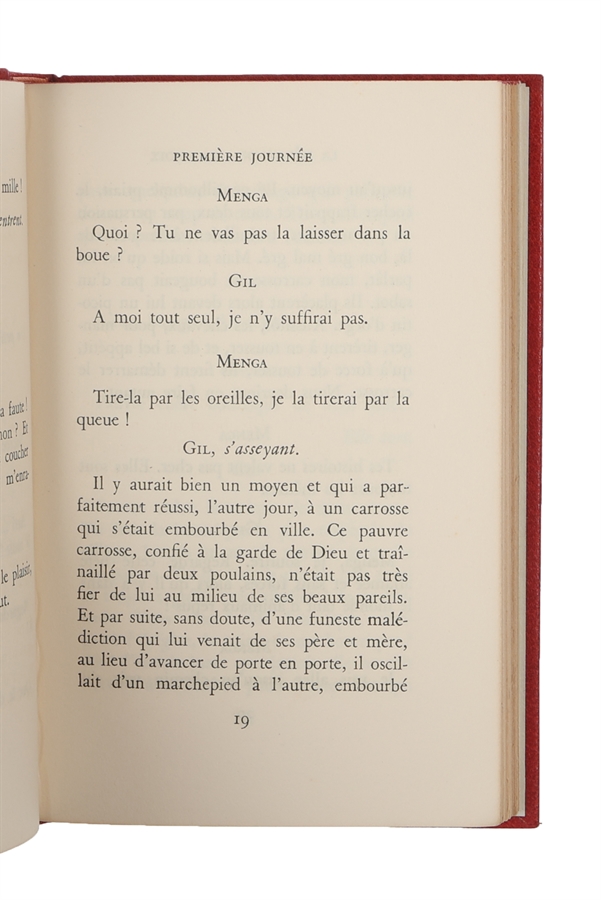
First edition - nr. 3140 out of 3265 numbered copies, on alfama Marais (preceded by 65 copies on Lafuma Navarre) - signed presentation-copy from Camus, of his translation of an early 17th century historical play by the Spanish dramatist Pedro Calderón de la Barca (1600-1681), La dévotion de la croix (ES: La devoción de la cruz; EN: Devotion to the Cross). "A keynote of Calderon’s tragic view of life is his deep-seated realization that a man can be responsible through his own wrongdoing for the wrongdoing of another. This realization probably derives from Calderón’s own family experience. In La devoción de la cruz (c. 1625; Devotion to the Cross) [...], the heart of the tragedy lies in the fact that the greatest sinner is also the most sinned against—in that others, before he was born, had begun to dig his grave" (Parker 2026). The play was translated for the Festival D'Angers – founded in 1950 and still existing today as Festival D'Anjou – of which he was an artistic director in 1953 and again in 1957, where he selected another Spanish play, The Knight from Olmedo, by Lope de Vega, the predecessor of Calderon. Camus translated this particular piece upon the request of the actor Marcel Herrand (1897-1953), who passed away before the festival took place (see foreword written by Camus, p. 11). The stark tradegy was performed in June 1953, starring Maria Casarès, who had assisted Camus in the translation, Serge Reggiani, Paul Oettly and Jean Marchat (Lottman: 524-25), and was a success: "Camus' adaptations received national press attention, and locally the press would say that the Calderón work was so perfectly performed it could never again be played on an ordinary theater stage." (Lottman: 525) The presentation-inscription reads: "à Sylvester | pour son salut | et avec la fidèle et | cordiale pensée | d'Albert Camus". Aronson, Ronald. (Winter 2022 Edition). Albert Camus. In Edward N. Zalta & Uri Nodelman (eds.), The Stanford Encyclopedia of Philosophy. https://plato.stanford.edu/archives/win2022/entries/camus/ Cruickshank, J. (2026, July 31). Albert Camus. Encyclopedia Britannica. https://www.britannica.com/biography/Albert-Camus Lottman, H. R. (1979). Albert Camus: A biography. Weidenfeld & Nicolson. Parker, A.A. (2026, May 21). Pedro Calderón de la Barca. Encyclopedia Britannica. https://www.britannica.com/biography/Pedro-Calderon-de-la-Barca Todd, O. (1998). Albert Camus: A life (B. Ivry, Trans.). Vintage. Zaretsky, Robert (4 March 2018). 'No Longer the Person I Was': The Dazzling Correspondence of Albert Camus and Maria Casarès. Los Angeles Review of Books. Retrieved 04 September 2026.
After WWII, Albert Camus (1913-1960) became, as a novelist and playwright, moralist and political theorist, "the spokesman of his own generation and the mentor of the next, not only in France but also in Europe and eventually the world" (Cruickshank 2026).
Sources and further reading:
Order-nr.: 63531