
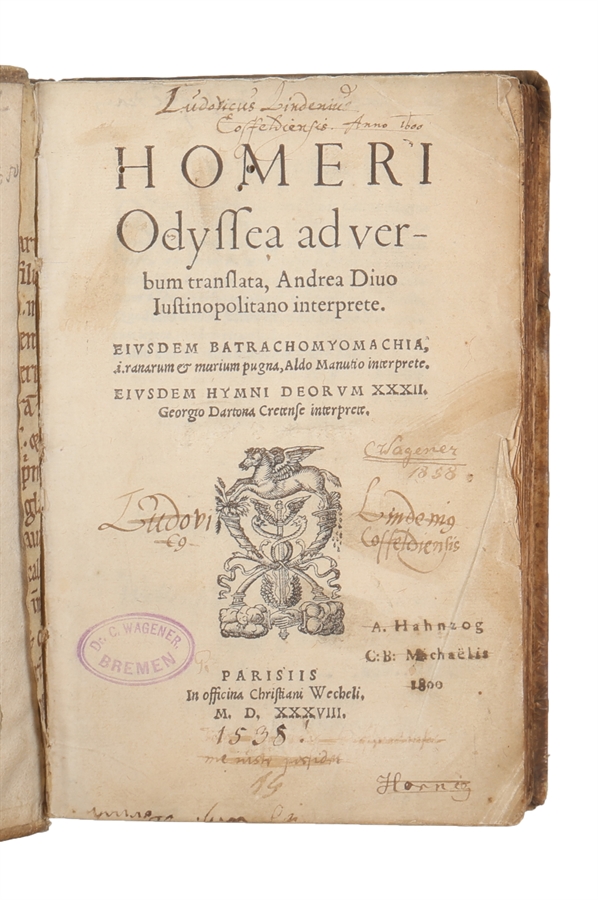
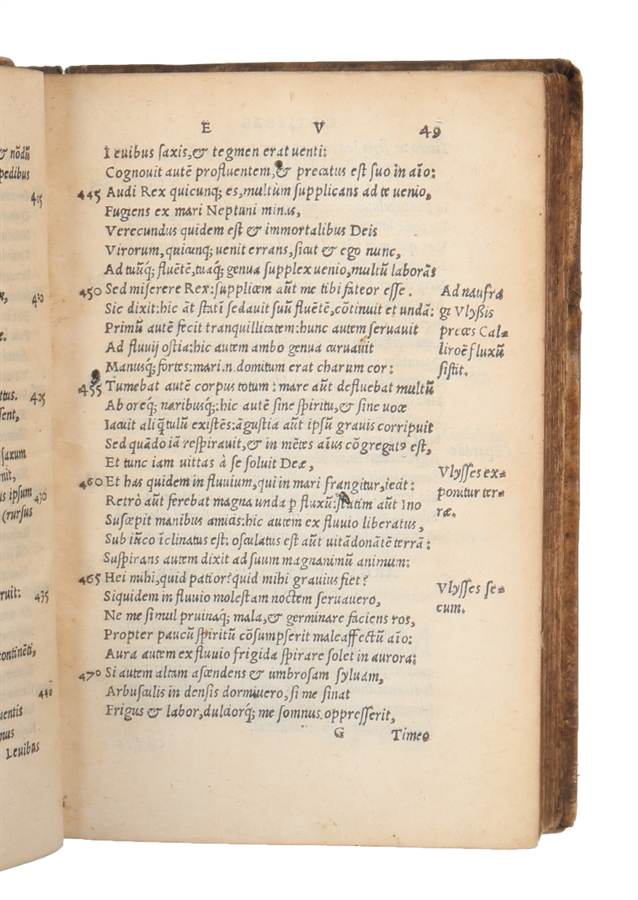
Parisiis, In officina Christiani Wecheli 1538.
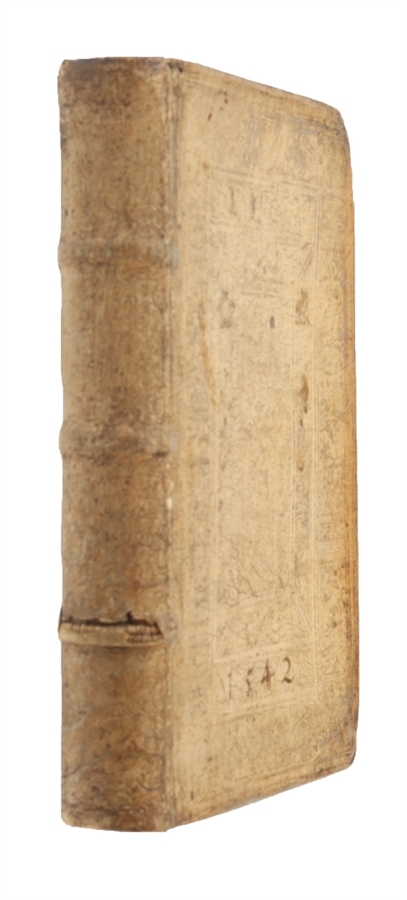
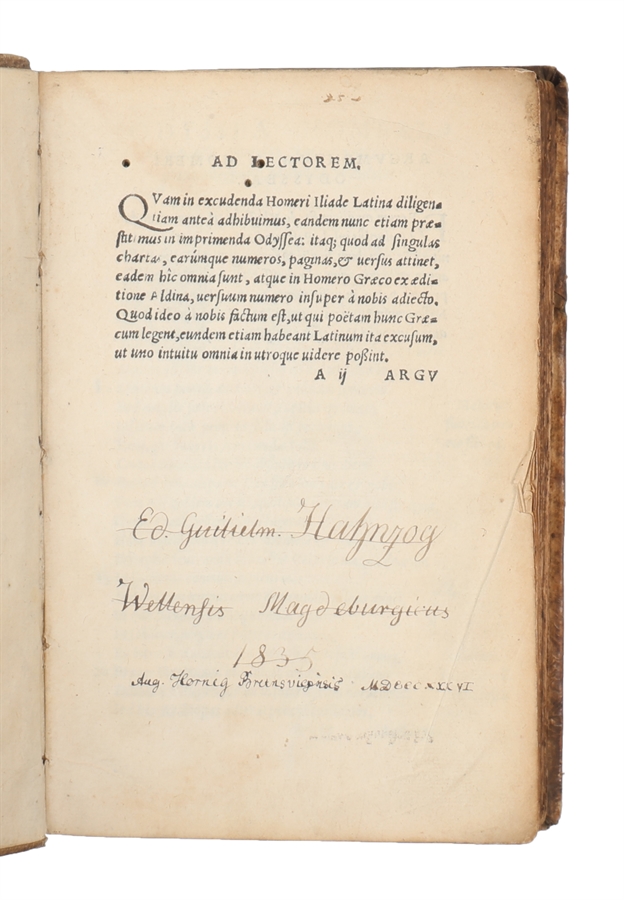
8vo (125 x 180 mm). Lovely contemporary blindstamped, ornamental full pigskin binding, dated 1542. Richly blindstamped ornamental borders on both boards, with portraits in the middle. Raised bands to ornamented spine. A few smaller wormholes on back board and to the bottom raised band, leaving the sewing cords exposed. Small tear to upper back hinge and small hole to lower back hinge. Woodcut printer's device to title-page: the famous Pegasus device used by Wechel, and woodcut chapter initials. Title-page browned, with spotting, two small, private ownership stamps (one dated 1800) and numerous old ownership inscriptions, most crossed out (one dated Anno 1600, the latest dated 1858) and the printing year 1538 added in hand. Several old owners' signatures to blank part of AII as well. A few, occasional underlinings in the text and handwritten notes in pencil and black ink on p. 245. (2), 250 (11) pp.
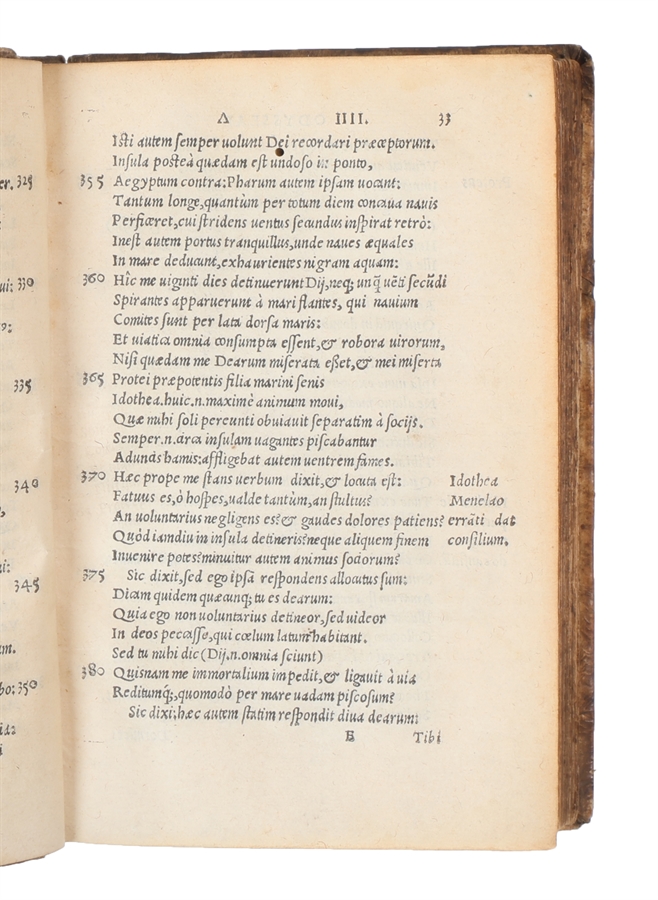
Scarce second issue (Greasse calls it “réproduction") of the first Divo-edition of The Odyssey, the first printed official "Versio Latina", which was the first complete Latin text of the Odyssey available in print and one of the most influential versions the masterpiece ever to appear. "The Versio Latina, or Latin translation of the works of Homer, has existed since the 14th century, but was first printed, under the name of Andreas Divus, in 1537. It is a crib, to give it no finer name, but a crib which had immense influence, being the first introduction to Homer for generations of mediaeval and early modern scholars." (Introduction by Hefyd to the Libri Vox-version of Book 6 of the Odyssey). Divo's Latin translation came to greatly dominate Homeric reading in the 16th century and became one of the most influential versions of the Homeric corpus ever to appear. The official “Versio Latina” of Homer was the first complete Latin text of the Odyssey available in print. The first edition was printed in Venice in 1537, and the present second edition/issue was printed the following year, in 1538, in Paris (another edition, by Giunta, appeared in 1538 as well. We can establish no precedency between them). While several other versions of the Odyssey had appeared earlier, Divo's Latin translation with the Batrachomyomachia and Homeric hymns in Latin versions by Aldus Manutius and Georgius Dartona came to greatly dominate the reading of the Odyssey in the 16th century and became one of the most influential versions of text ever to appear. Christian Wechel, or Chrestien Wechel (1495-1554) was a German book printer, who set up his business in Paris. He was the founder of a printing dynasty, succeeded by his son Andreas Wechel who fled France after the massacre of St. Bartholomew's Day in 1572. Christian himself had run into trouble when he published Erasmus' De eso interdicto carnium (1534). Wechel used his famous Pegasus device here: "[...] the device incorporates a caduceus framed by two horns of plenty and surmounted by Pegasus, the flying horse, and supported at the bottom by two hands joined together. His choice is interesting because in the sixteenth century, the figure of Pegasus personified the prestige acquired through the practice of ‘virtu’, thus reflecting the printer’s ambitions while at the same time, his subtly blending of ancient Greek pagan knowledge and Christian morality. The use of Pegasus, a Greek mythological figure, also underlines Wechel’s appreciation of Hellenistic knowledge, which was at the heart of his enterprise. In fact, in the most quoted version of the myth, Pegasus is described as a creature born of Medusa’s blood when Perseus cut off her head, making it a symbol of poetic inspiration." (edwardworthlibrary.ie) Carl Eduard Wagener (1842-1920) was a German classical philologist and teacher. In academic circles, he is particularly known as the editor of Christian Friedrich Neue's Morphology of the Latin language ("Neue-Wagener"). Adams H773 Graesse III:332
This came to be the standard Latin version of The Odyssey for centuries to come. It was this version of the text that Chapman used for his translation into English in 1598, and it was used directly by Ezra Pound in his long poem "The Cantos" more than three centuries later.
Order-nr.: 63492