
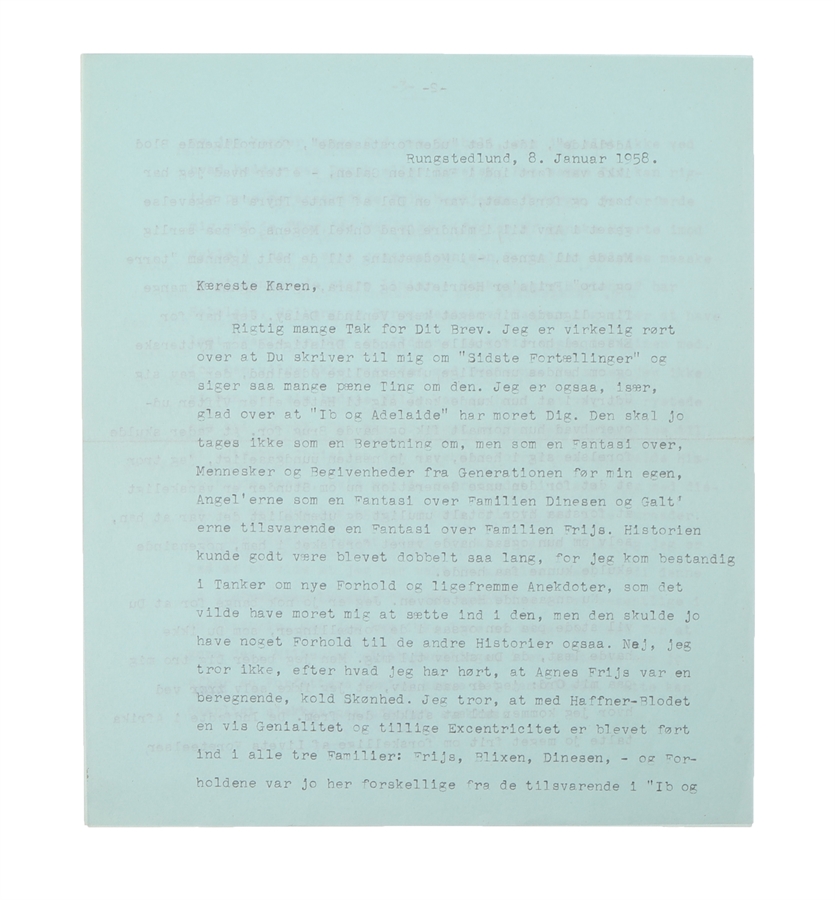
Rungstedlund, 8. Januar, 1958.
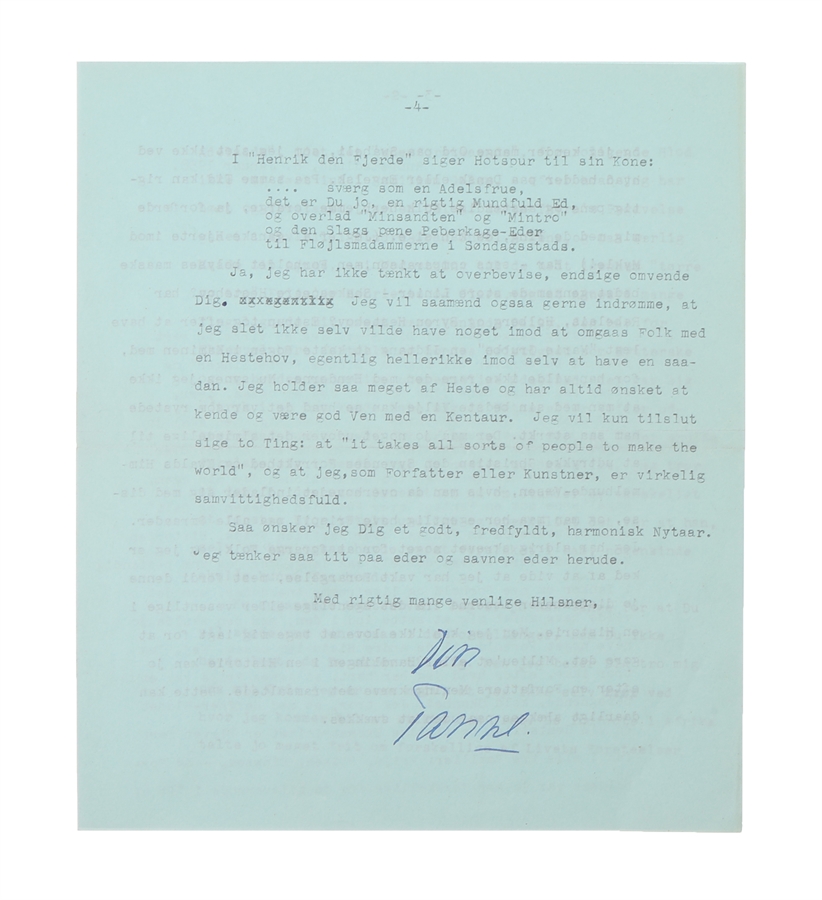
Original typewritten letter (230 x 195 mm), 4 page, 80 lines. Signed "Din / Tanne" (i.e. "Your / Tanne"). Horisontal fold, otherwise fine and clean. 2 ff.
A most interesting and reflecting four-page typed and signed letter from Danish author Karen Blixen addressed to a unknown woman named Karen. Blixen here responds to the recipient's comments on her recently published “Sidste Fortællinger” (“Last Tales”) and discusses both literary interpretation and some of the criticism. “In “Last Tales” Karen Blixen chose to collect together some of the tales that were to have been included in the new collections. For this reason they are not as uniform in theme and content as the stories in “Seven Gothic Tales” and “Winter’s Tales”. Nevertheless, “Last Tales” sold an impressive thirty-five thousand copies in two months, and was published simultaneously in ten languages in November, 1957, selling in total half a million copies.” (Karen Blixen Museum, Blixen.dk) The legendary Karen Blixen-Finecke (1885-1962), who wrote under the male pseudonym Isak Dinesen, was a Danish baroness, who married her cousin, the Swedish Baron Bror Blixen-Finecke, in 1914. They soon moved to Africa, where they ran a coffee-farm near Nairobi, and the happiest years of Blixen's life were spent here (she used to say that "Africa made me"). The farm in the Ngong Hills is the centre of this world famous novel. She divorced her husband, who was cheating on her and gave her syphilis, in 1922, and in 1932 she moved back to Denmark after the farm had gone bankrupt and her lover, Denys Finch-Hatton, had died in a plane-crash. She spent the remaining 30 years of her life in Denmark and died a legendary writer. She greatly influenced writers and cultural personas of the generations to come, and many authors recognize the direct impact she has had on their writings. Several of her novels have been filmatized, most famously "out of Africa" with Meryl Streep and Robert Redford, she was nominated for the Nobel Prize twice, she was elected honorary member of "The American Academy of Arts and Letters" (1957), and her portrait is printed on the Danish 50 kr. notes.
Blixen begins by thanking Karen warmly for her letter and says she has been deeply touched by the generous praise of “Sidste Fortællinger”. She is particularly pleased that the recipient enjoyed "Ib og Adelaïde." She explains that the story was never intended as a literal account of real people, but rather as a fantasy inspired by earlier generations of the Dinesen, Galt, and Frijs families.
She then discusses the historical figures behind the story.
Contrary to what Karen apparently suggested, Blixen does not believe that Agnes Frijs was a calculating or cold beauty. Instead she argues that the Frijs, Blixen, and Dinesen families all inherited a certain brilliant eccentricity through the Haffner family while the more unsettling traits belonged to the other branch of the family.
Toward the end she quotes a humorous passage from Shakespeare's “Henry IV” making the point that human nature comes in many forms. She concludes that she has no wish to persuade or convert anyone, only to remain true to her artistic conscience. The letter ends affectionately with New Year's wishes saying she often thinks of Karen and misses her.
We have not been to determine who Karen, the recipient, were.
Order-nr.: 63363