
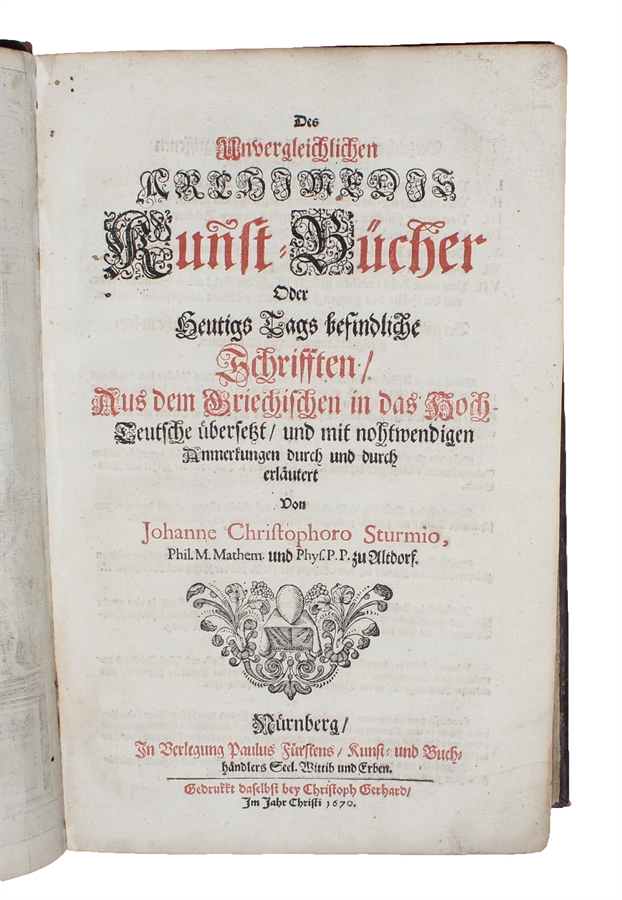
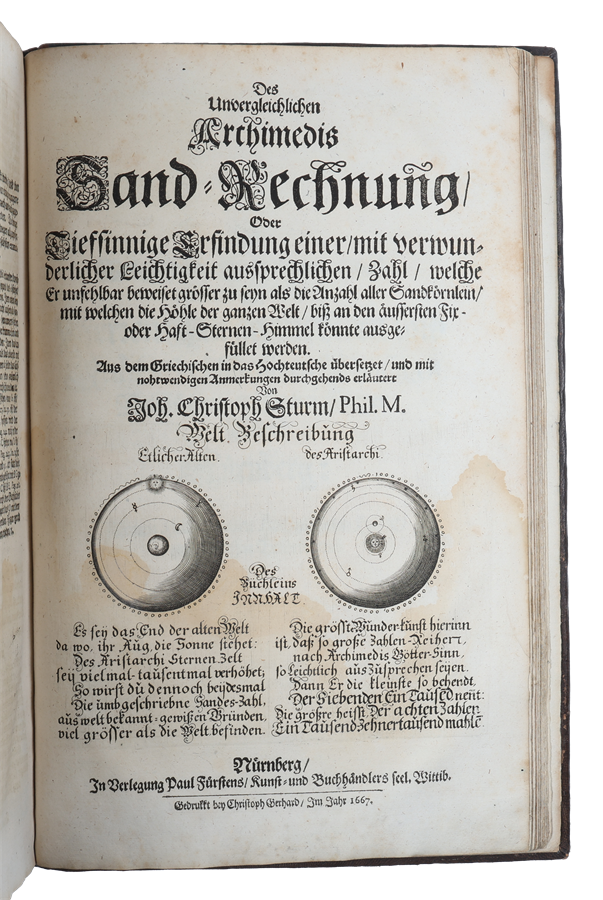
Nürnberg, Paulus Fürsten, 1670 + (Sand=Rechnung) 1667.
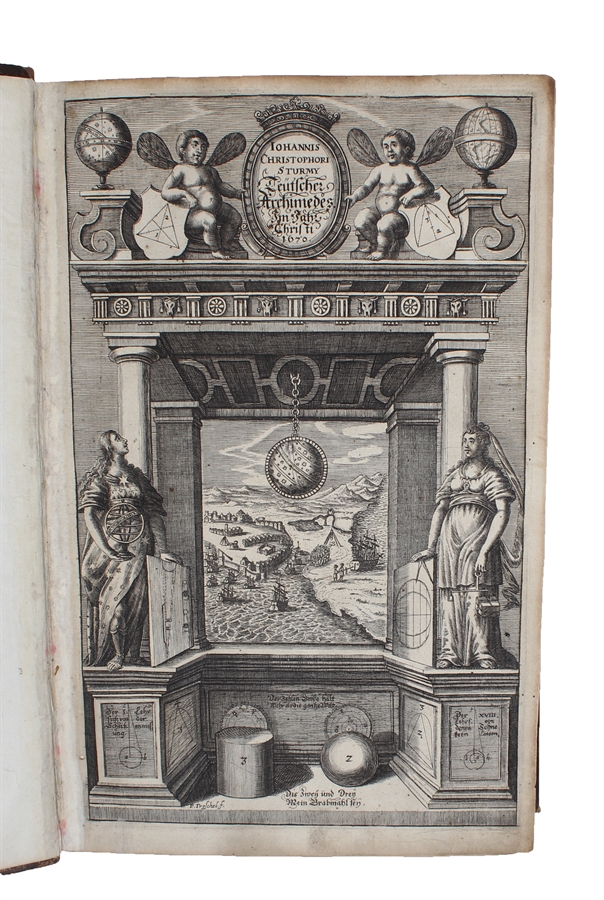
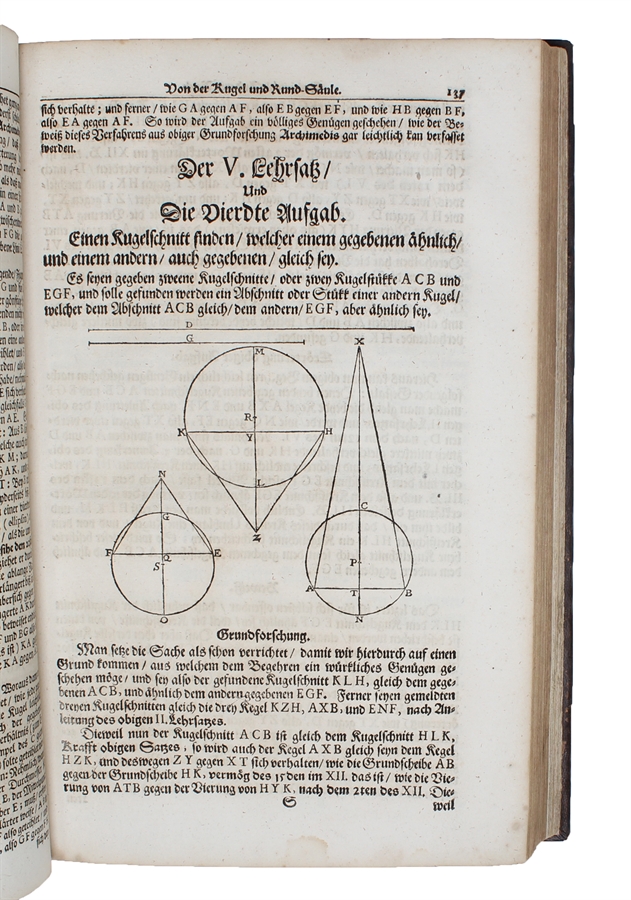
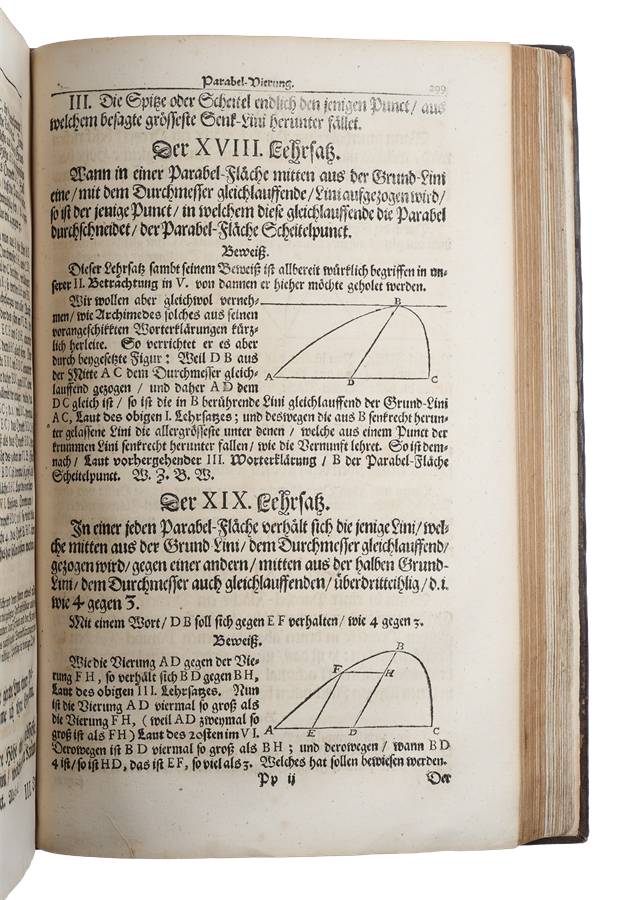
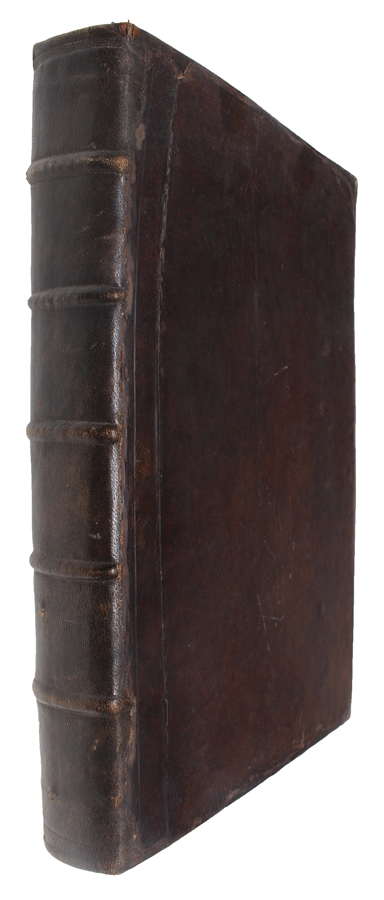
Folio. Contemporary full calf, rebacked in old style with 5 raised bands. Corners neatly restored. Extremities slightly rubbed. Engraved frontispiece with globes, world-systems, and Archimedean figures. Title in red and black. (18), 427, (1) pp. + (8), 32 pp. Numerous diagrams in the text. Occasional light browning, a few brownspots. Some leaves in the "Sand-Rechnung" with a dampstain. Ovcerall fine and clean, printed on good paper.
The highly important first edition of the first German translation of Archimedes' main mathematical works, marking a milestone in the reception of the science of Antiquity. The translation was based on David Rivault's Latin-Greek edition of 1615 and has the famous commentaries by the editor Johann Christoph Sturm (1635-1703), professor of mathematics and Physics at the university of Altdorf from 1669. This seminal work contains the first German translations of the following main works by Archimedes: As well as This seminal work, the Sand Reckoner, introduced an extremely large number in arithmetics, ("How many grains of sand could the whole universe hold?") and also contained the first printed statement of the heliostatic world-picture, a theory first put forward by ARISTARCHUS in a lost work and here referred by Archimedes: "Dann er fetzet (Aristarchus) die Fix-oder Haft-Sterne, samt der Sonne als unbeweglich in einem Kreiss umb die Sonne, welche das Mittel solches Kreises besitze. Der Fix-oder Haft-Sternen aber ihren umb der Sonnen Mittelpunct ausgespannten, Himmel beschreibet er in solcher Grösse, dass der Erden Lauffkreiss, auf welchem sie umb die Sonne bewegt werden solle, gegen derer Haft-Sternen fernen Entlegenheit, sich nicht anderst verhalte, als einer Kugel Mittel-punct gegen deroselben Umbkreiss." (pp. 2 -3 in Sand=Rechnung"). Called "the God of Mathematics" by Plinius, Archimedes is arguably the greatest mathematician, physicist, and engineer of ancient times. Without the background of the works of Archimedes the development of mathematics in Europe during the 16th end 17th centuries is inconceivable. "There is no one individual whose work epitomizes the character of the Alexandrian age so well as Archimedes (287-212 B.C.), the greatest mathematician in antiquity." (Morris Kline). "He gave birth to the calculus of the infinite conceived and brought to perfection successively by Kepler, Cavalieri, Fermat, Leibnitz and Newton." (Chasles) The first German edition of the works of Archimedes was foundational in the spreading of the Aristotelian teachings in Northern Europe, making them accessible to a much wider, learned audience. Sturm was a highly important German mathematician, whose fame was not only national. He was closely connected with the Royal Society in London, where his portrait was presumably the first of a German scientist. In 1672, he gained wide acknowledgement for his “Collegium Experimentale” and became a pioneer in the introduction of experiments in scientific teaching in Germany. He is responsible for several important inventions, like the differential thermometer, and his many mathematical works greatly improved the teachings of mathematics in German schools. His magnum opus is no doubt his monumental first German edition of Archimedes’ works. Poggendorff II:1043.
Order-nr.: 62952