
Kjøbenhavn, Philipsen, 1843-45.
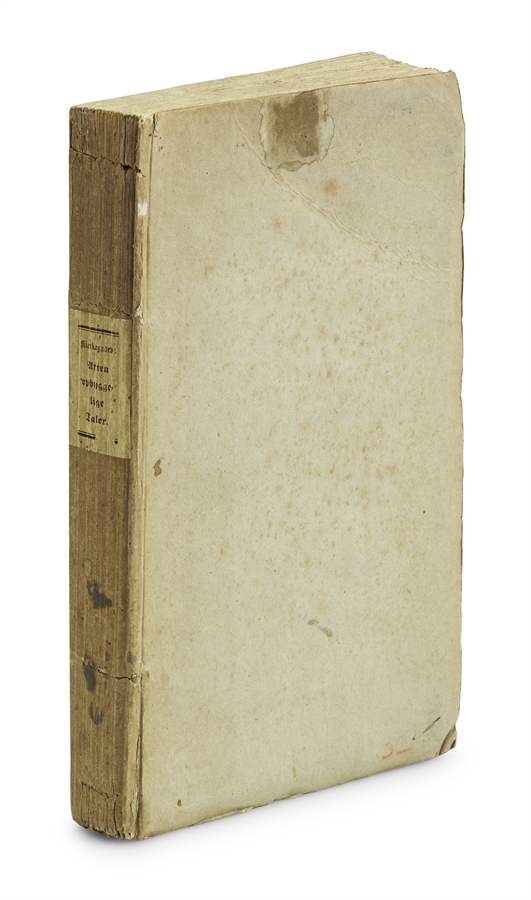
8vo. (4), 52 + 62 (+ 1 blank leaf) + 84 + 59 (including the blank leaf between the title-page and the preface!) + 70 (+ 1 blank leaf) + 111 pp. Completely uncut in the original brownish grey boards with original printed title-label to spine (fully intact). Boards a bit brownspotted and a larger damp stain to top of front board. A couple of smaller stains (lacquer or wax) to spine. A few horizontal creases to spine with paper almost invisibly glued back on to hold tight. Occasional brownspotting, mostly to the first and last leaves. But overall splendidly preserved.
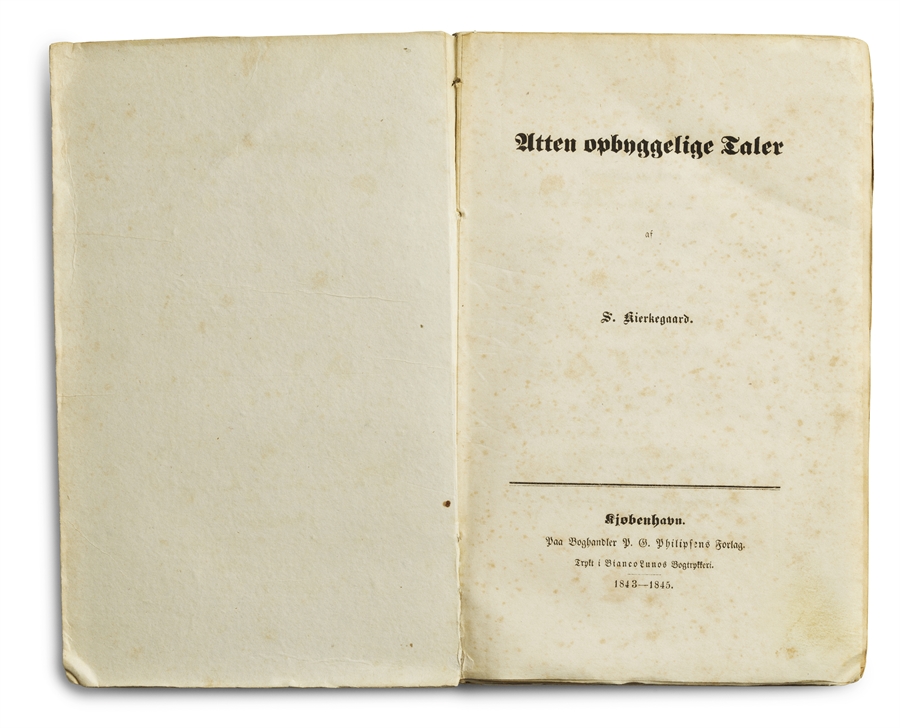
A truly magnificent copy of the first edition of this very scarce Kierkegaard-title, in completely original condition with all of the original printed title-label preserved, and fully complete with the This Kierkegaard-title is rare in itself, with much less than 278 copies printed in all, but it is utterly amazing to find this exceedingly rare book in original state like here. Only very few copies are left in the original binding, which we have only seen once before. The spines of the original Kierkegaard cardboard bindings are always just thin paper directly glued on the block, making them extremely fragile. If one finds these original bindings, the spines are almost always more or less disintegrated. The present copy is a rare exception that furthermore has the original title-label, which is of the utmost scarcity. To our knowledge, only one other copy in the original binding has been located. Apart from the other copy we have seen of this work in the original binding, the present copy is also the only original Kierkegaard-binding we have seen that is not in the usual blue “hollanderet” cardboard binding, but plain brown. No other such copy has been registered for sale, and no other such copy, to our knowledge, is registered in Kierkegaard’s Upbuilding (or Edifying) Discourses were published over the course of two years, in 1843 and 1844. In all, 18 Upbuilding Discourses were published, divided over six publications, namely: Two Upbuilding Discourses from 1843 Three Upbuilding Discourses from 1843 Four Upbuilding Discourses from 1843 Two Upbuilding Discourses from 1844 Three Upbuilding Discourses from 1844 Four Upbuilding Discourses from 1844 Each of these publications accompanied one of the main pseudonymous works, beginning with Either-Or in 1843. As opposed to his major philosophical works, the religious upbuilding discourses actually bear the name of the author on the title-page. Of course, this was by no means incidental. While the pseudonymous works could raise the question of the religiousness of the author, the parallelly written religious discourses stress the fact that we are dealing with an author, who was religious from the very beginning – an essential fact that Kierkegaard wished to stress for those interested in his authorship. In his journals, Kierkegaard clearly states that the religious discourses are as significant in his oeuvre as a whole as are the larger pseudonymous works, “I began with “Either-Or” and two upbuilding discourses...” he says, and explains that he intended the upbuilding, the religious, to advance, and that he wanted to show “that the writer was not an aesthetic author who in the course of time grew older and for that reason became religious”. (Journals, IX A 227). He was religious all along, also during all of the major philosophical publications that were not written in his name. The fact that every major pseudonymous work – up until Concluding Unscientific Postscript appeared and revealed the identity of the real author – was accompanied by one of these small Upbuilding Discourses, bears testament to the pivotal role they play in Kierkegaard’s philosophical development. Furthermore, while Kierkegaard could not present anyone with copies of his pseudonymous works (as explained above), he could indeed give away presentation-copies of his accompanying Upbuilding Discourses, which he then did. The Upbuilding Discourses are particularly interesting in several regards, one being that it is in the course of the printing of these that Kierkegaard changes his publisher. Ever since Kierkegaard had chosen to publish his first book himself, he had had his books on commission with the leading Copenhagen publisher Reitzel (the sole exception being his thesis, the Irony). That was also the case with Two Upbuilding Discourses from 1843. But for some reason, the following five publications of Upbuilding Discourses did not appear with Reitzel, but with P.G. Philipsen instead. We do not know the exact reason for this change in publishers, as the commission was exactly the same for the two. Whereas Two Upbuilding Discourses from 1843 had sold relatively well, the Three and Four Upbuilding Discourses from 1843 did not sell well. A mere 102 and 104 copies respectively out of a commission issue of 300 were sold. In an attempt at making money on these discourses in spite of the poor sales numbers, Philipsen offers to buy the unsold copies of Two Upbuilding Discourses from 1843, buys a sales issue of 300 copies of the Two Upbuilding Discourses from 1844, and makes the same agreement with Kierkegaard for the following two Discourse-publications. Sales numbers are still poor, however, and in the spring of 1845, only ca 100 copies of each of the 1844 Discourse publications have been sold. The printing issue of each was about 500, and Philipsen’s sales issue 300; thus, both Philipsen and Kierkegaard had large numbers of each Discourse-publication left, and in May 1845, they make a new deal. Philipsen buys the remainder issues of all six Discourse-publications, including the 278 copies of Two Upbuilding Discourses from 1843 from Reitzel. Philipsen has a joint title-page printed, along with a contents-leaf, and now issues the seminal Kierkegaard-publication that is no. 85 in the bibliography (Himmelstrup), namely Eighteen Upbuilding Discourses – all six publications, constituting all eighteen Upbuilding Discourses collected in one book. Seeing that there were 278 copies left of the Two Upbuilding Discourses from 1843, a maximum of 278 copies of Eighteen Upbuilding Discourses can have been made, making it one of the scarcest Kierkegaard-books. The actual number is certainly lower than 278, though, probably quite a bit lower, seeing that Philipsen continued to sell the separate publications, all copies of which he then evidently did not include in the Eighteen Upbuilding Discourses. The individual pamphlets, of course, are even scarcer, with a maximum of 232 copies of Two Upbuilding Discourses from 1843 and somewhere between 100 and 150 copies of the others. We know from the Erindringsbog fra Bianco Luno 1844 that Kierkegaard had 506 copies of Four Upbuilding Discourses 1844 printed, six of them on fine paper for presentation. Seeing that we have already established the clear thread of identity throughout all six publications, we must assume that the other pamphlets were printed in the same numbers. And we have the record of the remainder issues that Philipsen buys in 1845, which lets us conclude of the Upbuilding Discourses, that, by that time, 222 copies of Two 1843 139 copies of Three 1843 130 copies of Four 1843 120 copies of Two 1844 92 copies of Three 1844 96 copies of Four 1844 were sold out of the total number of original issues. In other words, these are extremely scarce. Not least in the original wrappers or bindings. The scarcest Kierkegaard-title that exists, however, will be found in the continuation of the printing history of the Upbuilding Discourses. It is the mythically rare title of Sixteen Upbuilding Discourses, which Philipsen issued in 1852, when the Two Upbuilding Discourses had been sold out and it was no longer possible to collect Eighteen Upbuilding Discourses. Thus, Philipsen had yet another title-page printed, this time with Sixteen Upbuilding Discourses as the title and the year 1843-45 on it, along with a new index-leaf; he issued this, the scarcest of all Kierkegaard-titles, in March 1852. “It is not known how large the issue was, but it cannot have been more than 83, seeing that that was what was left of Three Upbuilding Discourses from 1843.” (Tekstspejle p. 54, translated from Danish). The idea of the Eighteen Upbuilding Discourses (let alone the Sixteen) was not Kierkegaard’s. He had agreed to the Eighteen, but it was not his intended project with the Upbuilding Discourses. Therefore, he wished for the book not to be reviewed, and he naturally did not give away any copies of the Eighteen Upbuilding Discourses, and of course not the Sixteen either, only the individual pamphlets. In all, seven presentation-copies of the different Upbuilding Discourses are registered, all being for either Heiberg or Nielsen. Curiously, neither Eighteen nor Sixteen Upbuilding Discourses were to be found in Kierkegaard’s book collection after his death. All the individual pamphlets were, however, along with a copy of the first nine Upbuilding Discourses – i.e. the three publications from 1843 – bound together. For more on the conundrum of the actual number of copies of the Upbuilding Discourses, see the Preface by Flemming Chr. Nielsen in Girsel’s Kierkegaard-catalogue, p. 19. Himmelstrup 85
joint title-page, contents, all the half-titles, dedications, blanks, etc.
any institution. Furthermore, this seems to be the only copy to have surfaced so far, which has preserved the original printed title-label in its entirety. As far as we know, it has been recorded no-where, due to its extreme scarcity.
Order-nr.: 62941