
Kjøbenhavn, Philipsen, 1844.
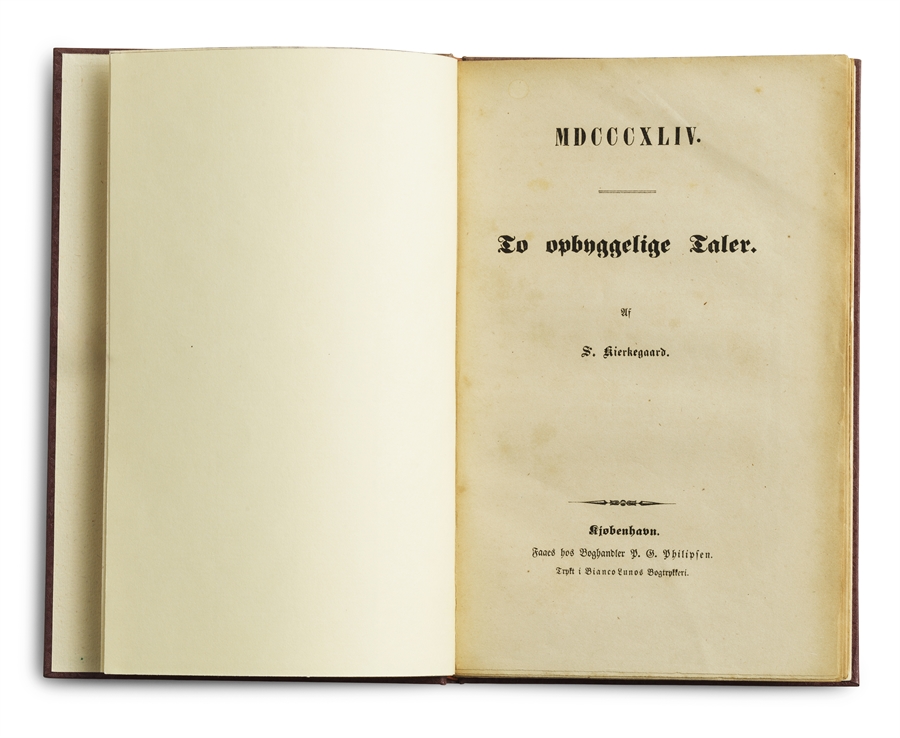
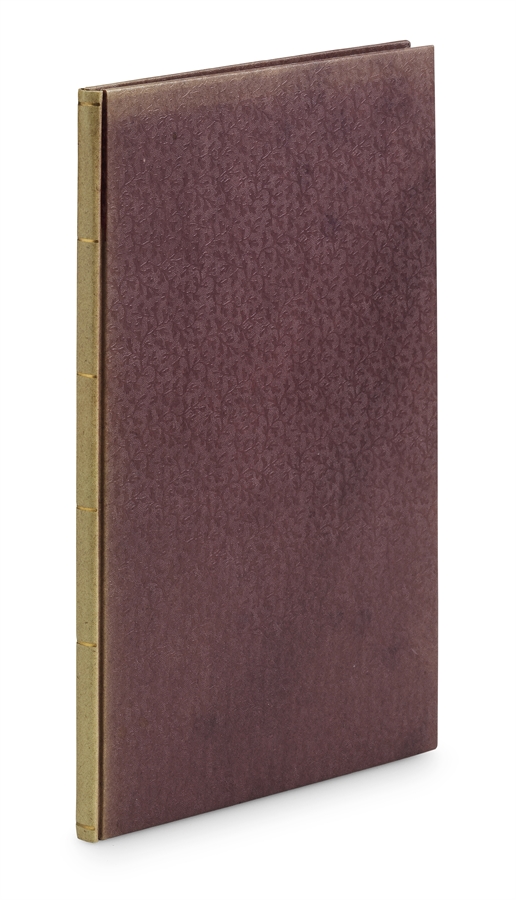
8vo. 59 pp. Beautiful newer purple full patterned cloth with gilt lines to spine, reminiscent of the bindings Kierkegaard had made for himself. A splendid, partly uncut copy with a bit of brownspotting. With pencil-annotations to end-papers, the back one explaining that this is taken from an incomplete copy of Eighteen Upbuilding Discourses and has the blank leaf (pp. 3-4) preserved.
A beautiful copy of the Two upbuilding Discourses from 1844 with the incredibly scarce blank leaf between the title-page and the preface preserved. A significant typographical anomaly is present in the Two Upbuilding Discourses of 1844. In that, Kierkegaard had a blank leaf inserted between the title-page and the preface. This blank leaf is almost always missing in bound copies of the publication – even in the two known presentation-copies. But it is actually quite important and bears witness to the fact that when it comes to In the preface to Two Upbuilding Discourses from 1844, Kierkegaard writes that “Even though this little book […] has omitted something, it has forgotten nothing.” That which has been omitted Kierkegaard's Upbuilding (or Edifying) Discourses were published over the course of two years, in 1843 and 1844. In all, 18 Upbuilding Discourses were published, divided over six publications, namely: Two Upbuilding Discourses from 1843, Three Upbuilding Discourses from 1843, Four Upbuilding Discourses from 1843, Two Upbuilding Discourses from 1844, Three Upbuilding Discourses from 1844, Four Upbuilding Discourses from 1844. Each of these publications accompanied one of the main pseudonymous works, beginning with Either-Or in 1843. As opposed to his major philosophical works, the religious upbuilding discourses actually bear the name of the author on the title-page. Of course, this was by no means incidental. While the pseudonymous works could raise the question of the religiousness of the author, the parallelly written religious discourses stress the fact that we are dealing with an author, who was religious from the very beginning – an essential fact that Kierkegaard wished to stress for those interested in his authorship. In his journals, Kierkegaard clearly states that the religious discourses are as significant in his oeuvre as a whole as are the larger pseudonymous works, “I began with “Either-Or” and two upbuilding discourses...” he says, and explains that he intended the upbuilding, the religious, to advance, and that he wanted to show “that the writer was not an aesthetic author who in the course of time grew older and for that reason became religious”. (Journals, IX A 227). He was religious all along, also during all of the major philosophical publications that were not written in his name. The fact that every major pseudonymous work – up until Concluding Unscientific Postscript appeared and revealed the identity of the real author – was accompanied by one of these small Upbuilding Discourses, bears testament to the pivotal role they play in Kierkegaard’s philosophical development. Furthermore, while Kierkegaard could not present anyone with copies of his pseudonymous works (as his name did not appear as the author on the title-page), he could indeed give away presentation-copies of his accompanying Upbuilding Discourses, which he then did. Himmelstrup: 60.
Kierkegaard’s books, nothing is left to chance: In a paper entitled Kirkelig Polemik, which appeared in Heiberg’s periodical Intelligensblade, Mynster had given a laudable review of Kierkegaard’s
Upbuilding Discourses from 1843, especially the Four. Mynster stressed the touching fact that Kierkegaard had devoted all three collections to the memory of his father, concluding that Kierkegaard’s father had been the inspiration for the suffering Job in Four Upbuilding Discourses. Kierkegaard disliked that conclusion – his father was by no means the inspiration for his portrayal of Job, which constituted his own interpretation of the Job figure in the Old Testament.
is the usual printed dedication to his father, not forgetting his father, but subtly demonstrating the fact that Mynster was wrong. The dedication had not been forgotten, it had been deliberately
replaced by a blank leaf instead of the leaf with the printed dedication that is in the other pamphlets.
Order-nr.: 62939