
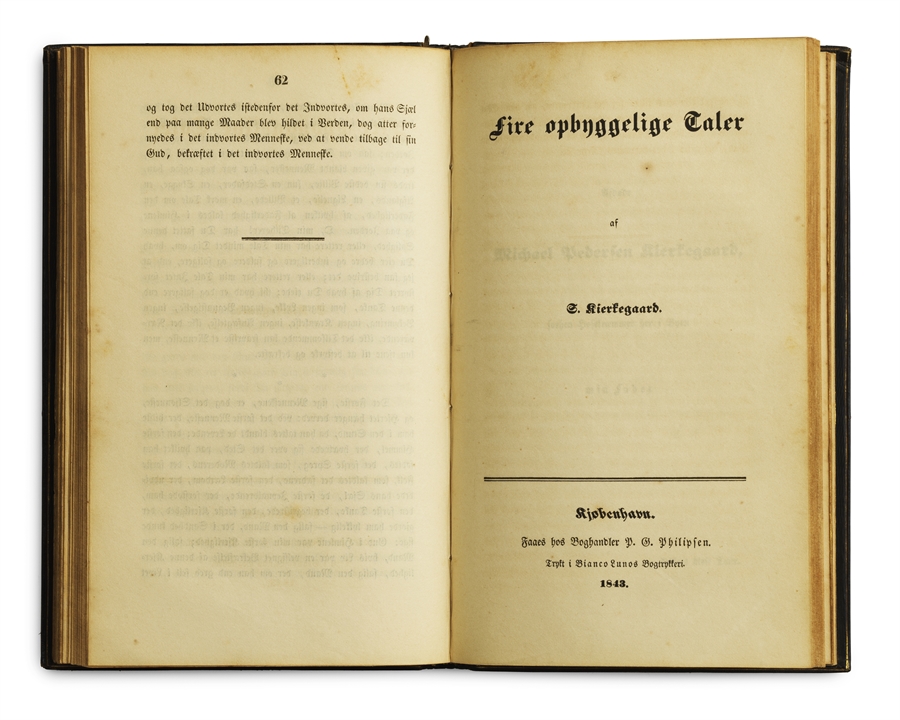
Kjøbenhavn, Trykt i Bianco Lunos Bogtrykkeri, 1843 + Kjøbenhavn, Philipsen, 1843.
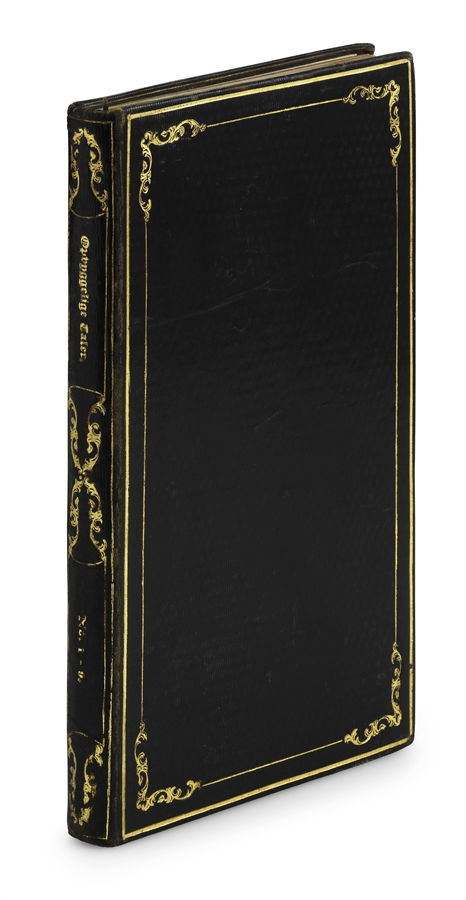
8vo. 52 pp. + 62 pp. + 84 pp. All three publications bound together in an absolutely magnificent full black fine morocco binding with richly gilt ornamental spine with gilt Gothic lettering: Opbyggelige Taler. No. 1-9. White moiré-endpapers. Boards with a single gilt line-frame inside which another gilt frame with ornamental corners. Edges of boards and inner dentelles with gilt single line-ornamentation. All edges gilt. A truly magnificent binding with just minimal wear and no restorations of any kind. Printed on varying paper, one quire being thinner than the rest. Some browning and light brownspotting. Old owner’s names to front fly-leaf and previous owner’s neat pencil annotations to front and back free end-papers, explaining that this is Kierkegaard’s own, personal copy, and the further provenance of it.
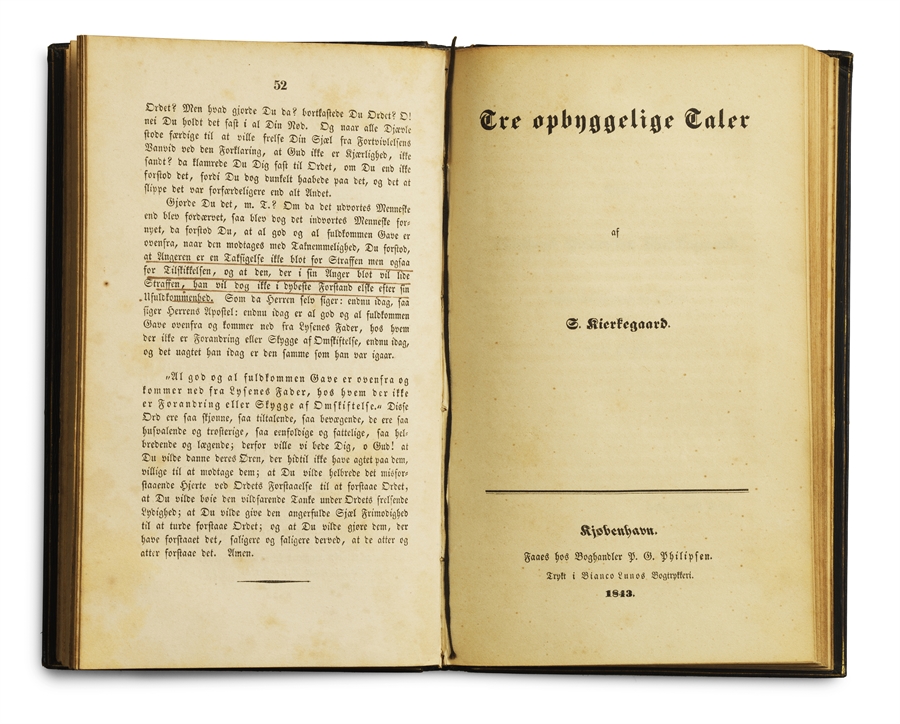
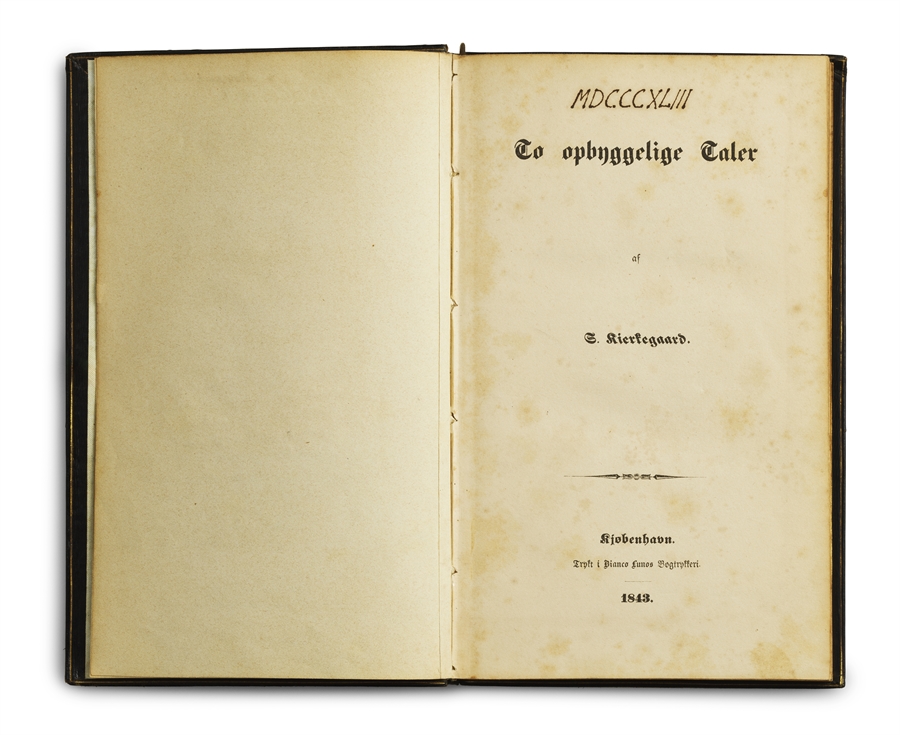
“MDCCCXLIII” contemporarily handwritten in brown ink to the title-page of Two upbuilding Discourses, in exactly the manner in which the year was written in the Upbuilding-publications from the following year, 1844. Some pencil-annotations and -underlinings have been erased (Two upb.: pp. 25, 47, 48, 50; Three upb.: pp. 10 & 33, Four upb.: pp. 27 (here, red crayon removed), 31, 35, 37, 38, 39, 63). Three lines underlined in ink (same as that on the title-page) on p. 52 of Two upb.
This is with great certainty Kierkegaard’s own copy, lavishly bound for himself, of his first three publications of Upbuilding Discourses, the copy listed in the auction catalogue as no. 2121, which is described as exactly what this copy is called in gold on the spine, namely “Opbyggelige Taler, 1-9.” This privately made copy is bound in exactly the same style as the most lavish of Kierkegaard’s gift bindings and some of the few other books that have been identified as being Kierkegaard’s copies (of e.g. the Bible). It is impossible to say whether the erased underlinings could have been Kierkegaard’s own. But it seems very likely that the roman numeral of the printing year on the title-page could be in his hand. See Tekstspejle p. 207, where the present copy is depicted and described. Kierkegaard's Upbuilding (or Edifying) Discourses were published over the course of two years, in 1843 and 1844. In all, 18 Upbuilding Discourses were published, divided over six publications, namely: Two Upbuilding Discourses from 1843, Three Upbuilding Discourses from 1843, Four Upbuilding Discourses from 1843, Two Upbuilding Discourses from 1844, Three Upbuilding Discourses from 1844, Four Upbuilding Discourses from 1844. Each of these publications accompanied one of the main pseudonymous works, beginning with Either-Or in 1843. As opposed to his major philosophical works, the religious upbuilding discourses actually bear the name of the author on the title-page. Of course, this was by no means incidental. While the pseudonymous works could raise the question of the religiousness of the author, the parallelly written religious discourses stress the fact that we are dealing with an author, who was religious from the very beginning – an essential fact that Kierkegaard wished to stress for those interested in his authorship. In his journals, Kierkegaard clearly states that the religious discourses are as significant in his oeuvre as a whole as are the larger pseudonymous works, “I began with “Either-Or” and two upbuilding discourses...” he says, and explains that he intended the upbuilding, the religious, to advance, and that he wanted to show “that the writer was not an aesthetic author who in the course of time grew older and for that reason became religious”. (Journals, IX A 227). He was religious all along, also during all of the major philosophical publications that were not written in his name. The fact that every major pseudonymous work – up until Concluding Unscientific Postscript appeared and revealed the identity of the real author – was accompanied by one of these small Upbuilding Discourses, bears testament to the pivotal role they play in Kierkegaard’s philosophical development. Furthermore, while Kierkegaard could not present anyone with copies of his pseudonymous works (as his name did not appear as the author on the title-page), he could indeed give away presentation-copies of his accompanying Upbuilding Discourses, which he then did. Most of these presentation-copies are in the typical black glitted paper bindings with single gilt lines to spines. Some, however, are in the original printed boards. The trade copies appeared in original wrappers, some of them blank, some of them printed, repeating the printing from the title-page within a printed frame. In May 1845, the publisher Philipsen buys the remainder issues of all six Discourse-publications, has a joint title-page printed along with a contents-leaf and now issues all six Discourse-publications together under the title Eighteen Upbuilding Discourses. The idea of the Eighteen Upbuilding Discourses was not Kierkegaard's. He had agreed to it, but it was not his intended project with the Upbuilding Discourses. Therefore, he wished for the book not to be reviewed, and he naturally did not give away any copies of the Eighteen Upbuilding Discourses, only the individual publications. In all, seven presentation-copies of the different Upbuilding Discourses are registered, all being for either Heiberg or Nielsen. Only a few months after Kierkegaard died (11th of November 1855), at the beginning of April 1856, his books were put up for sale. The sale was an event which created stir among scholars all over Denmark, and the event drew large crowds. Everyone wanted a piece of the recently deceased legend, and bidding was lively. The average price for the single items was nearly a rix-dollar a very high price for that time. As the old Herman Lynge wrote in a letter on the 22nd of May (The Royal Library, Recent Letters, D.), to the famous collector F.S. Bang, “At the sale of Dr. Søren Kierkegaard’s books everything went at very high prices, especially his own works, which brought 2 or 3 times the published prices”.” (Rohde Auction Catalogue, p. LVIJ). Many authors, philosophers, and scholars were present in the auction room, which was completely full, as was the Royal Library, who bought ca 80 lots. “Many of the books, "Some books were bought by libraries where they still are today, others were bought by private people, who sometimes wrote their names in the front of the books and thus, indirectly, stated that they came from Kierkegaard’s book collection… The edition (of the auction catalogue, 1967) registers all books from Kierkegaard’s book collection that it has hitherto been possible to identify – either in public or in private ownership… All in all, nearly a couple of hundred volumes – i.e. ca. 10 % – of the Kierkegaardian book collection is said to be rediscovered…" (Rohde). Thus, today, books from Kierkegaard’s library are of the utmost scarcity. Only very few are still possible to acquire, and they hardly ever appear on the market. Himmelstrup 45, 57, 58; No. 2121 of the auction catalogue.
not only his own, were paid for with much higher prices than in the book shops” (In Morgenposten no. 99, 30. April 1856, written by “P.”, translated from Danish).
Order-nr.: 62937