
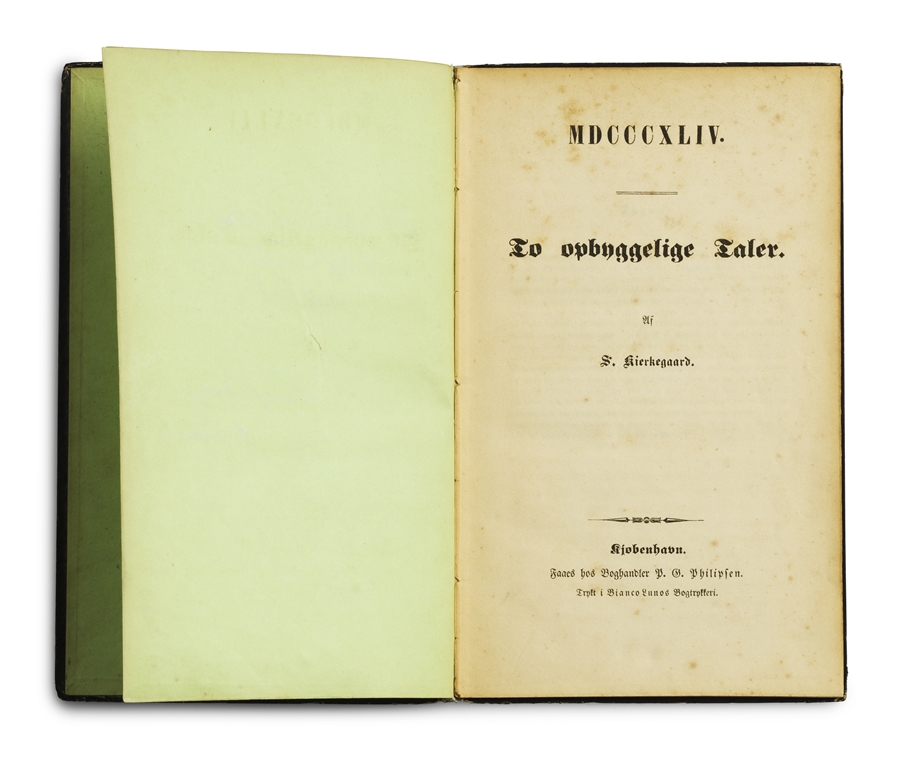
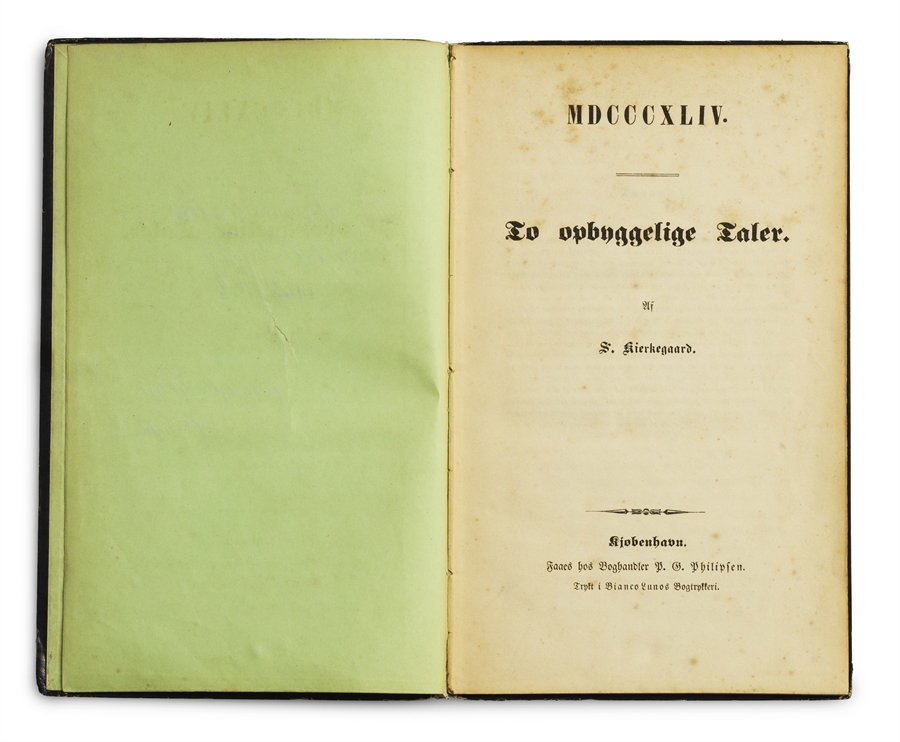
Kjøbenhavn, Philipsen, 1844.
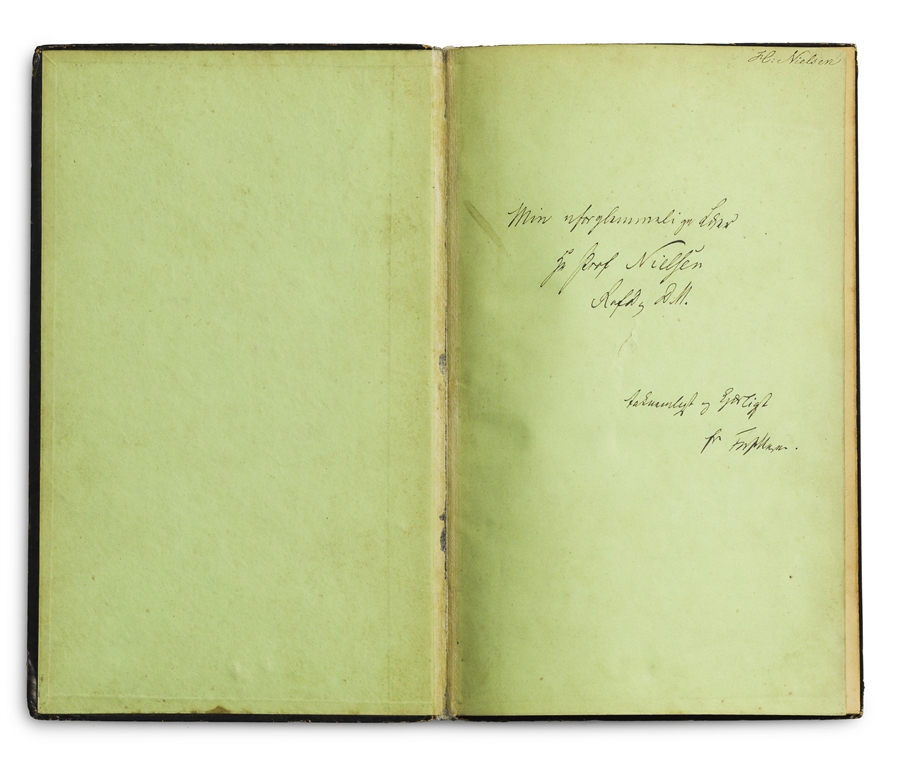
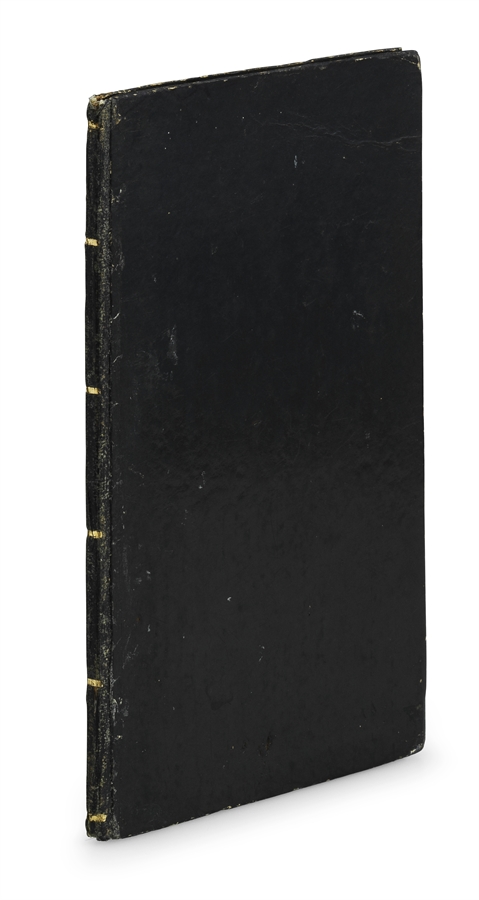
8vo. 59 pp. (but without the blank leaf between the title-page and the preface). Original gift-binding of the black glitted paper and all edges gilt. Boards with a bit of overall wear. Rebacked, slightly crudely done, with broader gilt lines than the original, and the newer spine also worn, though tight. Inner hinges re-enforced. Light occasional brownspotting. Ownership-signature of M. Nielsen to top of front free end-paper.
One of two known presentation-copies of the important Two Upbuilding Discourses from 1844, the religious companion to Philosophical Fragments, with an unusually heartfelt and personal inscription from Kierkegaard to Michael Nielsen on front free end-paper: “Min uforglemmelige Lærer / Hr Prof Nielsen / R af D of DM / taknemmeligt og hjerteligt / fra Forfatteren. (i.e. My unforgettable Teacher / Mr Prof Nielsen / R af D (i.e. Ridder (Knight) of Dannebrog) og DM (short for Dannebrogsmand, another honourable title) / gratefully and heartily / from the Author.). Not only is the unusually heartfelt inscription, from his old Latin teacher and principal at Borgerdydsskolen, noteworthy, so is the handwriting. It is notably more loose and relaxed than those for Heiberg, also bearing witness to the personal relation he had to Nielsen as opposed to Heiberg. Kierkegaard's Upbuilding (or Edifying) Discourses were published over the course of two years, in 1843 and 1844. In all, 18 Upbuilding Discourses were published, divided over six publications, namely: Two Upbuilding Discourses from 1843, Three Upbuilding Discourses from 1843, Four Upbuilding Discourses from 1843, Two Upbuilding Discourses from 1844, Three Upbuilding Discourses from 1844, Four Upbuilding Discourses from 1844. Each of these publications accompanied one of the main pseudonymous works, beginning with Either-Or in 1843. As opposed to his major philosophical works, the religious upbuilding discourses actually bear the name of the author on the title-page. Of course, this was by no means incidental. While the pseudonymous works could raise the question of the religiousness of the author, the parallelly written religious discourses stress the fact that we are dealing with an author, who was religious from the very beginning – an essential fact that Kierkegaard wished to stress for those interested in his authorship. In his journals, Kierkegaard clearly states that the religious discourses are as significant in his oeuvre as a whole as are the larger pseudonymous works, “I began with “Either-Or” and two upbuilding discourses...” he says, and explains that he intended the upbuilding, the religious, to advance, and that he wanted to show “that the writer was not an aesthetic author who in the course of time grew older and for that reason became religious”. (Journals, IX A 227). He was religious all along, also during all of the major philosophical publications that were not written in his name. The fact that every major pseudonymous work – up until Concluding Unscientific Postscript appeared and revealed the identity of the real author – was accompanied by one of these small Upbuilding Discourses, bears testament to the pivotal role they play in Kierkegaard’s philosophical development. Furthermore, while Kierkegaard could not present anyone with copies of his pseudonymous works (as his name did not appear as the author on the title-page), he could indeed give away presentation-copies of his accompanying Upbuilding Discourses, which he then did. Most of these presentation-copies are in the typical black glitted paper bindings with single gilt lines to spines. Some, however, are in the original printed boards. The trade copies appeared in original wrappers, some of them blank, some of them printed, repeating the printing from the title-page within a printed frame. In May 1845, the publisher Philipsen buys the remainder issues of all six Discourse-publications, has a joint title-page printed along with a contents-leaf and now issues all six Discourse-publications together under the title Eighteen Upbuilding Discourses. Kierkegaard had agreed to the idea of the collected Eighteen Upbuilding Discourses, but it was not his intended project with them. Therefore, he wished for the book not to be reviewed, and he naturally did not give away any copies of the Eighteen Upbuilding Discourses, only the individual publications. In all, seven presentation-copies of the different Upbuilding Discourses are registered, all being for either Heiberg or Nielsen. Michael Nielsen (1776-1846), who devoted most of his life to teaching and education, was Kierkegaard’s Latin teacher at Borgerdydsskolen in Copenhagen. Remembered by most as an incredibly strict and demanding teacher, Nielsen had a great influence on the young Kierkegaard. Kierkegaard was already as a schoolboy a skilled Latinist and was later asked by Nielsen to assist him in grading Latin compositions.
Order-nr.: 62934