
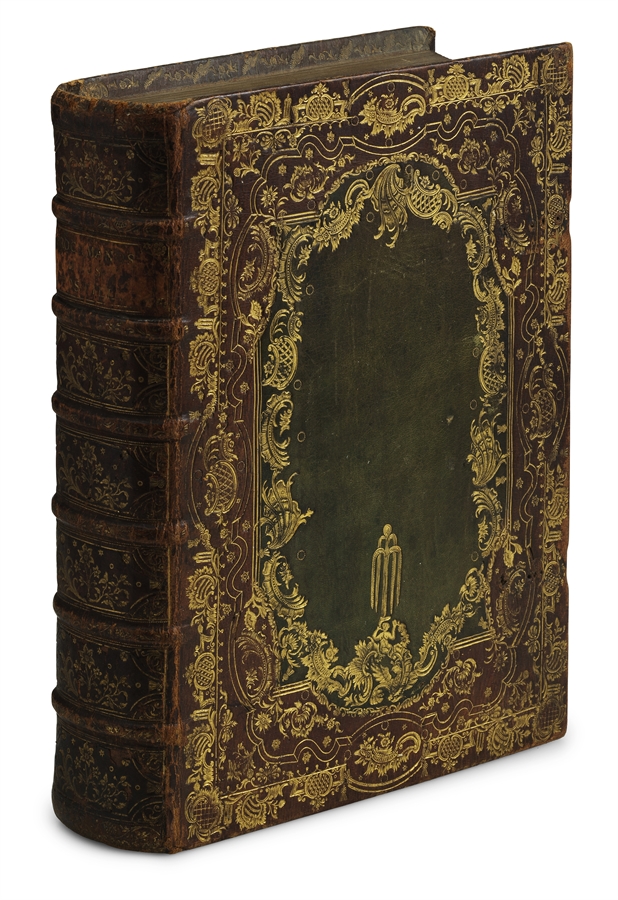
Kiøbenhavn, Vaysenhuses Bogtrykkerie, Friedrich Kisel, 1741.
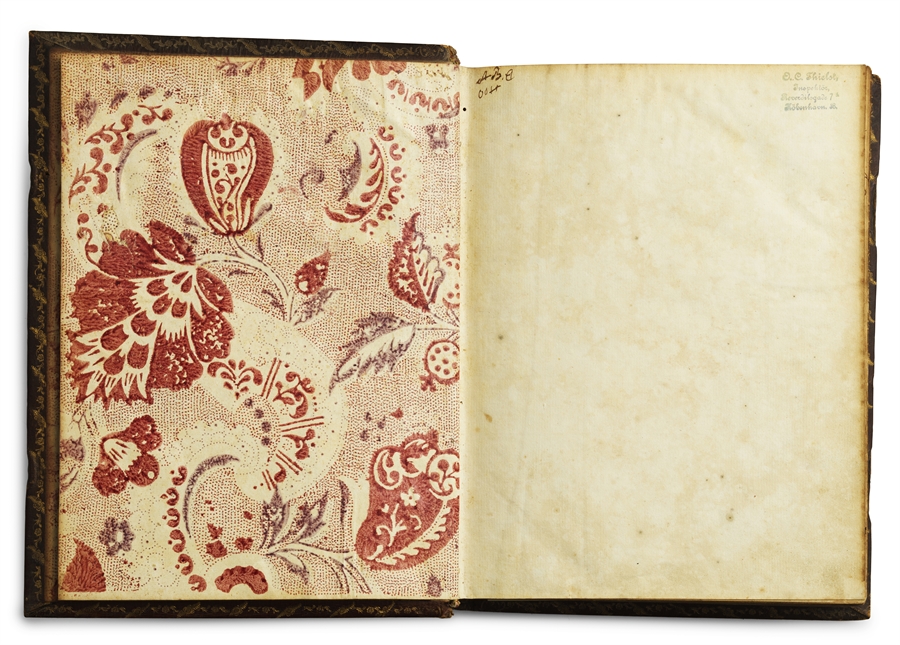
Large quarto. Bound in an absolutely magnificent, contemporary full morocco binding over wooden boards. Richly gilt spine with six raised bands and sumptuously gilt boards with a blank centre “mirror” of green morocco. Inner gilt dentelles and all edges of boards gilt. All edges gilt. Beautiful 18th century end-papers with flower-print motif. A bit of wear to spine and extremities. Small holes from clasps and remains of these to the back board. A truly splendid copy. (8), 710; (2), 613, (3) pp.
Second front fly leaf with handwritten entries by Terkild Olsen (Regine’s father), spanning the years 1809-1830, of important events in his family, recording his wedding to Regina Malling as well as two confirmations and seven births, among them that of Regine Olsen.
With the ownership stamp of O.C. Thielst (who was related to the Olsen family) to first fly-leaf.
The “family-bible” of Kierkegaard's fiance Regine Olsen, being a truly magnificent, splendidly bound copy of the 1741-edition of Brochmand’s seminal Huus-Postill, which throughout two centuries constituted the most widespread devotional book in Denmark. REGINE OLSEN It is safe to say that Regine Olsen occupies a place like none other in Kierkegaard’s life. Their love story is one of the most intriguing in the history of intellectual thought and has always been an inevitable source of fascination for anyone interested in understanding Kierkegaard. It is not so much the love story itself, the engagement, and the rupture of the engagement that is responsible for the lasting importance that Regine has come to have upon Kierkegaard-reception and -scholarship, as it is Kierkegaard’s own, endless reflections upon it and his constant insistence that she – the one – is the reason he became the writer that he did. Regine is inextricably linked to Kierkegaard’s authorship, and in his own eyes, she became the outer, historical cause of it. It is not only in his journals and in letters to his confidantes that Kierkegaard keeps returning to Regine, their story, and the ongoing importance she holds for him, her unique position in his authorship is evident both directly (as in the preface to his Two Upbuilding Discourses from 1843, where he imagines how the book reaches the one) and more indirectly, albeit still clearly alluding to her in e.g. Repetition, Either-Or, Fear and Trembling, Philosophical Fragments, etc. “Even though Regine is not mentioned by her legal name one single time in the authorship, she twines through it as an erotic arabesque. In poetical form she appears before the reader in works such as Repetition, Fear and Trembling and Guilty? – Not Guilty [i.e. in Stages on Life’s Way], which in each their way thematizes different love conflicts, but she can also show herself quite unexpectedly, e.g. deep inside philosophical Fragments, where it is said about the relationship between god and man that “The unhappy lies not in the fact that the lovers could not have each other, but in the fact that they could not understand each other.” (Gert Posselt, in Lex, translated from Danish). One of the most striking passages is from Repetition, where Constantin Constantius explains the paradox of loving the only one, but still having to end the relationship and how the loved one became the cause of his writing career: “The young girl whom he adored had become almost a burden to him; and yet she was his darling, the only woman he had ever loved, the only one he would ever love. On the other hand, nevertheless, he did not love her, he merely longed for her. For all this, a striking change was wrought in him. There was awakened in him a poetical productivity upon a scale which I had never thought possible. Then I easily comprehended the situation. The young girl was not his love, she was the occasion of awakening the primitive poetic talent within him and making him a poet. Therefore he could love only her, could never forget her, never wish to love anyone else; and yet he was forever only longing for her. She was drawn into his very nature as a part of it, the remembrance of her was ever fresh. (Lowrie, 1946, p. 140). It is no wonder that anyone interested in understanding Kierkegaard is also interested in understanding the relationship with Regine. According to Kierkegaard himself, there would not be the Kierkegaardian opus we have today, were it not for Regine Olsen – “the importance of my entire authorial existence shall fully and absolutely fall upon her” (draft of a letter, see: Mit Forhold til Hende, p. 116). Due to numerous letters and a wealth of journal entries, we have a very vivid picture of how Kierkegaard got engaged and what happened afterwards. Kierkegaard wanted us to know. He wanted posterity to know the significance that Regine and the relationship with her had upon his life and work. A few of Kierkegard’s journal entries about Regine are redacted – some things have perhaps become too personal for prosperity to read, or Kierkegaard had later wished to put the story in a slightly different light –, but the rest gives a very clear picture of both the engagement and Kierkegaard’s afterthoughts. And about the continuous role of both her and the rupture of the engagement in his authorship and personal life. Added to that, we also have many of the letters that Kierkegaard sent to Regine during their engagement period. A few years after the engagement ended, Regine got engaged to and later married the Government officer Fritz Schlegel, who got stationed in the Danish West Indies, where they lived from 1855 to 1860. Kierkegaard died the very same year that Regine left Denmark, and after his death, Regine received in the post the bundle of letters that Kierkegaard had written to her, along with the letters he wrote to his friend Emil Boesen concerning Regine as well as Kierkegaard’s Notebook 15, entitled My Relationship with “her”. When Søren and Regine’s engagement ended, it seems that they each gave back to the other the letters that they had written. Regine says that she burnt hers (see Raphael Meyer) – some speculate, however, that maybe she did not after all and that they might be out there in the world somewhere, but none of them have ever surfaced –, and Kierkegaard kept his, for Regine later to do with as she wanted. Regine kept the letters and the Notebook 15 and for years did nothing with them. But she did not destroy them. As she got older, she decided to pass them on to someone she trusted, and in 1893, she visited Henriette Lund (Kierkegaard’s favourite niece) and told her that she wished for her to be entrusted with the notebook and the letters. According to Henriette Lund, by the following year, Regine had given the matter some more thought and had decided that Henritte Lund should publish the letters, also parts of those to Boesen and parts of Notebook 15. The publication was to also include conversations she had with Regine about the engagement. The fruit of this is the book entitled Mit Forhold til Hende (My Relationship with Her) by Henriette Lund, which was finished in 1896 and published after Regine’s death, as agreed, in 1904. We do not know exactly what happened, but it seems that Regine was not completely satisfied with the collaboration, and in 1896 she turned to Raphael Meyer and asked him to “listen to what “an old lady” could have to tell”, write down everything about the engagement period, along with the publication of the letters, the letters to Boesen, and the contents of Notebook 15. This work too appeared in 1904, after Regine’s death, and is more complete than Henriette Lund’s publication. Thus, although this enormously important relationship seems to be somehow still shrouded in mystery and Kierkegaard followers still hunt for Regine’s diary from the period and the allegedly burnt letters that may contain groundbreaking new information that will let us understand the great existentialist philosopher and somehow solve the “mystery”, the Søren-Regine relationship is very well documented, from both sides. This does not make it any less interesting. There is a reason why it occupies Kierkegaard so deeply throughout his life. And why it continues to occupy the rest of us. It all begins in 1837, when Kierkegaard meets the lovely young girl Regine Olsen when paying a call to the widowed Cathrine Rørdam. Three years later, in September 1840, after having corresponded frequently with her and visited her on numerous occasions, Kierkegaard decides to ask for her hand in marriage. She and her family accept, but already the following day, Kierkegaard regrets his decision and agonizes endlessly over it, until finally, in October 1841, he breaks off the engagement. Or at least intentionally behaved in such a manner that Regine had no other choice but to break it off. Disregarding the scandal, the heartbreak (his own included), and the numerous pleas from family members and friends alike, Kierkegaard’s tortured soul, still searching for God and for the meaning of faith, cannot continue living with the promise of marriage. Once again, he says in his journals from 1848, looking back, he had been flung back to the abyss of his melancholy, because he did not dare believe that God would take away the underlying misery of his personality and rid him of his almost maddening melancholy, which is what he wished for with the entire passion of his soul, both for Regine’s and thus also for his own sake. (See Pap. 1848, p. 61). Later the same month, he flees Copenhagen and the scandal surrounding the broken engagement. He leaves for Berlin, the first of his four stays there, clearly tortured by his decision, but also intent on not being able to go through with the engagement. As is evident from his posthumously published Papers, Kierkegaard’s only way out of the relationship was to play a charming, but cold, villain, a charlatan, not betraying his inner thoughts and feelings – the relationship had to be broken and Kierkegaard had to be gruesome to help her – “see that is “Fear and Trembling” “ (Not 15:15 1849, SKS 19, 444). Despite the brevity of the engagement, it has gone down in history as one of the most significant in the entire history of modern thought. It is a real-life Werther-story with the father of Existentialism as the main character, thus with the dumbfounding existentialist outcome that no-one could have foreseen. This exceedingly famous and difficult engagement became the introduction to one of the most influential authorships in the last two centuries. It is during his stay in Berlin, right after the rupture of the engagement, that he begins writing Either Or, parts of which, like Repetition, as we have noted above, can be read as an almost autobiographical rendering of his failed engagement. Several of Kierkegaard’s most significant works are born out of the relationship with Regine – and its ending. And she is constantly at the back of his head, the backdrop to all of his writings. She was the reason for my authorship”, Kierkegaard writes, “Her name shall belong to my writing, remembered for as long as I am remembered”, “Her life had enormous importance”, “Neither history nor I shall forget you”, “In history she will walk by my side”, “She shall belong to history”, and so we could go on establishing the enormous importance of Regine through quotes from Kierkegaard’s diaries and letters. “– she has and must have first and only priority in my life – but God has first priority. My engagement to her and the break is in fact my relationship to God, is, if I dare say so, divinely my engagement to God.” (NB27 :21, SKS 25, 139). With good reason, many view Regine as the key to Kierkegaard’s authorship. Without Regine, not only none of Kierkegaard’s writings, but also no absolute relationship to God.
Brochmand’s collection of sermons for family use first appeared in two parts printed in 1635 and 1638 repectively under the title Sabbati Sanctificatio, with the first collected edition appearing in 1655. The first edition under the title Huus=Postill appeared in 1719, and the 1741-edition is the fifth edition under this canonical title. Numerous other editions appeared throughout the 18th century, the latter ones being the most common.
The work was of the utmost importance to Danish Christianity throughout the 17th and 18th centuries, and almost every churchgoing household in Denmark owned a copy. It became decisively influential upon the form of the sermon in the Danish Church.
Caspar Erasmus Brochmand, or Jesper Rasmussen Brochmand, (1585-1652) was a Danish Lutheran clergyman and theologian. He was professor at the University of Copenhagen from 1610-1638, and from 1638 until his death, he served as Bishop of Zealand. He was a key founder of the dogmatic system that formed the basis for the Lutheran orthodoxy in Denmark. His most widespread work is the Huus-Postill, which remained a classic for two centuries. The work proclaims preaching that is centered around Jesus’ death of atonement for the sake of man. This extraordinarily finely bound copy has belonged to Regine’s family, and her father, Terkild Olsen, has noted the most important family events on the front fly-leaf, beginning with the wedding of himself to Regine’s mother, Regina Frederikke, in 1809. After that follows the births of their seven children, Regine being the 7th.
The entry about Regine reads “Den 20.de Januarum 1822 fødte hun [i.e. Regina Frederikke] en Datter som hun kaldte Regine og døbtes under Frue Menighed” (i.e. The 20th of January 1822 she [i.e. Regina Frederikke] gave birth to a daughter who she called Regine and was christened under Frue congregation). And thus begins the story of Regine – and in turn the story of Kierkegaard as an author.
There are several later corrections and additions to the entries, e.g. dates of death etc. One of the corrections is in the Regine-entry, where her birthday has been corrected, first to January 22nd, then to 23rd. Regine’s father seems to have entered the birth dates at the same time as the christening dates, explaining why he
could have made a mistake in the birth date.
Interestingly, Regine’s birthday seems to have always had some confusion about it. In Heiberg and Kuhr’s edition of Kierkegaard’s Papers, Regine’s birthday is recorded as January 23rd, 1823 and her christening as February 15, 1823. This is repeated from vol. 3, 1911 up until the last volume in 1948. Also, in the Kierkegaard-entry in Dansk Biografisk Leksikon, it says that Regine was 17 when they got engaged. According to the church books, Regine (there registered as Regina, whereas her father here, in their family book of sermons, calls here Regine) was born on January 23rd, 1822 and christened om March 15, 1823.
We here have an extraordinary family heirloom from Regine’s family, a rare glimpse into a bygone time, when the mythical muse of the father of Existentialism was born.
Terkild Olsen (1784-1849), Regine’s father, was councilor of state and department head in the Finance Ministry. His son Jonas Olsen, Regine’s brother, inherited the family heirloom after their father. According to a family record, the book was passed on to Oluf Thielst, when Jonas died in 1902. Oluf got it from his mother, Sophia Olsen, who was the daughter of Jonas Olsen, and who had married Johannes Mathiesen Thielst, Oluf Thielst’s father. Oluf Thielst was close to his aunt (his father’s sister) Regine and had taken great care of her in her old age. Oluf Thielst passed on the book to his son Otto Christian Mathiesen Thielst.
Laid in the book is a photograph depicting Jonas Olsen (1816-1902) with his second wife Cathrine Elisabeth Augusta Petersen and his daughter Sophia Olsen (1847-1929). The photograph is presumably taken at the vicarage in S. Stenderup, where he was priest from 1871-1902. The picture is in his study, with his bookshelves in the background. On one of the shelves, right above his head, one sees the present copy of Brochmand’s Huus-Postill.
Jonas Olsen – Regine’s brother, who inherited the present work from their father – was very close to his sister. He was also a good friend of Kierkegaard, with whom he studied theology before Kierkegaard’s engagement to his sister. Kierkegaard had great respect for him, as he had for their father, who almost took on a father role for Kierkegaard. When Kierkegaard broke off the engagement with Regine, Jonas was outraged and swore to hate Kierkegaard “like no-one had hated before”.
Bibl. Dan. I: 480. Provenance: directly from the Thielst family.
Order-nr.: 62334