
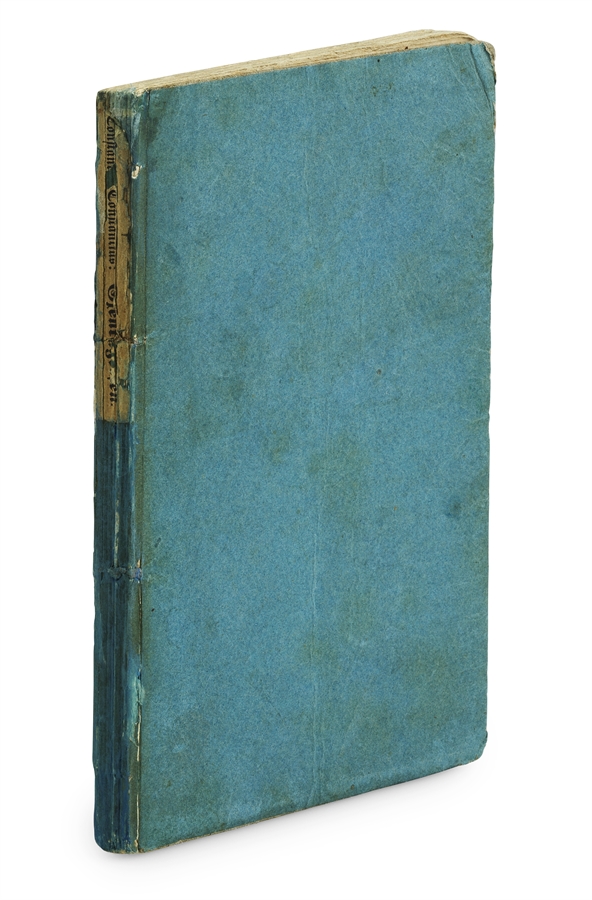
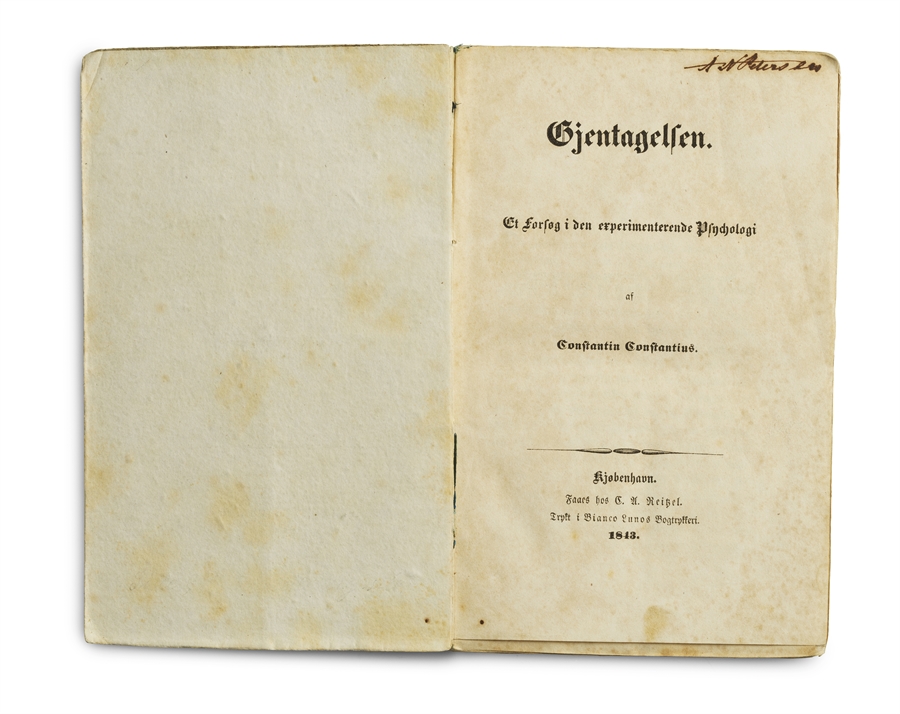
Kjøbenhavn, Reitzel, 1843.
Small 8vo. 157 pp. Original blue cardboard-binding. The spine has been restored, but it has the original printed paper title-label partly preserved. Hinges are a bit weak, and there is some edgewear. Browning and brownspotting, but not more than usual. Completely uncut.
Housed in a nice custom-made half lather box in pastiche style with richly gilt spine.
The first edition in the very rare original blue binding with most of the original printed title-label preserved. REPETITION – not only the title of one of his most significant books, but also a key concept in the philosophy of Kierkegaard – was written during the same brief spell of feverish activity that also produced Fear and Trembling; the two books were even published on the same day. ”Say what you will, this question will play a very important role in modern philosophy, for repetition is a crucial expression for what “recollection” was to the Greeks. Just as they taught that all knowing is a recollecting, modern philosophy will teach that all life is a repetition.” (Repetition, p. 3 – translation by Hong), Kierkegaard states in the beginning of his treatise, anticipating the importance that his concept of Repetition is to have for modern philosophy. Written in the narrative form of an experimental novel centered on two stories that are internally linked, Kierkegaard lets us understand what Repetition could be and what it is in his philosophy. The first story portrays Repetition as something empty and trivial, whereas the second portrays it as an ethical category that is inextricably linked to religion. Repetition is that which makes it possible for man to become and to remain present in the present. Kierkegaard’s explanation of his key concept of Repetition is exhausted in the present work, but it also plays a significant role throughout his later works and is considered one of the key concepts in his philosophy. The work is centered around the story of a young man, who has fallen in love with an innocent young girl to whom he has become engaged. But, finding himself unable to consummate the love because of poetic stirrings inside himself, he tries to understand what is going on inside him and whether or not he should break off the engagement. The elderly Constantin Constantius, one of Kierkegaard’s numerous pseudonyms, interferes with the emotions of our young man and begins to conduct speculative experiments with him that are meant to investigate whether a repetition (of the relationship with the girl, of the young man’s feelings, etc.) might be possible. At the end of the first part, the young man flees Copenhagen and leaves the girl, presumably at her wits’ end. Later, she marries someone else, and the young man transforms into the true poet that he could only be when unattached to the girl he loved. It does not take much of an imagination to link this story to the Kierkegaard’s own wildly famous love story and failed engagement to Regine Olsen. It all begins in 1837, when Kierkegaard meets the lovely young girl Regine Olsen at a visit to the widowed Cathrine Rørdam. Three years later, in September 1840, after having corresponded frequently with her and visited her on numerous occasions, Kierkegaard decides to ask for her hand in marriage. She and her family accept, but the following day, Kierkegaard regrets his decision and ends up finally breaking off the engagement in October 1841. Disregarding the scandal, the heartbreak (his own included), and the numerous pleas from family members and friends alike, Kierkegaard’s tortured soul, still searching for God and for the meaning of faith, cannot continue living with the promise of marriage. Later the same month, he flees Copenhagen and the scandal surrounding the broken engagement. He leaves for Berlin, the first of his four stays there, clearly tortured by his decision, but also intent on not being able to go through with the engagement. As is evident from his posthumously published Papers, Kierkegaard’s only way out of the relationship was to play a charming, but cold, villain, a charlatan, not betraying his inner thoughts and feelings. It is during his stay in Berlin, his first of four altogether, right after the rupture of the engagement, that he begins writing Either-Or, parts of which, like Repetition, can be read as an almost autobiographical rendering of his failed engagement. Repetition, more than any other work, lets us see how Kierkegaard came to be as an author through his tumultuous inner life during his engagement and the ending of it. Like Fear and Trembling, there are no presentation-copies known to exist of Repetition. Himmelstrup 53
Order-nr.: 62218