
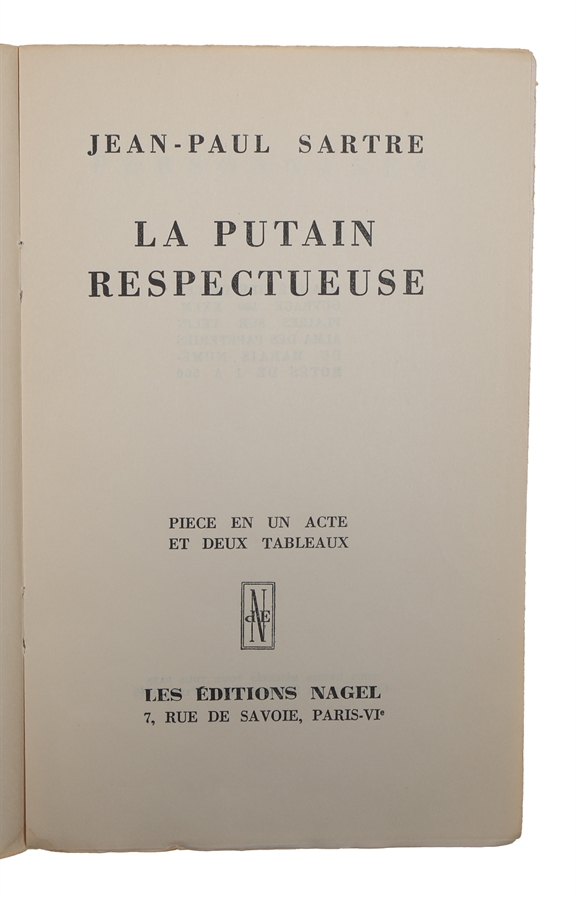
Paris, Nagel, 1946.
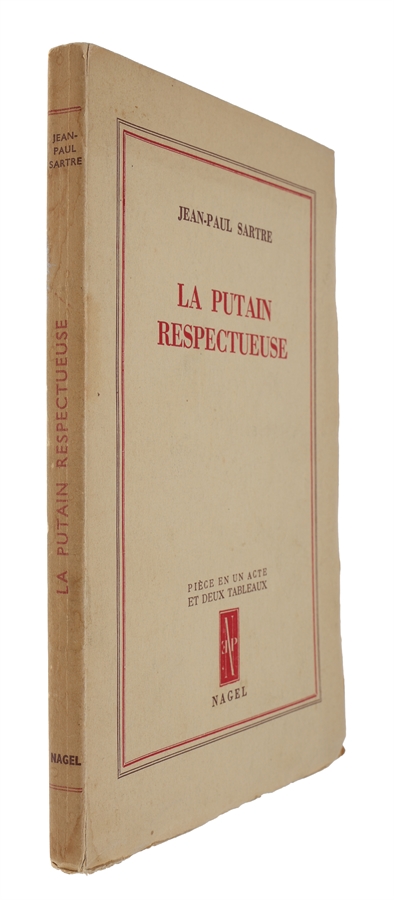
8vo. Original printed wrappers. Uncut copy. The spine shows light wear, with a small tear to lower front hinge, but remains fully intact. The corners are slightly bumped, and there is minor edge wear to the covers. Internally clean and well-preserved throughout.
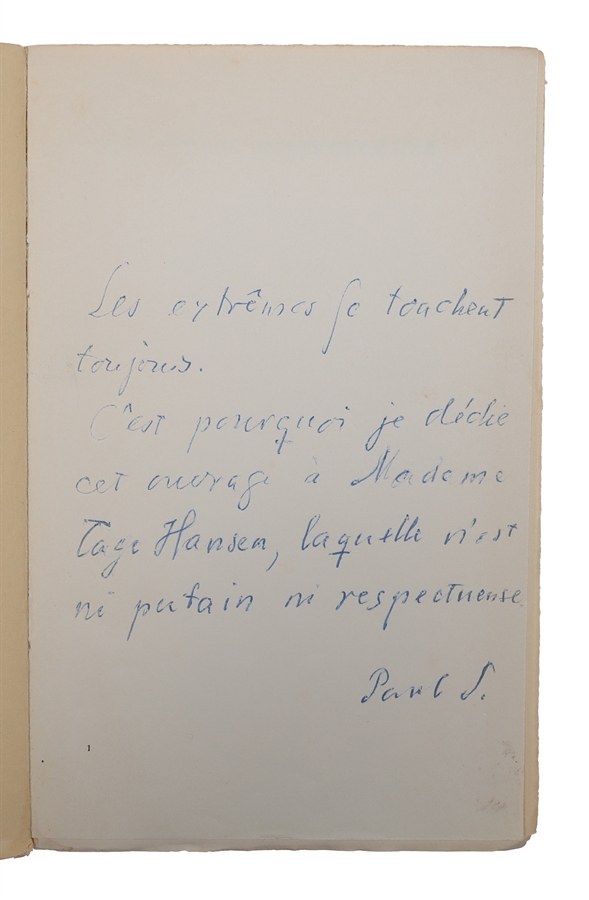
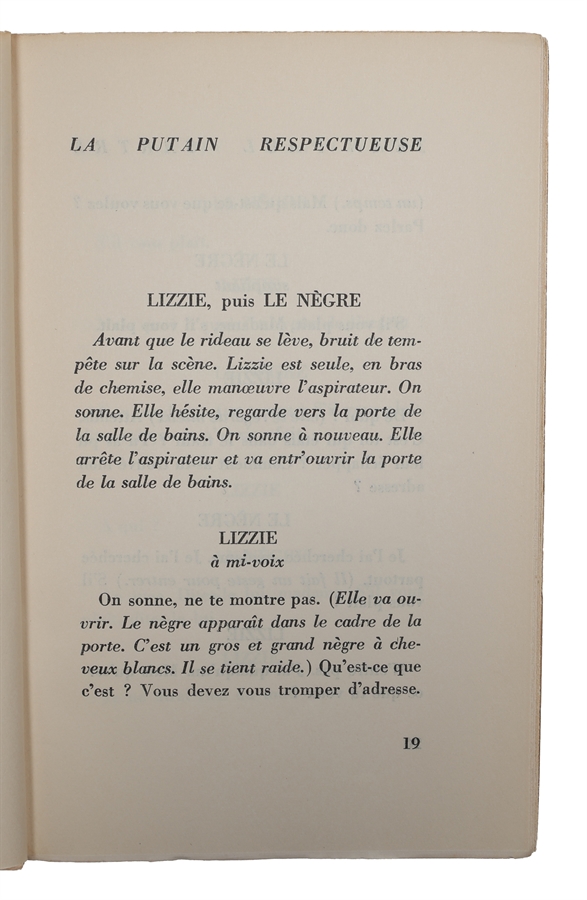
First edition, presentation-copy, of one of the most significant plays. Inscribed and signed by Sartre to front free end-paper: "Les extrêmes se touchent toujours. / C’est pourquoi je dédie / cet ouvrage à Madame / Tage Hansen, laquelle n’est / ni putain ni respectueuse. / Paul S." Jean-Paul Sartre's La Putain respectueuse is one of the most significant plays in his vast literary oeuvre, first published in 1946, just after World War II, during a time of profound social and political change. This play is not only a compelling dramatic work but also a profound exploration of existentialist philosophy, a hallmark of Sartre’s writing. Sartre masterfully weaves his philosophical ideas into La Putain respectueuse, using it to examine the complex intersection of race, class, and moral integrity—themes that resonate powerfully both in their historical context and in contemporary discussions. Sartre was inspired in part by his relationship with Simone de Beauvoir, a prominent philosopher and writer. Their intellectual partnership greatly influenced Sartre's exploration of themes such as gender and morality, as Beauvoir's work often challenged traditional notions of femininity and societal roles. This context deepens the understanding of Sartre's characters and moral dilemmas. Set in the deeply segregated American South, the play offers a sharp critique of racial injustice, centering on a Black man falsely accused of rape. This accusation reflects the pervasive systemic racism of the time, which remains largely unchallenged by society. The protagonist, Lizzie, a prostitute, finds herself at the heart of a moral and ethical dilemma. Her testimony could either condemn an innocent man or align with the corrupt powers that seek to manipulate her. Lizzie’s struggle embodies a broader existential question: How can one maintain individual freedom and moral integrity when society pressures them to comply with injustice? In La Putain respectueuse, Sartre’s meditations on freedom and responsibility come to life. Lizzie’s plight encapsulates the existential challenge of living authentically—staying true to oneself and one’s values—while being caught in the web of societal expectations and moral compromise. Sartre’s existentialist philosophy argues that individuals are "condemned to be free," meaning that freedom carries the unavoidable weight of choice. Lizzie’s decision becomes a powerful commentary on the human condition, the burden of ethical choices, and the often painful consequences of moral courage. Beyond its philosophical depth, La Putain respectueuse stands as an exemplary representation of Sartre’s ability to merge political commentary with dramatic intensity. His critique of systemic racism and class exploitation remains highly relevant, offering both a historical reflection and a mirror to contemporary issues of inequality and oppression. This work remains a cornerstone of French theatre and existentialist thought, emblematic of Sartre’s enduring intellectual legacy. La Putain respectueuse continues to offer profound insights into the social conflicts of its time while maintaining a timeless relevance in its exploration of the human condition.
Order-nr.: 61617