
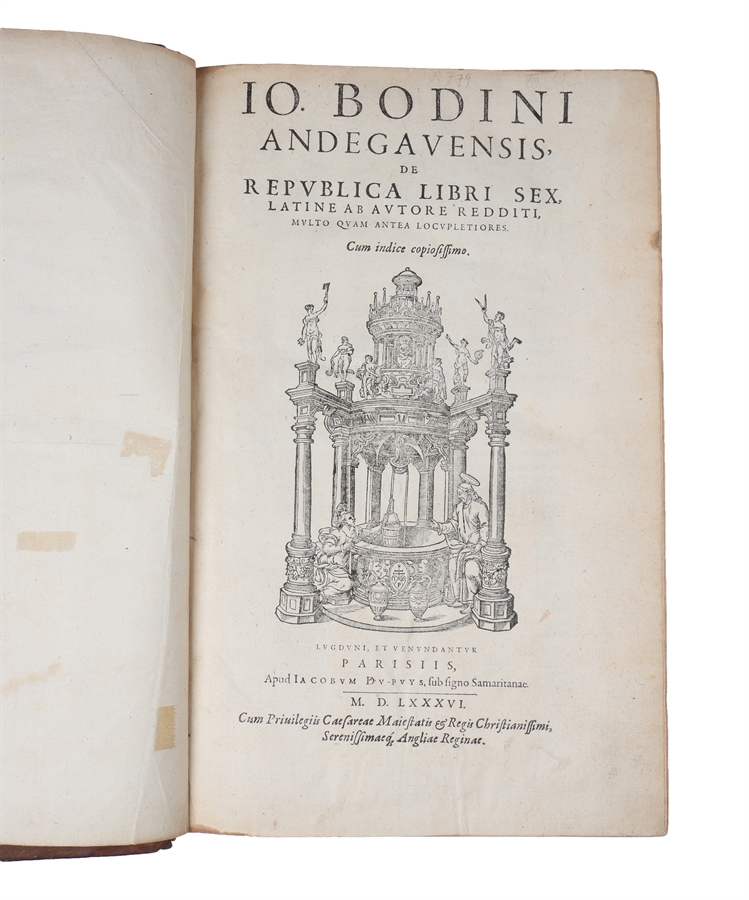


Lyon & Paris, Jacob Du-Puys, 1586.
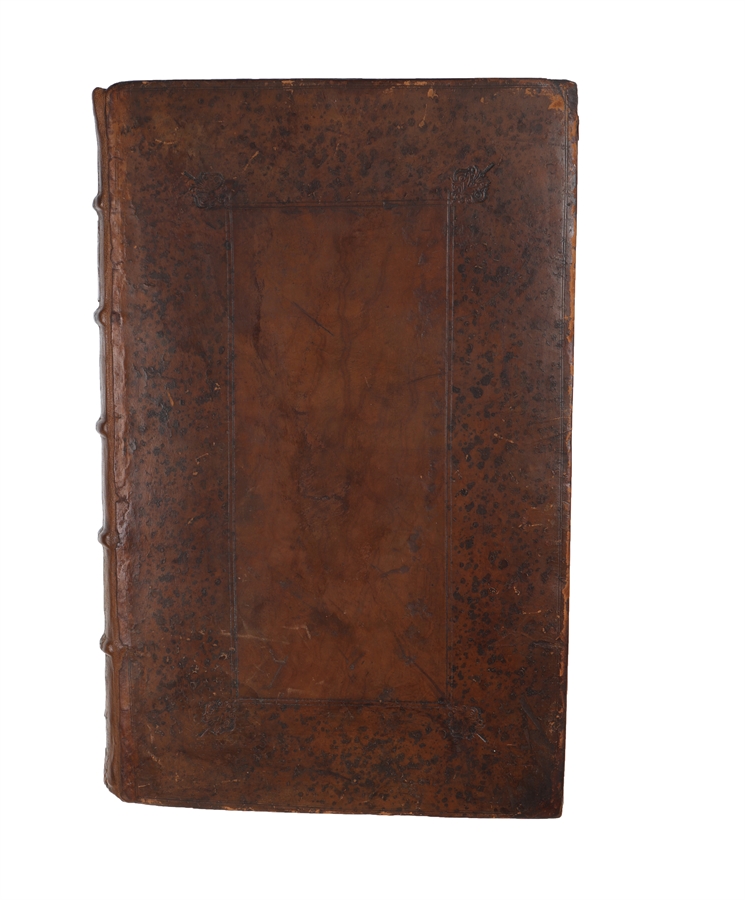
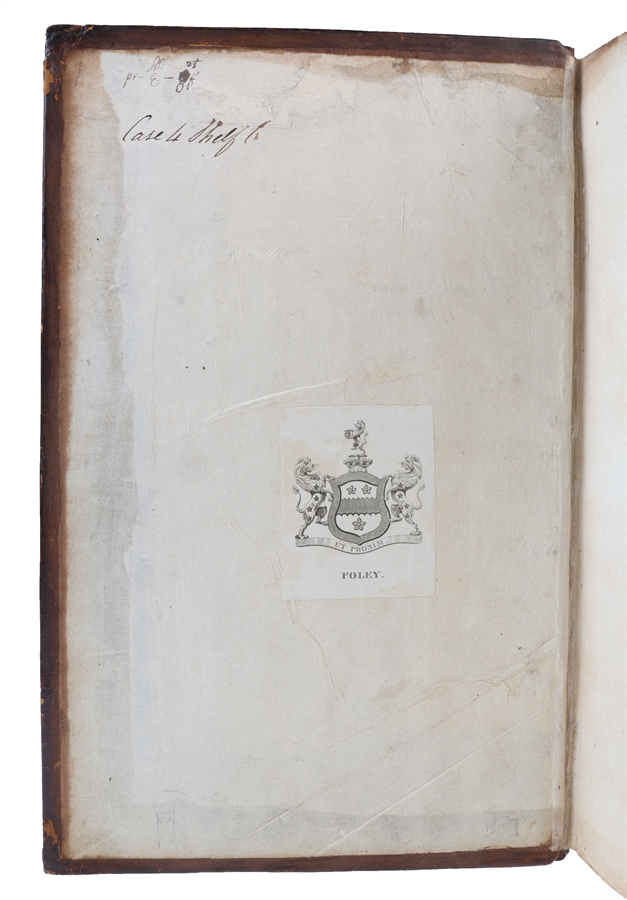
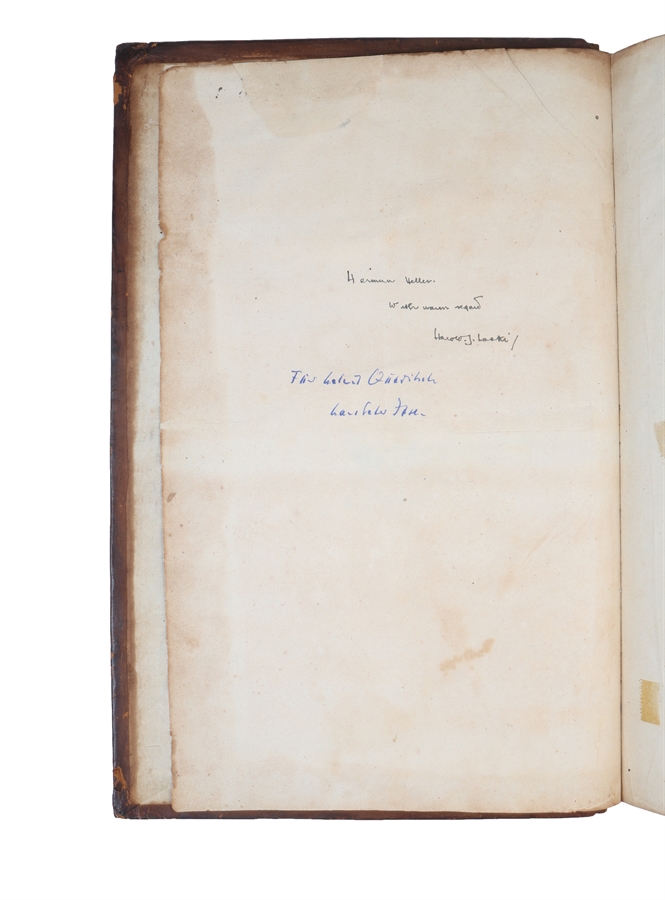
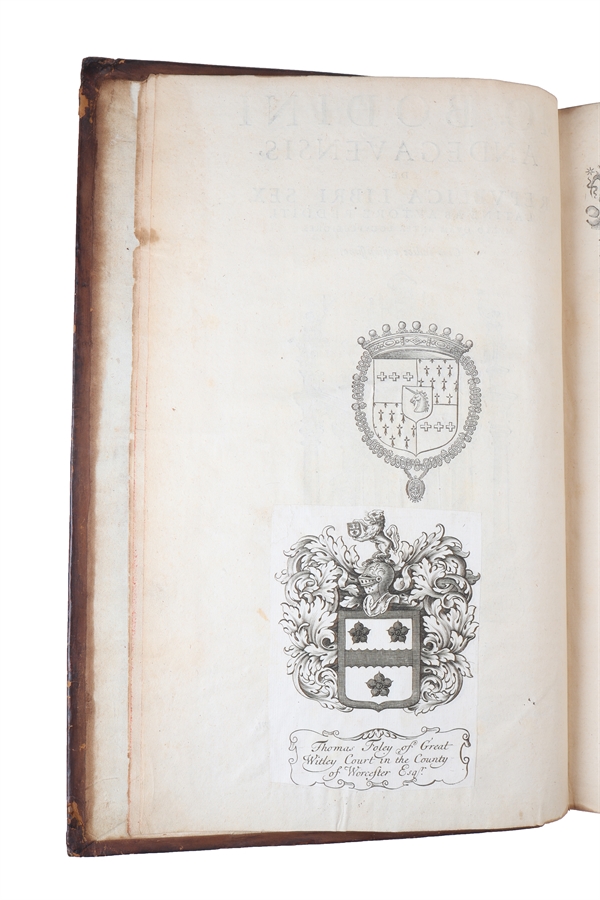
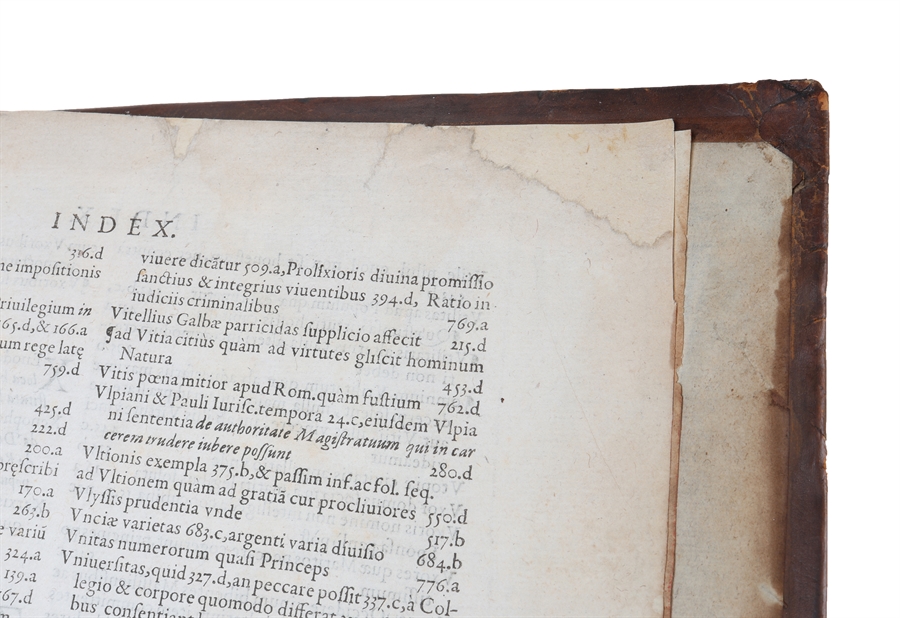
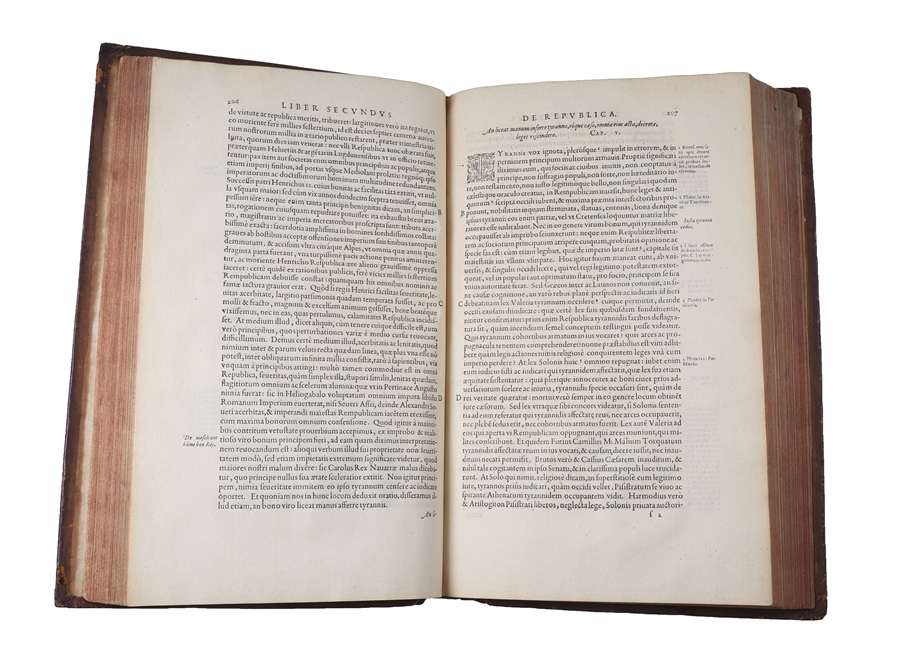
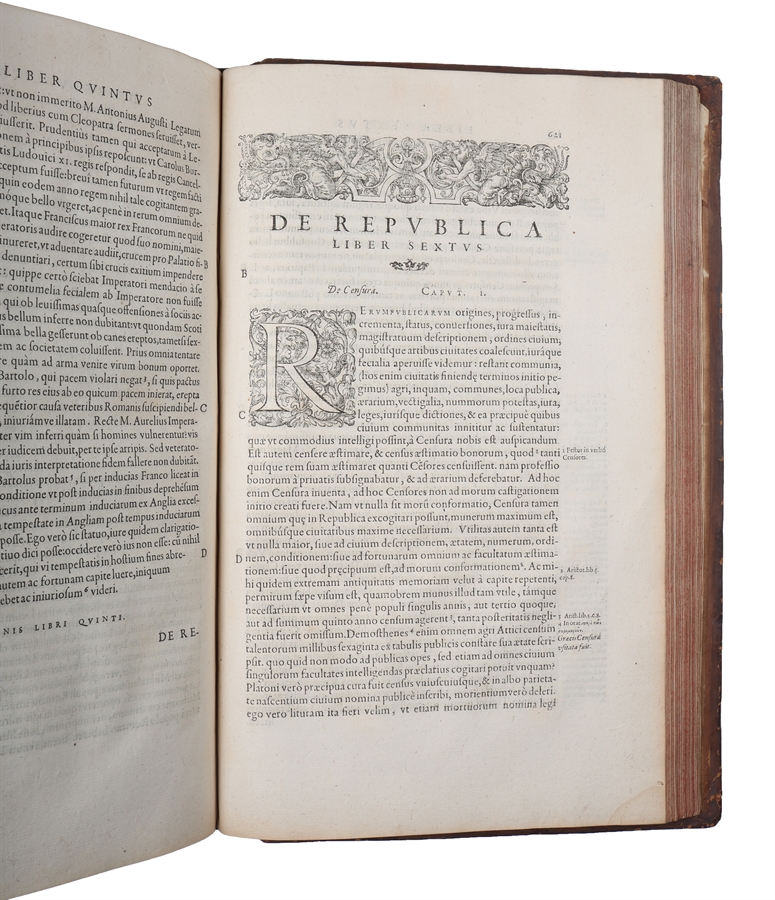
Folio. Lovely English a little later (ca. 1730'ies) full mottled calf. Boards with a large polished calf centre framed in blindstamped line-borders and with blindstamped corner pieces. Five raised bands to richly gilt spine and gilt red morocco title-label. Hinges restored with new leather. A bit of wear to spine and edges of boards. Overall a very nice and solid binding. With the book-plate of Foley (armorial bookplate with motto "ut prosim") to inside of front board and handwritten placement on the castle shelf as well as the large armorial book-plate of "Thomas Foley of Great Whitley Court in the country of Worcester" to verso of title-page. Later handwritten presentation-inscriptions to front free end-paper (From Hermann Heller to Harold Laki and later one for Helmut Quaritsch). Tiny marginal worm holes to least leaves, far from affecting text, and of Index with a restoration to the upper blank margin, also far from affecting text. Otwherwise internally very nice, clean, and fresh. An overall excellent copy. (8), 779, (1), (60) pp.
A wonderful copy with excellent provenance including several important legal political thinkers. Please see the end of the description below for full explanation of provenance.
The very rare first edition thus of Bodin's landmark work, being the first Latin edition (and the first translation overall), translated and significantly altered and added to by Bodin himself, thus constituting the most complete and the most influential edition of the first systematic statement of sovereignty - the work in which "sovereignty" is defined and treated extensively for the first time. "Bodin's "statement of sovereignty" is the first systematic one in modern European philosophy, and thus deserves a landmark status." (SEP). The work is also the first to coin the term "Political Science"; it occupies a central place in European political thought and immensely influenced all thinkers on the subject throughout centuries. "... for the next three centuries the political thought of the West will be preoccupied with these ideas, with a new theory of the State and with the concept of Sovereignty." (Catlin, A History of the Political Philosophers, 1950, p. 207).
Provenance: The Great Whitley Estate (or Witley Court) in Worchestershire, England was built for the Foleys in the 17th century. Thomas Foley, 1st Baron Foley FRS (1673 –1733) was an ironmaster and a Tory politician. He sat in the English and British House of Commons from 1694 until 1712, when he was raised to the peerage as Baron Foley, as one of Herley’s Dozen. Hermann Heller (1891 – 1933) was a highly important German legal scholar, political scientist, and philosopher, hailed as being responsible for the revival of political theory in Germany. “Hermann Heller (1891–1933) was a German constitutional lawyer and political theorist, best known for his pioneering work in constitutional law and democratic theory. A staunch opponent of National Socialism, he championed democracy, individual rights, and a version of ‘democratic socialism’ that fused socialist ideals with a strong rejection of authoritarianism. Although he died young, at just 42, his intellectual legacy remains significant – particularly in times of democratic crisis.” (“Hermann Heller – Pioneer of Social Democracy”: Leo Baeck Institute London) “Heller taught at the universities of Kiel, Leipzig, Berlin, and Frankfurt and left Germany in 1933 after the advent to power of the National Socialist Party of Adolf Hitler. An eclectic thinker, he utilized aspects of the thought of Georg Hegel, Karl Marx, Max Weber, and Hans Kelsen without accepting their principal conclusions. Heller stressed the need for a conscious balance between the will of society and man’s utopian ideals-norms and championed the authority of the state in the name of order. Heller revived political theory as sociological in method. He taught that the higher law of the state and the state itself, though shaped by historical civilizations, remain above nature. Deeply concerned about the political crisis of the West, he perceived the potential of Nazism in Germany and as an active member of the Social Democratic Party opposed the federal takeover of Prussia in 1932 as unconstitutional. As a Socialist he criticized the bourgeoisie for bringing about the psychology of strong-man rule in the face of disorder. Heller also favoured European unification as a means of safeguarding national cultures.” (Encycl. Britt.). Heller was forced to go into exile in Spain in 1933 and died in Madrid later the same year. In spite of his short career, it was very influential, especially in the Spanish-speaking world as well as Japan, and recent decades has witnessed a renewed interest in his work, especially in Germany. Political scientist with an interest in democracy, liberalism, and authoritarianism deem him extremely important and attribute to him the origin of the term “authoritarian liberalism” (1933). “Sadly, Hermann Heller’s personal library has not survived. But from his political education work, we know he placed great importance on opening up the cultural canon to the working class – a canon which, in his view, was shared with the bourgeoisie. He showed little interest in cultivating a distinct ‘labour movement literature’; instead, he believed that cultural integration was crucial to democratic citizenship.” (Dr Thilo Scholle, interview for an article by by Lutz Vössing, Leo Baeck Institute). Although his personal library does not survive, we at least know that he had Bodin’s magnum opus “De Republica”, in a splendid copy that he gifted to Harold Laski, a fellow outsider “he (i.e. Heller) was one of the few legal scholars in the Weimar Republic to openly support social democracy and to stand firmly by the Republic. But his ideas also set him apart. Heller believed that capitalism was neither a natural endpoint nor a sacred order. He warned that growing social inequality could undermine the Republic’s very foundations. In his view, even the bourgeoisie should support the evolution of democracy into a social democracy – precisely to preserve political stability. His vision of democracy as a tool for social transformation went far beyond the mainstream thinking of legal scholars at the time.” (Dr Thilo Scholle) and fellow part Marxist “Heller valued Karl Marx’s economic analysis highly. What he rejected, however, was the deterministic element he saw in Marx’s theory – specifically, the idea that history follows a fixed, inevitable course of development.” (Dr Thilo Scholle). Harold Joseph Laski (1893 - 1950) was a British political scientist, educator, and prominent member of the British Labour Party, who turned to Marxism in his effort to interpret the “crisis in democracy” in Britain during the economic depression of the 1930s. Like Heller, he too was very controversial, and the Labour party disavowing him, their own chairman. Laski was one of Britain's most influential intellectual spokesmen for Marxism in the interwar years, and his teaching greatly inspired students, some of whom later became leaders of the newly independent nations in Asia and Africa. “From about 1920 to about 1950, Harold Laski was one of the best-known academic intellectuals in the English-speaking world. After Oxford and after two relatively obscure years at McGill University in Montreal, he came to Harvard in 1916, where he remained for four years. He might have remained for the rest of his career, for he dazzled the academic world of the East Coast and particularly of Harvard with his exceptional learning, his spoken and written fluency, his deference to his elders, and his delightfully pleasing personality. He won the admiration and affection of Felix Frankfurter (who discovered him), Justice Oliver Wendell Holmes, Jr., and Louis Brandeis, and he stood very well with Roscoe Pound, Charles MacIlwain, and other great figures of the Harvard of that day. He was also greatly cherished by the first generation of the guiding spirits of The New Republic, which was founded in 1912.” (The New Criterion). “Harold Laski (1893-1950) was perhaps the best known socialist intellectual of his era, with influence in the USA, India and mainland Europe as well as Britain… [H]e dedicated his life to the quest for a just society, and his thought remains highly relevant for our own times.” (Springer). Helmut Quaritsch (1930-2011) was a German significant German legal scholar and ministerial general director. He was also director of the Research Services of the German Bundestag. Quaritsch’s primary research interests included the law concerning foreigners, asylum, and citizenship; the law governing the public service; modern theories of the state and sovereignty - with a particular focus on Jean Bodin and Carl Schmitt -, as well as studies on the issue of amnesty from the perspectives of constitutional and contemporary history.
The extremely scarce first issue of the "Six Books of the Republic" appeared in 1576, followed by a second issue in 1577 and a second edition later that year. The work was immediately recognized as important as was widely read throughout the French empire. But, as it was written in French, there was a limit to the spreading of its ideas outside of France. Passing through England with the duke d'Alencon, Bodin became aware of the difficulties foreigners had reading the French text, and when in Cambridge he encountered a very poor, defective, and faulty translation of his great work, done by an Englishman. He thus decided to translate the work himself and began his great Latin version of the work, which came to profoundly influence the reception of it throughout Europe.
Bodin not only undertook the translation into the universal language of the time, he also expanded the work and altered it significantly, causing the Latin edition to be considered the most complete version of the work and as important as the original French. Today, the Latin version is considered compulsory to the understanding of the work, and the new standard version of the work contains both the French and the Latin text.
Among the new chapters added to the work is that about social stratifications. "In 1586 Bodin wrote for the first time at length about social stratification, in a new chapter in which problems of the ordering of ancient society intersect continually with those of the estates of France, and in which many parallels are also drawn from the Italian cities." (William McCuaig: Carlo Sigonio. The Changing World of the Late Renaissance, p. 235).
There are several other new chapters of great significance, and Bodin emends many views throughout the work. In fact, there are several differences in doctrine between the two versions of the text. "One of these, the complete impossibility of sharing sovereignty between prince and people, originally seen as a form of popular government, appears as a direct result of Bodin's unhappy experiences in the Netherlands. His increasing belief in divine retribution and his discovery that princes had an obligation to protect foreign visitors may also reflect Bodin's experiences in foreign parts." (Brill's Studies in Intellectual History: The Reception of Bodin, p. 159).
Also the new preface that he writes for the Latin edition is considered of the utmost importance to the understanding of his ideas about sovereignty and the development and alteration of his doctrines. "Differences between the French and Latin versions of the "République" have often been noted, and Bodin's personal political experience an Anjou's side, vaulted in the new letter prefacing the 1586 version, has a role in accounting for them. Bodin had also responded to, and silently incorporated, some of the criticisms levelled at the original French text - notably Auger Ferrier's comments on Bodin's astrological conjectures. There was a notable change in personal circumstances as well. In 1576, Bodin had been a leading participant in the French Estates-General, in personal attendance upon the king; he was truly a rising star. By November 1584 when, in the wake of Anjou's death, Bodin composed the preface of his Latin translation, that star had fallen and burnt out." (Brill's Studies in Intellectual History: The Reception of Bodin, p. 159).
The French lawyer and political philosopher, Jean Bodin (1530-1596) wrote his main work, "Les six livres de la république" during the French Wars of Religion, when French Catholics and Protestants were fighting each other. He sees that the only real way to hold a community together and solve conflicts like the ones going on at the time is by establishing a supreme authority. There must be a ruling power which is unrestricted, but at the same time, it cannot be a power that is free to disregard all laws. Inspired by Aristotle's "Politics", Bodin now solves the problem of order though the definition of a concept that unites the rulers and the ruled in one body politic, one unitary political society, that is placed above any other human law and that defines human law; he can now define the concept of sovereignty without having to allow a ruler to neglect otherwise present laws and regulations. The sovereign body is necessarily unrestricted; it is bound by natural and divine law, but no human law can touch it or contest it; within its territory, it is the single authority. Bodin's Sovereign also has the power to legislate, and thus, he not only overrules the common law that had been prevailing in most sovereign states, he has also created a theoretical foundation for monarchy.
With this seminal work - the single most important political work of the French Renaissance, the work that came to influence all Western political thought for centuries -, Bodin had earned himself the reputation of being the founder of the science of the state.
The "Six Books of the Republic" went through many editions in the author's lifetime and after, and with Bodin's Latin version of it, it came to exercise a profound influence throughout all of Europe. "It is, in effect, the first modern attempt to create a complete system of political science. Its basis was the "Politics" of Aristotle, and it was through Bodin that Aristotle's work came to exercise influence on modern political thinking which has made him the father of modern democracy. Bodin was not content merely to reproduce his master, however; he added considerably from his own experience. Although like most sixteenth-century writers he approved of absolute government, he demanded its control by constitutional laws, in which respect he foreshadowed the development during the seventeenth century of the "social contract". Thus Bodin was the first to set out clearly the argument round which most political discussion centred in the seventeenth and eighteenth centuries, that law is merely an expression of the sovereign will, but that where this reposes in an absolute monarch, it must be mitigated by a customary or natural law. When the lawgiver's law becomes unjust, it ceases to be valid and must be resisted." (Printing and the Mind of Man p. 58).
The scarce first Latin edition is highly sought-after and, after the impossibly scarce first issue of the French version, the most desirable edition of the work.
Tchemerzine II:236; PMM 94(a) (first issue, 1576).
Order-nr.: 63692