
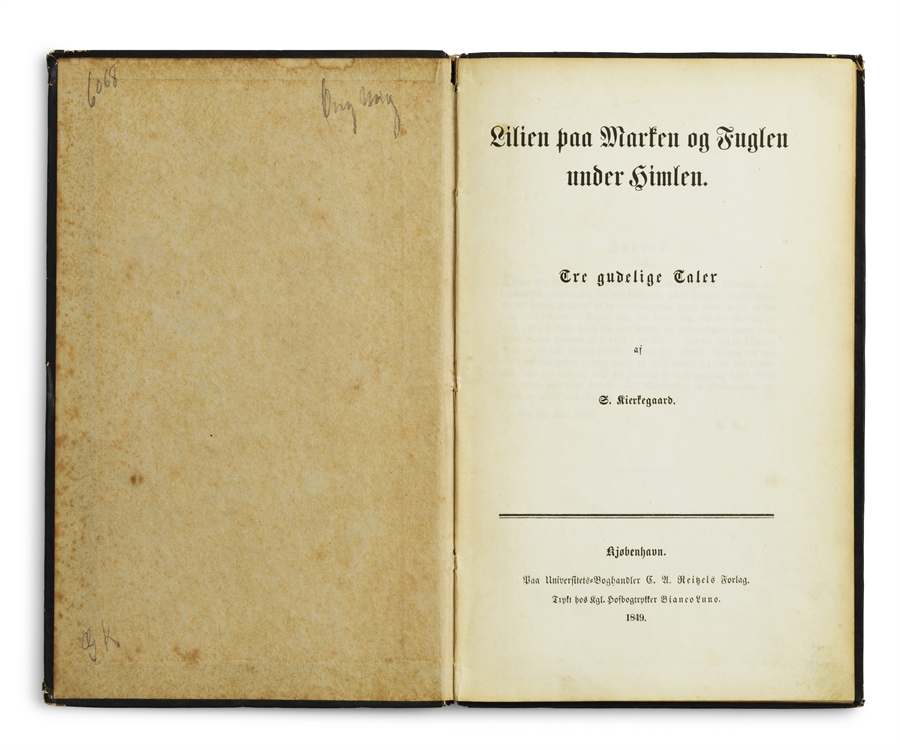
Kjøbenhavn, Reitzel, 1849.
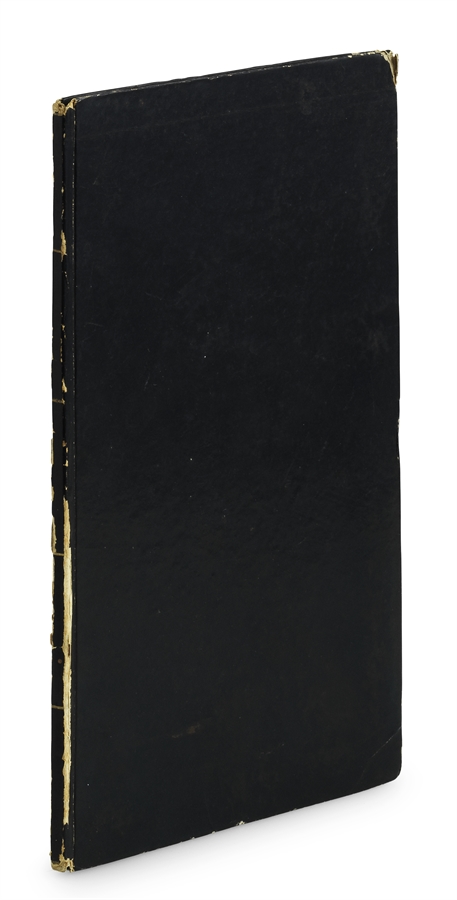
8vo. 51 pp. Original gift-binding of the black glitted paper with single gilt lines, all edges gilt, and printed on fine paper. Back hinge cracked and both hinges with loss of paper. Capitals and corners also worn with a bit of loss of paper, and lighter wear along edges of boards. Internally very nice and fresh.
A gift-copy, with all likelihood a presentation-copy, from which the presentation has been torn out.
Kierkegaard-inscriptions have been the object of many autograph-hunter’s desire, and we have several examples of front free end-papers that have definitely born a presentation-inscription from him, having been torn out.
An fabulous copy of the first edition of one of Kierkegaard's treasured works. This is without doubt a gift-binding and thus either one of the copies that Kierkegaard had in his possession when he died and never gave away, or it is a presentation-copy, from which the presentationinscription is lacking. In the present copy, the front free end-paper, on which Kierkegaard wrote his presentation-inscriptions in this work, has been torn out (there are tiny remains from it), making the latter scenario by far the most likely. Considered one of Kierkegaard’s most engaging works, “The Lily of the Field and the Bird of the Air” consists in three of his most important speeches, which represent the highlight of upbuilding existentialist thought. The three main themes of the work are silence, obedience and joy, and the thread that binds it all together is passion. “Experiencing the greatness of the universe, the beauty and the wonder of it, can lead to existential silence and induce a wonder that is the beginning of all philosophy. In the chosen book, Kierkegaard describes how inexpressibly much one can find joy in that which is near.” (Cappelørn). Like Nietzsche, Kierkegaard saw the period in which he was born as one characterized by a crisis of faith. But whereas Nietzsche sought to destroy the remnants of a Christianity that was falling apart, Kierkegaard wished to create a Christianity that would be able to live and flourish. This is particularly explicit in the present work, where he uses his three discourses to analyze the famous biblical Sermon on the Mount. These three Godly discourses vary from his other Discourses – Upbuilding and Various – in answering the by now so familiar question “what it is to be a human being” from a godly standpoint, teaching us about silence, obedience, and joy. Kierkegaard himself described the discourses as “indescribably uplifting” (Pap. X 1 A 353) and described the structure, meant to make us act and adapt to the “new” Christendom, as first, esthetic, second, ethical, third, religious (Pap. VIII 1 A 1). In 2018, a new translation of this seminal work appeared at Princeton University Press, the review of which very appropriately stated: “A masterful new translation of one of Kierkegaard’s most engaging works. In the Sermon on the Mount, Jesus tells his followers to let go of earthly concerns by considering the lilies of the field and the birds of the air. Soren Kierkegaard’s short masterpiece on this famous gospel passage draws out its vital lessons for readers in a rapidly modernizing and secularizing world. Trenchant, brilliant, and written in stunningly lucid prose, The Lily of the Field and the Bird of the Air (1849) is one of Kierkegaard’s most important books. Presented here in a fresh new translation with an informative introduction, this profound yet accessible work serves as an ideal entree to an essential modern thinker. The Lily of the Field and the Bird of the Air reveals a less familiar but deeply appealing side of the father of existentialism – unshorn of his complexity and subtlety, yet supremely approachable. As Kierkegaard later wrote of the book, “Without fighting with anybody and without speaking about myself, I said much of what needs to be said, but movingly, mildly, upliftingly.” This masterful edition introduces one of Kierkegaard’s most engaging and inspiring works to a new generation of readers.” (Princeton University Press, 2018). It is no wonder that it was precisely this work that was chosen to accompany Danish astronaut Andreas Mogensen into space on September 2nd, 2015. With its beautiful descriptions of nature, with its strong focus on the value of enjoying the moment and that which is present, and with its teaching us to be humble, the book seems the perfect choice for man in space. Kierkegaard had three copies of the work in his possession when he died (auction catalogue 2156-58). This is one of the scarcest Kierkegaard-titles to find in the trade. When we make our sets of first editions of Kierkegaard’s works, this is the one we always have to wait the longest to find. When we finally get a copy, it is rarely found on its own and is usually bound with something else. We have only handled few copies of it separately bound. The present copy is no. 64 in Girsel's "Kierkegaard" (The Catalogue) which can be found here.
Order-nr.: 63615