
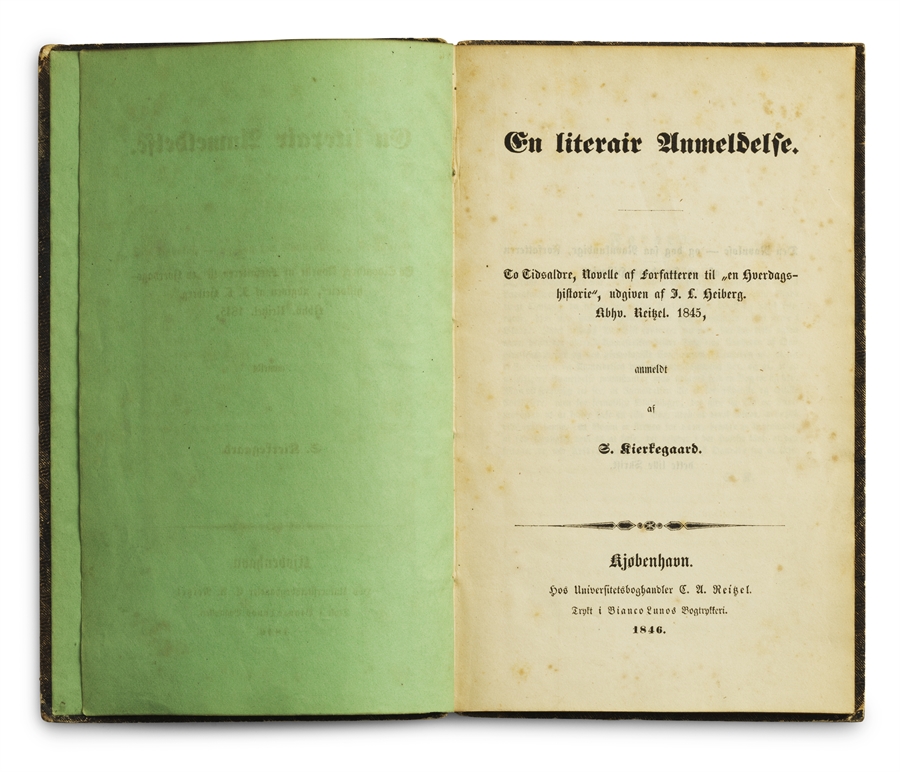
Kjøbenhavn, Reitzel, 1846.
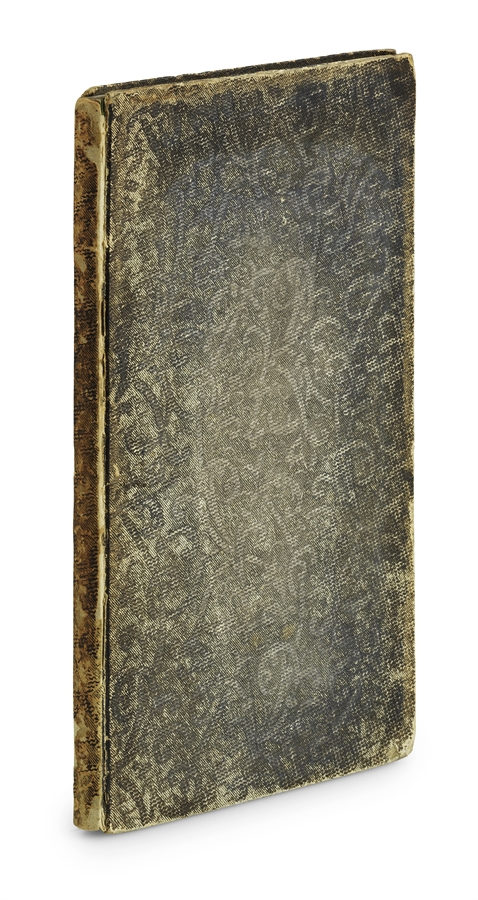
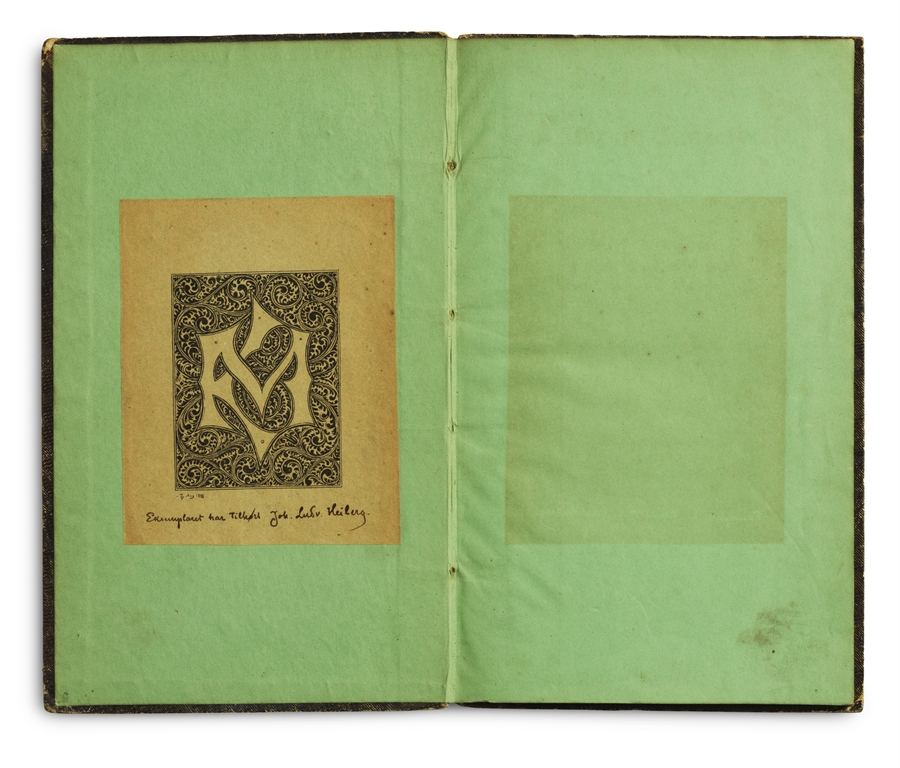
8vo. 114 pp. Splendidly bound in full patterned silver-moiré gift-binding with all edges gilt. Green endpapers. A bit of brownspotting. Spine, edges, and corners worn and the silver dulled. But a splendid binding, nonetheless. With Karl Madsen’s ex libris, on which he has added in hand “Eksemplaret har tilhørt Joh. Ludv. Heiberg.” (i.e. the copy has belonged to Johan Ludvig Heiberg) to inside of front board. Inside of front board with previous owner’s neat pencil annotation explaining that this is the copy that Kierkegaard sent to Heiberg with the wish of having it expedited to the author of Two Ages, alias Thomasine Gyllembourg.
First edition, magnificent copy in original silver-gift binding, with all likelihood be the copy that Kierkegaard intended for Thomasine Gyllembourg, mediated by Heiberg. Having finished his “first” authorship with his monumental “Unscientific Concluding Postscript”, the “Literary Review of Thomasine Gyllembourg’s Two Ages” invokes Kierkegaard’s second authorship. The Literary Review is a classic within the conservative critique of modern society. It is here that Kierkegaard presents his most concise and significant analysis of modern society as it shows itself through the press, in the relationship between public authorities and the subjects. The work was printed amidst the Corsair-Affair, which was a defining event in Kierkegaard’s life and work. Having been unbearably ridiculed in periodical The Corsair since January 1846, Kierkegaard uses his Literary Review of Two Ages (printed March 30th, 1846) to convey his thoughts on the public and the individual’s relationship to it. Thomasine Gyllembourg was the mother of Johan Ludvig Heiberg and a magnificent author herself. She was one of the most productive authors of the Danish Golden Age, despite having had her debut late in life, at the age of 53. She was the founder of Danish feminist literature, writing about the position of women in society and in the home. Her novel “Two Ages” portrays one of her eminent Madonna figures, Claudine, who, despite her status as seduced and abandoned single mother stays true to herself, her beliefs, and her role as a mother. Claudine’s sexual liberty of the Revolutionary age is contrasted to the gentle and modest heroine of the present age, whose identity is in caring for the home. As such, Two Ages opposes the ideals of freedom from the age of the French Revolution with the bourgeois ideals of the Golden Age. In his review, Kierkegaard is mainly concerned with the contrast between the two ages in the novel – that of The French Revolution, and that contemporary with the novel. Expressed with Kierkegaard’s concepts, the age of revolution is passionate and the present age dispassionate; Kierkegaard ends up attacking the conformity of the present age and the de-individualization of people into an abstract public. The inanimate beliefs and views of the present age become especially fatal in the daily press. As a reader, one is no longer a passionate individual, but part of an anonymous and diffuse public audience. Not until the single individual has established an ethical stance to the whole world as it is, can there be any question of genuinely uniting. This is a clear reference to the ridicule Kierkegaard himself experienced due to the Corsair and a harsh verdict upon the Copenhagen audience. But it is not only Kierkegaard’s characterization of mass media that has made “A Literary Review” a conservative classic within the critique of modern society, so has Kierkegaard’s description of how the dispassionate age has subverted all social hierarchies and put into question all the relative strength of the different powers of society. This magnificent work is one of Kierkegaard’s most political and that which gives us his clearest analysis of modern society. Two presentation-copies of the work have been registered (one for Giødwad, one for Madvig), and Kierkegaard had one copy in his library, which was sold at the auction of his books after he died. We also know that Kierkegaard gave a copy to Johan Ludvig Heiberg, in his capacity of publisher of Two Ages”, to pass on to the anonymous author of the work, who, as we know, happened to be Heiberg’s mother. The provenance, although it seems likely, has not been definitively established. We know that the copy belonged to Karl Madsen, as it has his ex libris, and we know that he bought a good deal of Mrs. Heiberg’s books after she died, among them quite a few gift-and presentation-copies from Kierkegaard to Heiberg (see Gert Posselt’s Preface in Girsel's Kierkegaard-catalogue p. 13). It is also clear that the book is in a gift-binding and is bound exactly like Kierkegaard’s own copy of the book. See Aarbog for Bogvenner 1925, where Karl Madsen describes how he came to buy a large part of the books from Mrs. Heiberg and also mentions Kierkegaard presentation-copies. But the present copy is not mentioned specifically. The present copy is no. 50 in Girsel's "Kierkegaard" (The Catalogue) which can be found here.
Order-nr.: 63610