
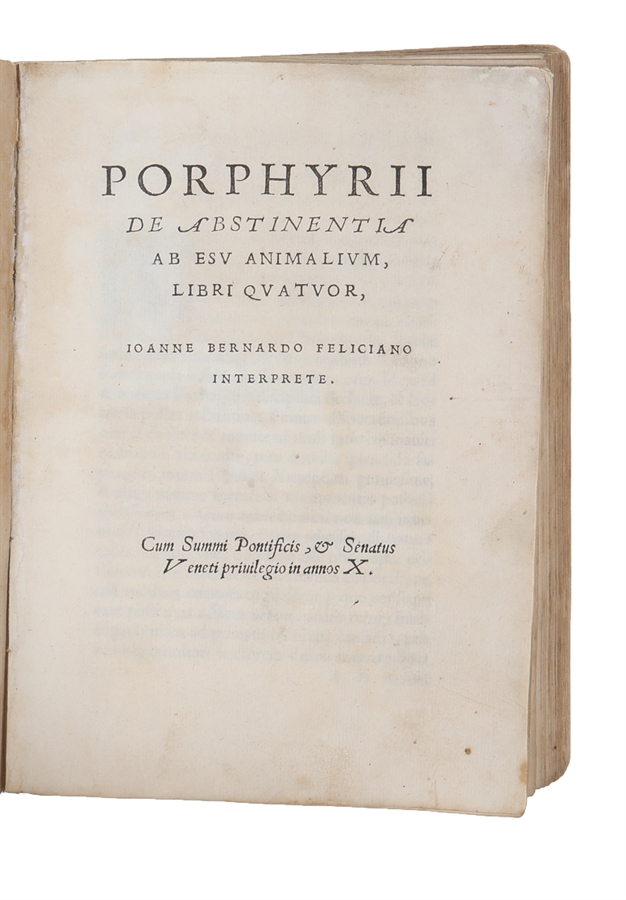
(Venice, Iohannes Gryphius, 1547).
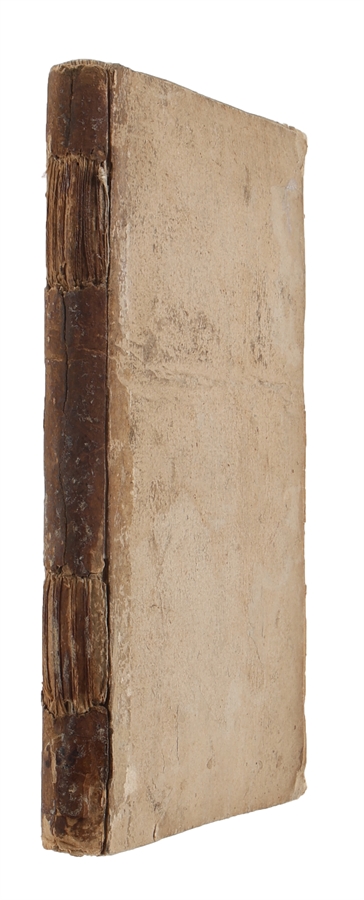
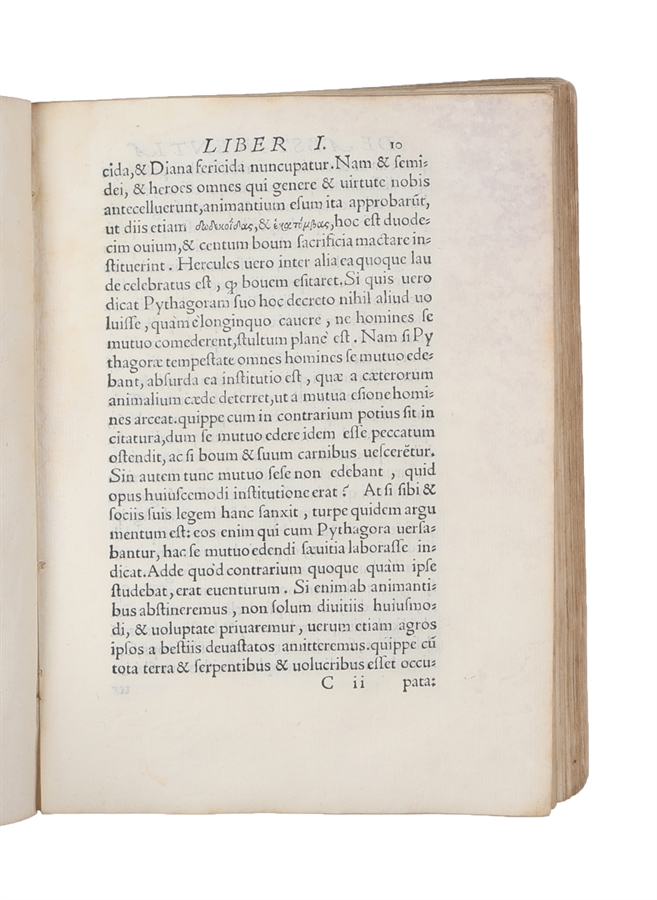
4to. Contemporary paper-covered boards. Spine with traces of previous onlay and with two compartments of paper spine gone - here the original sewing cords are visible and intact. A bit of soiling to binding, but overall very good, with a slightly fragile hinge. Old handwritten number to lower part of spine. Title in old ink to bottom edge of the text block. Damp staining to some leaves, especially towards the end, but mostly marginal. Overall in very good condition. Lovely woodcut pictorial chapter initials. Some occasional spotting to the blank outer margins, otherwise very good. A lovely, unsophisticated copy housed in a custom made navy blue cloth box. [6], 100 ff.
Scarce first edition of the first book entirely dedicated to vegetarianism. This cornerstone of vegetarian literature is not only considered the earliest book on the subject, but also a milestone in the history of animal rights, being one of the very first texts to argue that animal life is equal to that of a human. The work is the most elaborate classical work on vegetarianism known and one of the most important works in the history of Skepticism. By many, it is considered Porhyry’s magnum opus. The work is generally simply referred to as “De Abstinentia”, from its Latin title. It was translated from the original Greek by Giovanni Bernardo Feliciano (c.1490-1552) and published in 1547, one year before the publication of the Greek version of the text, the present Latin thus constituting the editio princeps. Porphyry of Tyre (c. 234-305?) was one of the most important Greek Neoplatonist philosophers and one of the most important disciples of Plotinus, the founder of Neoplatonism. Porphyry wrote extensively on philosophy, religion, philology, and science and is famed for having written the first extensive treatise on vegetarianism. After Plato, many Neoplatonist philosophers recommended a fleshless diet on ethical and spiritual grounds, but the only surviving classical treatises we have dedicated entirely to the subject, are Plutarch’s smaller, not individually published, twin essays “On the Eating of Flesh” (contained in his “Moralia”) and Porphyry’s seminal book devoted entirely to the subject of abstaining from eating meat. This work, Porphyry’s “De Abstinentia” is the most elaborate ancient pro-vegetarian text known to us, and together with Plutarch’s smaller essays, it is considered the founding work in the Western vegetarian canon. This magnum opus of vegetarianism is commonly recognized as the primary classical work, not only in vegetarianism, but also in animal ethics. Porphyry believed that animals are aware and capable of evaluating situations, have memory, and communicating. In short, all they lack that humans have is the ability to speak so that we can understand them. According to Porphyry in his “De Abstinetia”, killing an animal is no different from taking the life of a human being, and thus the work also became one of the first to state that animal life is equal to that of a human. Furthermore, he argues that by consuming meat, the body becomes corrupt and unhealthy, leading also to obesity. Porphyry’s groundbreaking vegetarian treatise is a polemical work addressed to Castricius Firmus, Porphyry's friend and fellow disciple of Plotinus, who had renounced a vegetarian diet. The treatise compiled most of the classical thought on the subject and incorporates arguments for and against vegetarianism. “Porphyry’s work [i.e. “De Abstinentia”] had long been a classic source of arguments in favor of a diet that excluded animal products, to the point that “abstinence,” the term traditionally used to translate Porphyry’s ?ποχ?, had become the cornerstone of philosophical discussions regarding the choice not to eat the flesh of animals. In this text, the disciple of Plotinus seeks to convince his friend Firmus Castricius to abstain from eating meat, a food which he had previously avoided but had subsequently gone back to consuming. Porphyry’s appeal is customarily considered one of the most extensive ancient defenses of vegetarianism” (Muratori: Vegetarianism Before Vegetarianism, Cambridge University Press, online, 2025). “On Abstinence” was not only extremely influential in antiquity, it also had an enormous impact upon the development of modern vegetarianism and is considered the most important statement in the history of vegetarianism until recent times (i.e. Percy and Mary Shelley in the 19th century). It is arguably the most quoted and referenced works in the history of vegetarianism and doubtlessly the most influential, also in a modern context. This is also in large part because of the seminal first printing of the work, in Lattin in 1547. “It is often believed that philosophical reflection on vegetarianism and human-animal relations intensified after Descartes, who praised a plant-based diet… Another argument for the modern invention of vegetarianism is the term’s coinage in the mid-nineteenth century. However, … vegetarian discourse flourished in the Italian Renaissance, largely in the wake of the translation and widespread reception of “On Abstinence” by the ancient Neoplatonist Porphyry… Porphyry’s insistence on complete abstinence from meat makes his position unique. Except the Pythagoreans, no other school of antiquity had unanimously considered vegetarianism a prerequisite for philosophical work. “On Abstinece” not only stood out for its author’s original treatment of the subject; structured as if in direct competition with other philosophers, it also became an incomparable reservoir of ancient ideas on various aspects of humans’ engagement with animals.” (Ovanes Akopyan in: Renaissance Quarterly, Vol 78, nr. 2 – University of Chicago Press, 1 August 2025). The work is scarce with almost no copies at auction over the last 50 years. Vicaire, Bibliographie Gastronomique, p. 703. Graesse: V:415
Order-nr.: 63390