
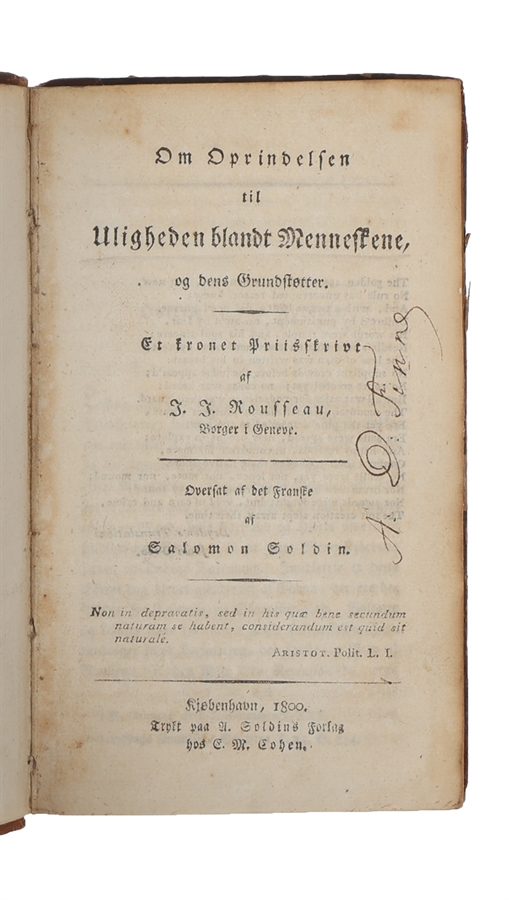
København, Soldins Forlag, 1800.
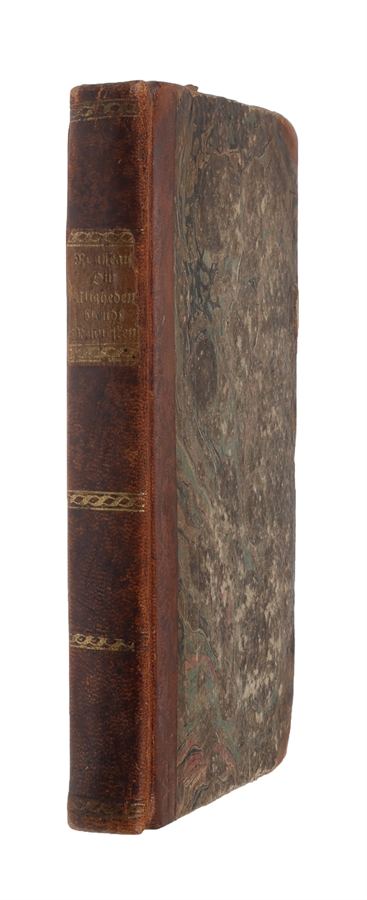
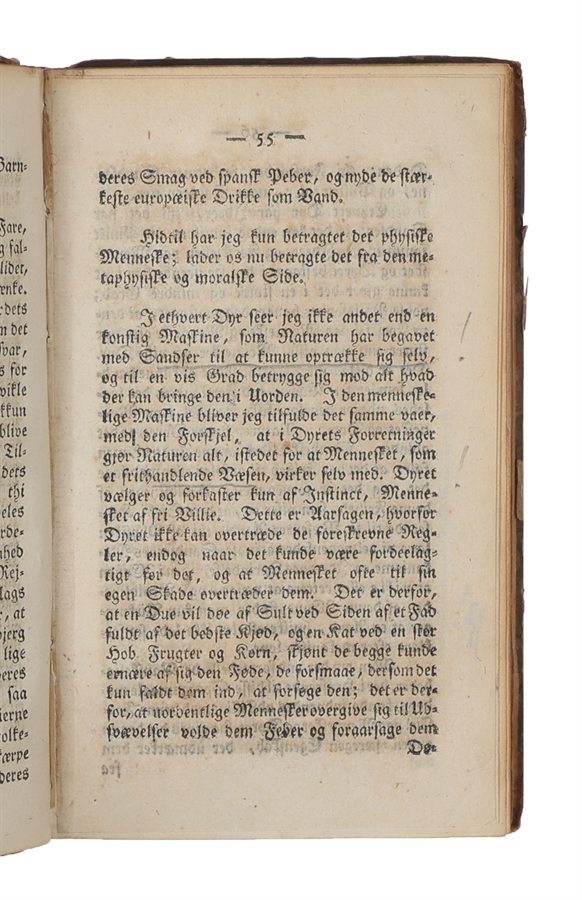
8vo. Contemporary half calf with gilt title-label. A bit of overall wear, mostly to extremities. Two ex libris to inside of front board, one being that of Anton Thomsen (Danish philosopher, 1877-1915), also with his signature and date on front free end-paper. Old owner's signature on title-page (A.D. Finns). Occasional marginal pencil notes and underlinings, otherwise nice and clean. (x), (2), 221 pp.
Scarce first Danish edition of one of Rousseau's main works, being one of the most important works of political thought in general: The "Discourse on the Origins of Inequality" (original Discours sur l’origine de l’inegalité, 1755) is considered Rousseau's first important work and the work that lays the foundation for his later thought. Like Rousseau's "Discourse on the Sciences and Arts " from 1750, the "Discourse on the Origins of Inequality" was written as a response to an essay competition from the Academy of Dijon. This work is thus often referred to as the "Second Discourse". Unlike the first, this did not win him a prize, even though it is was also at the time considered a far more accomplished work and now counts as one of his three main works (together with the "Contract Social" and "Émile"). It is in the present work that Rousseau begins to develop his theories of human social development and moral psychology and it is furthermore this work that for the first time clearly divides him from the Encyclopédiste mainstream of the French Enlightenment. According to OCLC, merely five libraries world-wide own a copy (two in Switzerland, and one in Denmark, UK, and Germany respectively). ________________________________________________________________________________________________________________ Cranston, Maurice. "The Social Contract". Encyclopedia Britannica. 11 Mar. 2025, https://www.britannica.com/topic/The-Social-Contract. Accessed 1 July 2026. Nygaard, B. (2011). Rousseau and Revolution in the Making of a Modern Political Culture: Denmark 1750-1850. I M. Thorup, & H. R. Lauritsen (eds.), Rousseau and Revolution (s. 114-129). Bloomsbury Academic. Sørensen, A. D. (2016). Opdragelsens filosofi: Jean-Jacques Rousseau, Immanuel Kant, Søren Kierk. Aarhus Universitet. https://doi.org/10.7146/aul.133.116
The work was translated by the editor and publisher Salomon Soldin (1774-1837) as his first independently published work. S. Soldin became famous for his work as editor, between 1804-1825 (and publisher, after 1811), of the renowned biweekly magazine Nyeste Skilderie af Kjøbenhavn, which, in addition to his own numerous articles, contained contributions from well-known authors such as Rasmus Nyerup, K. L. Rahbek, N. F. S. Grundtvig, and others (Frøland 2026). It was one of the most important magazines during its lifetime, where many of the most important literary feuds were published.
According to Sørensen (2016): "The cult of Rousseau also reached Denmark, and it is well known how Johann Friedrich Sturensee raised Crown Prince Frederik, according to a literal interpretation of Émile. Nevertheless, Danish interest in Rousseau remained within a narrow cultural environment, and after the turn of the century, Rousseau's influence faded." (original in Danish; 2016: 5).
The work is famous for Rousseau's portrayal of a multi-stage evolution of humanity from the most primitive condition to something like a modern complex society, which has gone down in history as one of the most important portrayal of man and society. But furthermore the work is famous for its long preface.
When Rousseau had converted to Catholicism, he also lost his rights to the status of Citizen of Geneva. This right was regained in 1754, though, when he reconverted to Calvinism, and a large part of his "Discourse on the Origins of Inequality" consists in a dedication to the state of Geneva. This preface is probably one of the most famous prefaces in the history of modern thought as it constitutes, not only a highly ironical and satirical praise of his birthplace, but also a masterpiece of utopian political thought. Geneva is praised as the good republic worthy of admiration for the stability of its laws and institutions, the common spirit of its inhabitants, the well behaved women that inhabit it, and the good relations with neighbouring states. Not only is this piece of political fiction that provides us with an imminent insight into how a state should ideally be according to Rousseau an ironical description of what Geneva was not, it was also a fierce attack on Paris.
Sources and further reading:
Frøland, Aleks. "Salomon Soldin". Dansk Biografisk Leksikon. https://biografiskleksikon.lex.dk/Salomon_Soldin. Accessed 1 July 2026
Order-nr.: 63354