
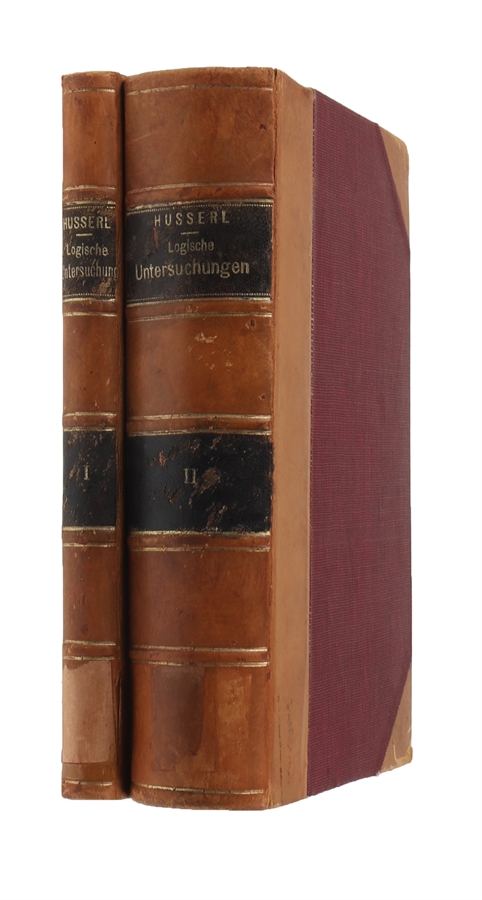
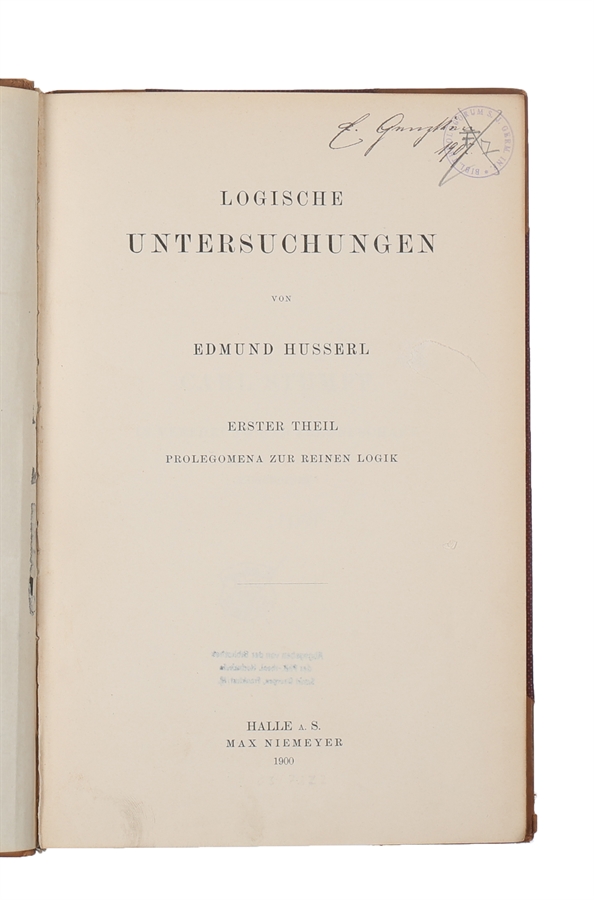
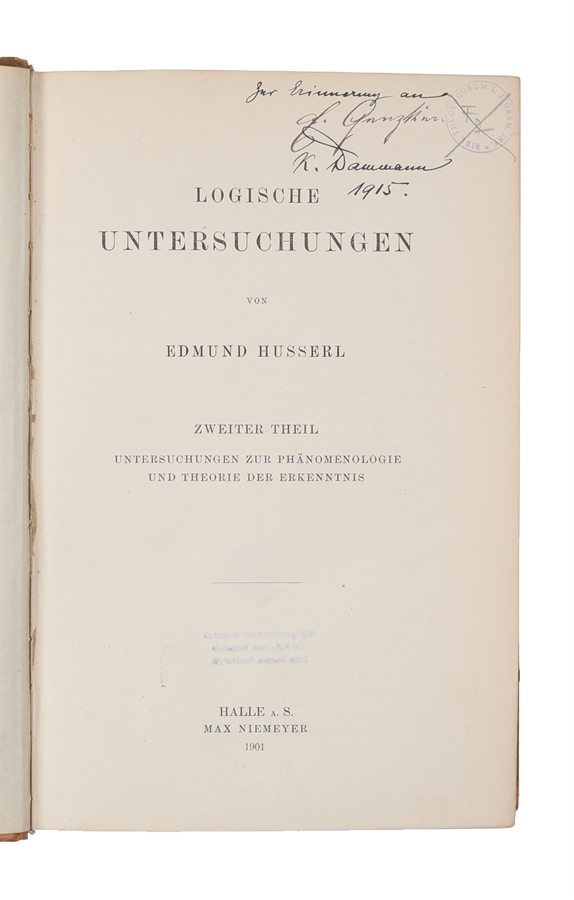

Halle, Niemeyer, 1900-1901.
Royal8vo. Uniformly bound in two contemporary half calf bindings with lettering to spines. Spines and corners with some wear and scratches. Lower compartments with traces from old labels. Previous owner's name "K. Dammann / 1915" to front free end-paper. Two small library stamps to front free end-paper and title-pages and accompanying deaccession stamps. Small tear to title-page in vol. 1, not affecting text. Otherwise a fine and clean copy. XII, 257, (1, -errata) pp.; XVI, 718 pp.
Rare first edition of Husserl's main work, one of the most important philosophical texts of the 20th century. The "Logical Investigations" fundamentally changed philosophy and invoked the new philosophical era of the 20th century, -with this work Husserl founds phenomenology. Together with Heidegger's "Sein und Zeit", this must be considered the most important work of modern philosophy.
Husserl's magnum opus opens with an attack on psychologism, and he then introduces his brand new philosophical method, which he had still by then not fully developed, but which came to influence all philosophy ever since -Phenomenology! Husserl himself calls this a "Work of Breakthrough" (see his preface to the second edition).
In short, psychologism taught that logic itself was not an independent discipline, but a part of psychology, and it is this notion that Husserl gives its final blow in his logical investigations, -far more definitely than Frege had tried to some years earlier.
Husserl now establishes a philosophy that asks the question of the essence of the matter of perception as opposed to the form of perception, as well as the meaning of the difference between formal or pure and material laws, truths and determinations, -all based on his strong interest in the relationship between the formalities of arithmetic and of logic. The work is the starting point for mereology, the formal first order theory of wholes and their parts. Mereology is both an application of predicate logic and a branch of formal ontology.
Husserl is now famous as the father of phenomenology, and he decisively influenced the likes of Heidegger, Sartre, Carnap, Merleau-Ponty, Levinas, Ricoeur, Derrida etc. etc. Among this list of eminent people, we can surely count Groos as well.
Order-nr.: 63275