
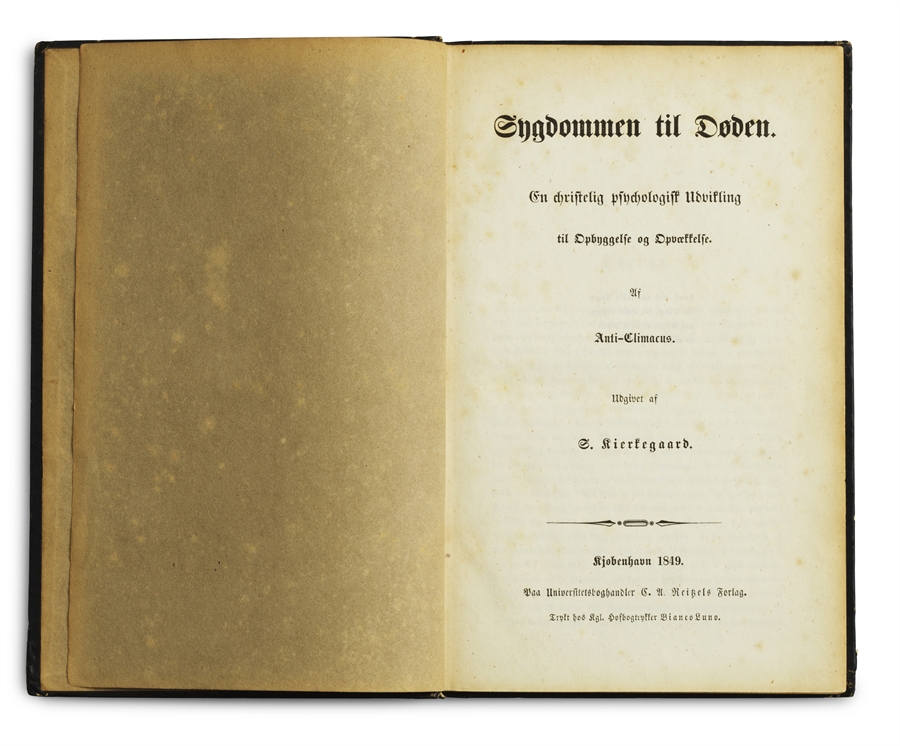
Kjøbenhavn, Reitzel, 1849.
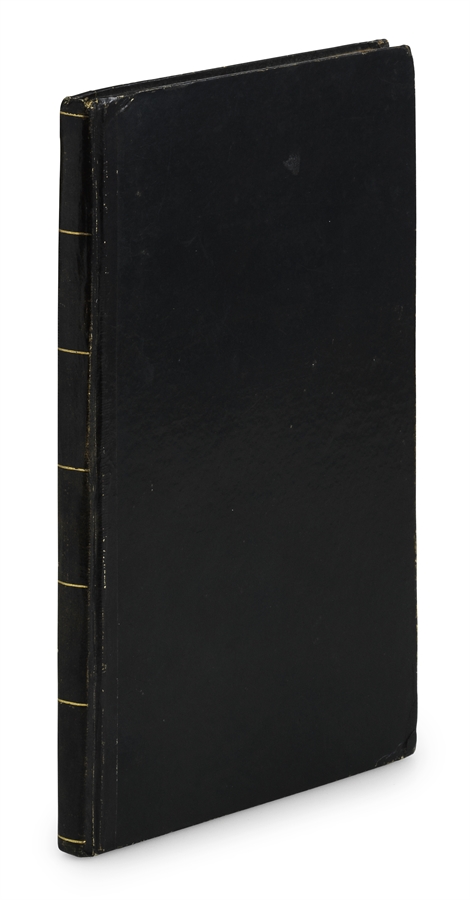
8vo. (8), 136 pp. Original gift-binding of the black glitted paper and printed on fine paper. Neatly rebacked in a slightly more brownish black tone, recreating the gilt lines of the original spine. Edges slightly bumped and light signs of wear overall. Light scattered brownspotting.
With the ownership signature of N. Chr. M. Bredsdorff to front free end-paper.
Excellent copy of the first edition, in the original gift-binding, presumably being one of the five copies that Kierkegaard had in his possession when he died. This is with all likelihood one of the copies Kierkegaard had bound to give away, but then never did, meaning that it was to be found in the auction of his books after he died. Only one buyer of any of the five copies he had in his collection was registered, the other four are registered as having paid cash and are not registered by name. This is presumably one of those four copies, possibly bought by Bredsdorff, who was out of a family of priests and himself became a theologian. Sickness unto Death is one of the main works of Christian existentialism. It is this monumental work, which introduces the new pseudonym of Anti-Climacus, that we find Kierkegaard’s concept of despair, and it is here that he develops his theory of “the sin of despair”. Together with Training in Christianity, Kierkegaard considered Sickness Unto Death ”the most valuable I have produced”, and, indeed, many consider this work the most perfect of all of his works. Here, Christianity is expressed in its most idealized form. Kierkegaard suffered daily from worries that publishing the work would convey that he was himself an ideal Christian, and he long left it unpublished. Finally, after more than a year of worries and considerations, he decided that, as with his major philosophical works, this too would have a pseudonymous author and himself merely as the publisher. The pseudonym here, however, had another purpose than the earlier ones. Instead of deceiving or qualifying the work esthetically, the pseudonym is chosen for Kierkegaard not to present himself as the perfect Christian. He chose a new pseudonym that perfectly contrasted the author of Philosophical Fragments and Concluding Unscientific Postscript (Johannes Climacus, who did not see himself as a Christian), namely Johannes Anti-Climacus, and finally, after more than a year of hesitation, Kierkegaard could publish his religious masterpiece with peace of mind. “Anti-Climacus is also the author of Practice in Christianity. He might be considered the author of Kierkegaard’s greatest religious works, just as Johannes Climacus is the author of the great pseudonymous (esthetic) works. H. Hong remarks, “The prefix (Anti-) does not mean ‘against.’ An old form of ‘ante’ (before), as in ‘anticipate,’ the prefix denotes a relation of rank, as in ‘before me’ in the First Commandment”. In his journals Kierkegaard said, “Climacus is lower, denies he is a Christian. Anti-Climacus is higher, a Christian on an extraordinarily high level”. Kierkegaard considered this work and Practice in Christianity to be among his most important. The Sickness Unto Death is a companion piece to the Concept of Anxiety, which is also a “psychological” work, and moves beyond the earlier preliminary psychological considerations of anxiety in the face of freedom or anxiety derived from and leading to sin. Like its companion, this work is short but very dense. Here Kierkegaard considers the spiritual aspects of despair. As anxiety is related to the ethical, despair is related to the religious, that is, to the eternal.” (D. Anthony Storm, Commentary on Kierkegaard). Kierkegaard had six copies of Sickness Unto Death in his possession when he died (Auction Catalogue 2159-63), all in gift bindings (i.e. the black glitted paper bindings). The present copy is no. 70 in Girsel's "Kierkegaard" (The Catalogue) which can be found here.
Order-nr.: 63616