
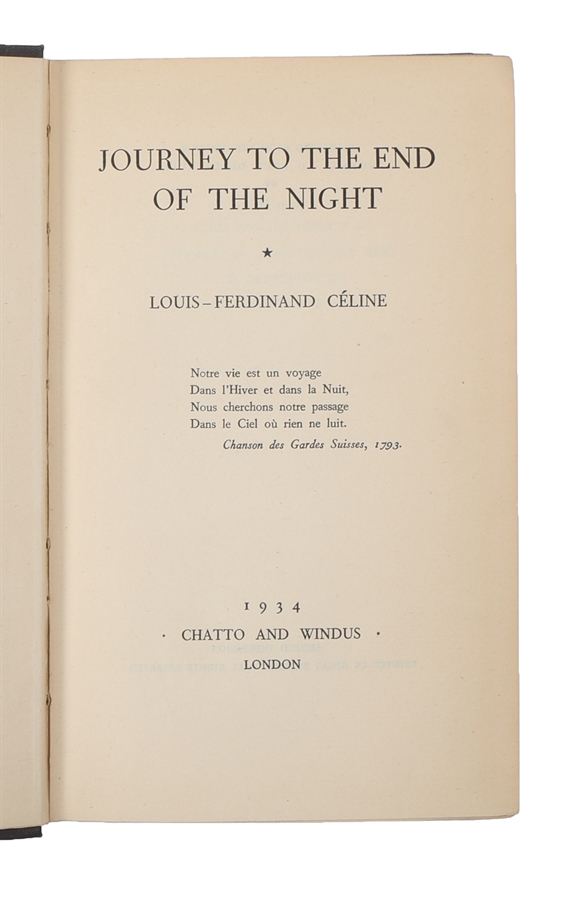
London, Chatto & Windus, 1934.
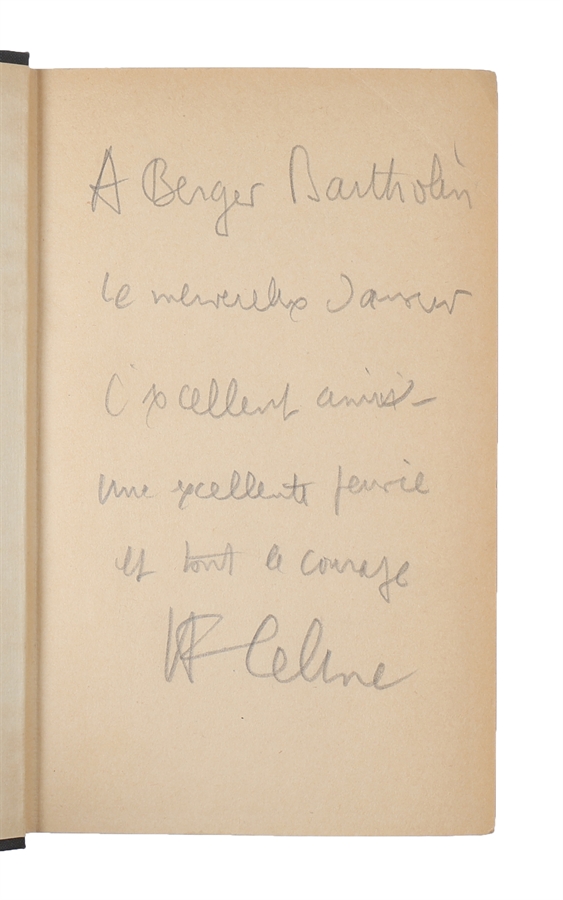
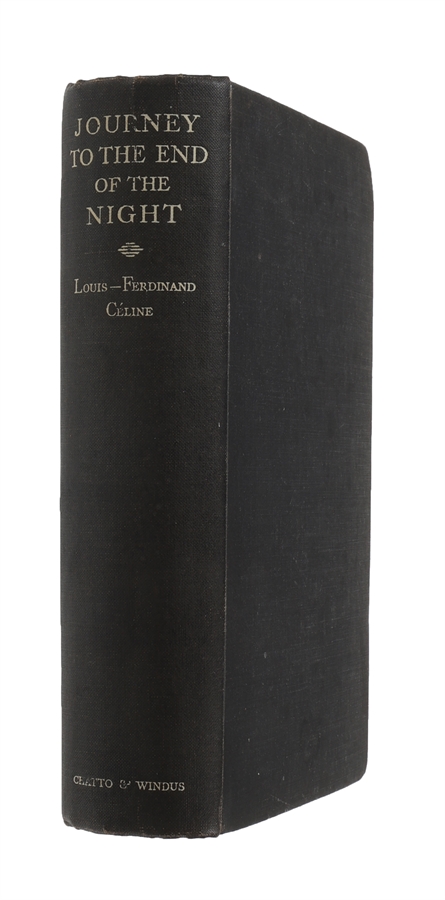
8vo. I the original full cloth binding with white lettering to spine. With author's presentation inscription in pencil to front free end-paper: "A Birger Bartholin / le meillure danseur / L'excellent ami / une excellent [illegible] / et tout de courage / LF Celine". Binding with light wear and and small vague stain, otherwise a nice and clean copy. (6), 543 pp.
Presentation copy of the first English translation of Céline's masterpiece of twentieth-century literature. This copy was given by Céline to the Danish ballet director Birger Bartholin (1900–1991), whom he met in London in May 1935. Bartholin would later play a central role in Céline's life during the turbulent years of his exile in Denmark. The dedication is not dated by it was arguably given shortly after they first meet in London. On 13 June 1936, through the intermediary of Boris Kochno, Céline proposed that Bartholin stage “Naissance d'une fée” (Birth of a Fairy). He sent Bartholin the manuscript, having already found an artist to design all the costumes, however, the project was never completed. "He is a little crook who shamelessly exploits us. He takes advantage of our miserable situation with complete impunity. [...] He is a filthy little Jewish thief, plagiarist, impotent, immensely pretentious and vain. He has plundered Lucette professionally with boundless audacity. He plays the master but knows nothing. He is the complete failure, embodying every vice and defect. Yet he is all that stands between us and total isolation. He is our mailbox. Ask him immediately for the 30,000 francs - without losing a single day. He would spend it all - in urinals. He belongs on the gallows." For further information on Céline and Bartholin’s relationship see: www.celineenphrases.fr
Celine, in 1945, arrived in Denmark and immediately re-established contact with Bartholin (whom he called Billy). He had his correspondence sent to the choreographer's address at 23 Herluf Trolles Gade under the name "H. Courtial.". During his stay Céline also proposed another, untitled ballet project to Bartholin (“Progrès”, later included in Œuvres pour la scène et l'écran) but the choreographer considered its storyline too oldfashioned.
In November 1945 the new French government applied for Céline's extradition for collaboration with the axis powers and the following month he was arrested and imprisoned at Vestre Prison by the Danish authorities pending the outcome of the application. He was released from prison in June 1947 on the condition that he would not leave Denmark.
While Céline was imprisoned Bartholin was entrusted with exchanging gold coins in Paris during his travels and he was supposed to hand over the proceeds to Marie Canavaggia. For unknown reasons Bartholin soon fell out of favour with Céline and December 1. 1945, Céline wrote to Marie Canavaggia:
The two never meet again.
Céline is today widely regarded as being one of the greatest French authors of the twentieth century and “Journey to the End of the Night” was ranked sixth on Le Monde's list of the 100 greatest novels of the twentieth century. The present copy arguably brings together the literary significance of one of the defining works of modern literature with an exceptional association to a seminal figure in Céline's controversial years of exile.
Order-nr.: 63358