
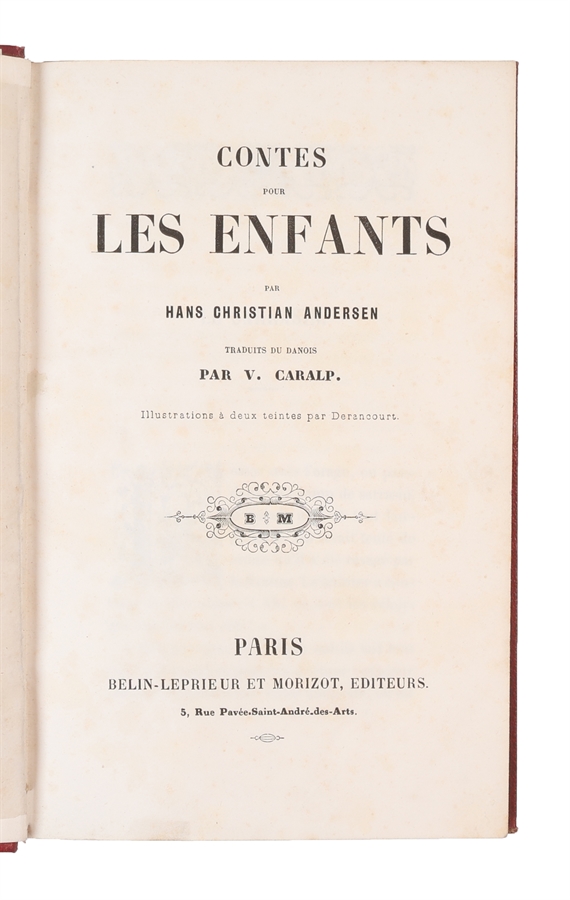
Paris, Morizot, (1848).
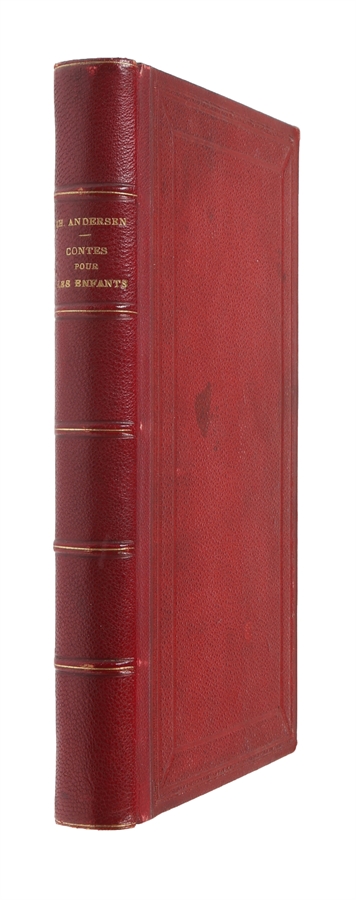
8vo. Very nice red half morocco with raised bands and gilt title to spine, red cloth to boards. A very nice copy with just light occasional brownspotting. (5), 329, (1) pp.
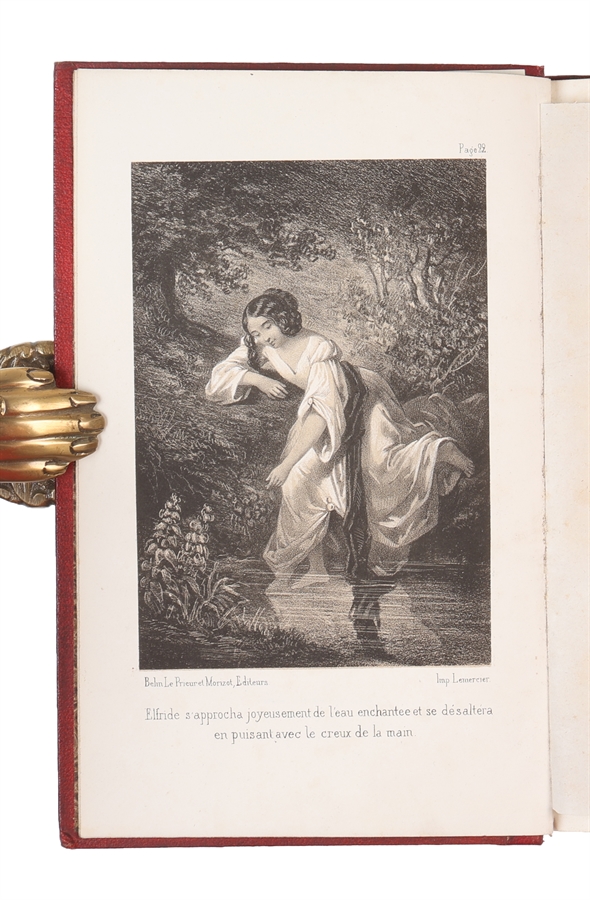
With 12 lithographic plates by C. Derancourt (active circa 1842–1871).
Extremely scarce first edition of the first translations of any of Hans Christian Andersen's fairy tales to appear in French. This first French Andersen-collection constitutes the introduction of Hans Christian Andersen's works in French literature, the introduction of the fairy tale genre in France and a cornerstone in the history French children's literature. According to Thomsen (2025), Andersen's work did not easily gain a foothold in France, although he was greatly inspired by French literature (2005: 16). It was through Andersen’s growing popularity in Germany in the early 1840’s that an interest was ignited in France – at the time the literary capital of the world (Thomsen 2025: 2). His success “lay in being compared with influential authors from both Germany and France, thus placing him in a European pantheon of writers” (Thomsen 2025: 10). In France, his first novel (translated to French in 1847) was compared to Madame de Staël’s Corinne, while his name was put alongside La Fontaine. “However, just as in Germany, where Andersen’s novels were placed in the context of an ongoing aesthetic debate, in which they represented something new, it is also the deviations from La Fontaine (1621-1695) that made the difference in France, according to Andersen himself. He had been advised to follow the French fairy tale patterns but chose not to, stating in this regard: ‘Had I followed the French patterns, I would hardly have been translated into French and placed alongside Lafontaine’ (Høybye)” (Thomsen 2025: 26) Additionally, Andersen himself played a big role in propagating his works abroad (see “the golden triangle”, Möller-Christensen 1993), as he consciously made himself available to the media via contacts in the literary world (Möller-Christensen 1991, see also Jørgensen 1996). Andersen visited Paris in 1843, where he had the opportunity for networking and self-promotion (Thomsen 2025: 3). While in Paris, Andersen made the acquaintance of several renown names: Heinrich Heine (1797-1856), a German writer and literary critic, Alexandre Dumas (1802-1870), Honoré de Balzac (1799-1850), Victor Hugo (1802- 1885) and Charles Reybaud (1802-1870). He frequently met with the writer Xavier Marmier (1808-1892), whom he had met in Copenhagen, and who was responsible for introducing Andersen to the French literary scene with an article six years prior (Thomsen 2025: 3). “In Marmier, Andersen found a gatekeeper not only to the French literary audience but to the European public”; he was “largely responsible for popularizing the impactful fiction about the poor boy destined by higher powers to become a world-famous author” (Thomsen 2025: 17). The translator of the first French edition of Andersen’s fairy tales was Françoi Garay (1796-1873), under the pseudonym V. Caralp. According to Høybye (1952), he was “a literary robber who also appears under the pseudonyms Eugène de Monglan, Albert Deville and Maurice Dufresne” [own translation]. At least in this edition, Caralp gave the credit to the author. Andersen placed an enormous importance on the translations of his work, which, to him, were a visible sign of recognition. During his travels he sometimes found his own work translated. He did not own a complete collection of French translations, as he didn’t always receive a copy. (see Høybye 1952) This first translation of Andersen’s fairy tales was, as with many other translations, based upon the German. It was not until 1856 that there appeared French translations directly from Danish. A study showed that the 14 tales in the present collection were made based on three different German translators’ work: 9 from Petit (1845), 4 from Reuscher (1844-45), and one from Jenssen (1838) (see Høybye 1952). Interestingly, in the autobiography The Fairy Tale of My Life, Andersen observes that, in Petit’s German translation, “The Ugly Duckling” (original: Den Grimme Ælling) was translated to “grüne Ente”, and from there to the French “le petit Canard Vert” (lit: “the little green duck”) (Høybye 1952), as is the case in Caralp’s translation.
Order-nr.: 63462