
(Munich), Prometheus, (1947).
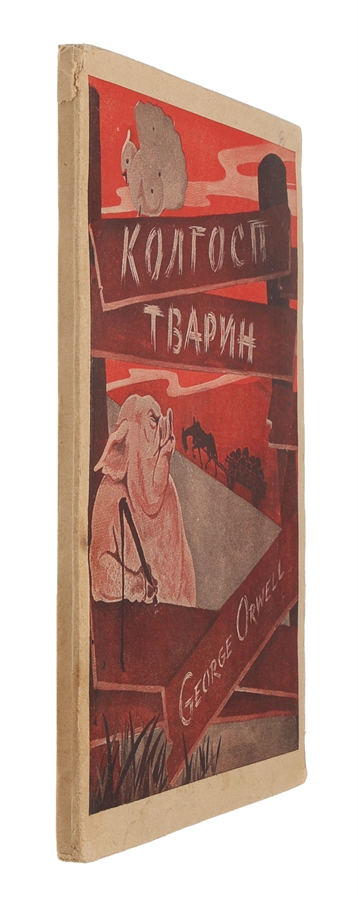
Original printed pictorial wrappers. In excellent condition with just slight edge wear and a small bump to upper capital. Internally also en very nice condition. Bookseller stamp to front free end-paper: Ukranian Book Store, Edmonton, Alberta. With portrait of Orwell after the preface.
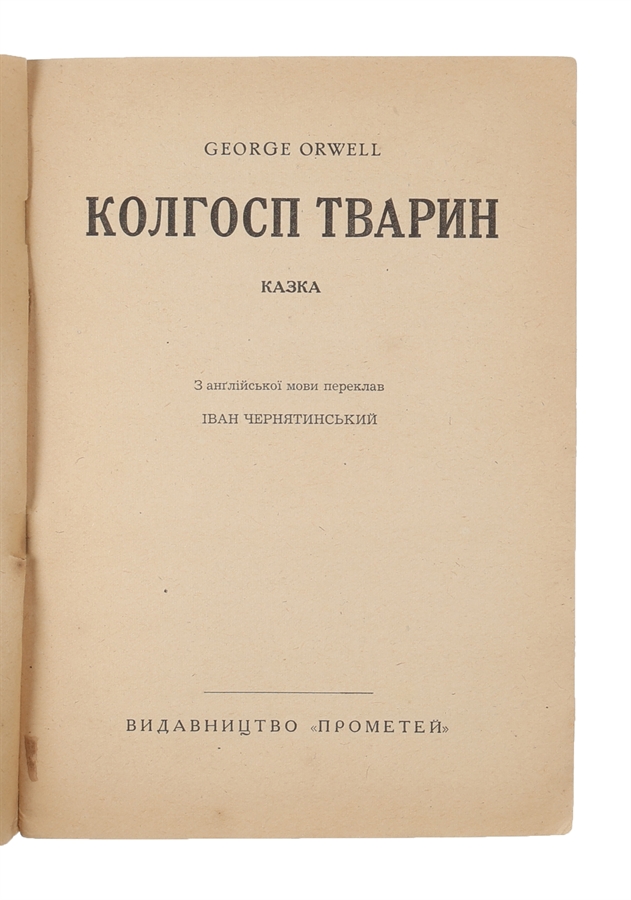
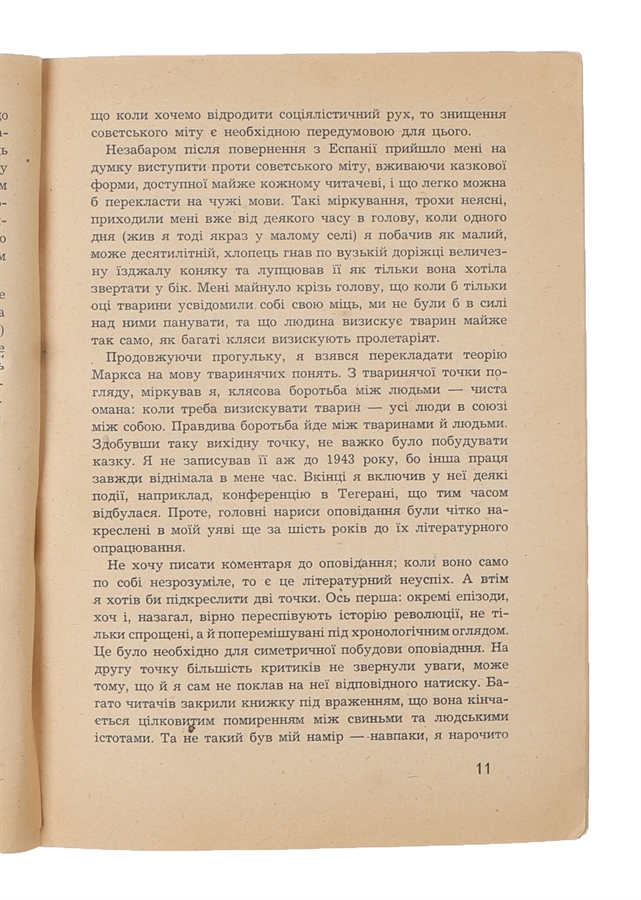
Scarce first edition of the first Ukrainian translation of Animal Farm, being the only edition of Orwell’s masterpiece with a personal preface written by the author. Needless to say, Animal Farm constitutes one of the most important literary works of the 20th century. The satirical-political masterpiece magnificently reflects the events leading up to the Russian Revolution and brilliantly caricatures Stalinism. As Orwell himself put it, with this work, he deliberately tried "to fuse political purpose and artistic purpose into one whole". (Orwell, "Why I Write"). George Orwell’s (1903-1950) Animal Farm was translated into Ukrainian by Ihor Ševcenko (1922-2009) – a Polish-born Ukrainian scholar, at the time residing in Germany – under the pseudonym Ivan Cherniatyns’kyi. The book was published by the Ukrainian publisher Prometheus in Munich in 1947. The Ukrainian title, Kolhosp Tvaryn (i.e. eng.: “A Collective Farm of Animals”) – a reference to Stalin’s collective farms (kolkhozy) – is deliberately not a literal translation, and “[a] brief examination of Ševcenko’s translation reveals that while his choices were distinctly loyal to the original English text, they simultaneously deepen the political allegory and expand the fairy tale tradition of the novel by domesticating certain aspects of the text through specific references to the Soviet Union and Ukrainian folktales.” (Gor, 2025, p. 18). The text “offered momentary solidarity, unity, and comfort to displaced Ukrainians through its loyal translation and parallel intentions between the source text and the translation” (Gor, 2025, pp. 3-4). At the time of the publication of Animal Farm, Ševcenko was regularly participating in the intellectual spheres of the Ukrainian Displaced Persons camps in Munich. There, he began sight-translating (i.e. without preparation) Animal Farm for camp residents. In April 1946, he wrote to Orwell requesting permission to publish the novel in Ukrainian. Among other things, he wrote to Orwell that "‘Soviet refugees were my listeners. The effect was striking. They approved of almost all your interpretations. They were profoundly affected by such scenes as that of animals singing "Beasts of England" on the hill. Here I saw that apart from their attention being primarily drawn on detecting "concordances" between the reality they lived in and the tale, they visibly reacted to the absolute values of the book, to the tale types, to the underlying convictions of the author and so on. Besides, the mood of the book seems to correspond with their own actual state of mind... [T]he attitude of the Western World in many recent issues roused serious doubts among our refugees, who wondered how it were possible that nobody “knew the truth”’...Your bookhas solved the problem." (Szewczenko to Orwell, 11 April 1946, XVIII, 236). Orwell immediately agreed to the translation, refused any royalties, and later also agreed to write a preface for it (Tatara, 2012; Gor, 2025, p. 14). "Although ‘frightfully busy’ Orwell did write this preface, which forever remained his most detailed explanation of the motives behind the “fairy story”. (Masha Karp: On the Ukranian Trnaslation of Animal Farm, the Orwell Foundation, 2022). The Ukrainian edition is especially interesting, not only because of its genesis, but also because it is the only edition of Orwell’s masterpiece with a personal preface written by the author, with the most detailed explanation of the motives behind the Animal Farm. In this context, it is worth noting that Orwell’s original version of the preface in English has been lost, and the only version surviving is the one he wrote for the Ukrainian translation. For the first edition in English, Orwell had intended to include his essay “Freedom of the Press” as a preface, but this was possibly rejected by the publishers. Overall, Orwell faced many obstacles when first publishing Animal Farm: It was rejected for almost a year by publishers, afraid of the criticism of England’s Soviet ally (Gor, 2025), and a preface never appeared. The small Ukranian printing press Promethius managed a print-run of 5.000 copies of the first edition of the Ukranian translation, but a mere 2.000 ended up being distributed throughout DP camps in and around Munich. The remaining copies were confiscated by the US military, who feared that it would be considered anti-Soviet propaganda and would jepardize the relationship with Stalin as the ally, who had helped defeat Hitler. The Americans thus handed over the confiscated copies to the Soviet authorities, who desctroyed them. Animal Farm was written between late 1943 and early 1944, when the wartime alliance with the Soviet Union was at its height and Stalin was held in highest esteem in Britain, among both the people and intelligentsia. Not surprisingly, it was initially rejected by both British and American publishers, and the publication of it was thus delayed. When it did appear, it became a great commercial success, however, probably not least due to the soon to follow Cold War. In his Ukranian preface, Orwell explains that 'It was of the utmost importance to me that people in Western Europe should see the Soviet régime for what it really was. Since 1930 I had seen little evidence that the USSR was progressing towards anything that one could truly call Socialism. On the contrary, I was struck by clear signs of its transformation into a hierarchical society, in which the rulers have no more reason to give up their power than any other ruling class. "Having explained ‘why ‘totalitarianism is completely incomprehensible… to the workers and intelligentsia in a country like England’, Orwell named as the aim of his book ‘the destruction of the Soviet myth …essential’, he insisted, ‘for a revival of the Socialist movement’. (Orwell Foundation, 2022). The work is generally considered one of the best and most influential literary productions of the 20th century. References: Chalupa, Andrea (2012, March 7). How ‘Animal Farm’ Gave Hope to Stalin’s Refugees. Andrea Chalupa. Tatara, Halyna. (2012, July 31). George Orwell and the Ukrainian refugees: the untold story of Animal Farm. Ukrainian Institute London. The Orwell Foundation. (2022, March 15). Masha Karp on the Ukrainian translation of Animal Farm. The Orwell Foundation. The Orwell Foundation. Preface to the Ukrainian Edition of Animal Farm. Gor, Diana. (2025). Found in Translation: George Orwell's Animal Farm in Ukrainian. [Capstone project, Stanford University].
Animal Farm brilliantly portrays not only the corruption of the revolution, but also how traits of human character themselves corrupt society. The greatest flaw of revolution is not the corrupt leadership on its own, but also the greed, indifference, ignorance, shortsightedness, wickedness, etc. that govern the individuals that make up the masses.
The original subtitle "A Fairy Story" was dropped when the book was published in the United States, and all but one of the translations omitted it.
Order-nr.: 63493