
Kjöbenhavn, [1822].
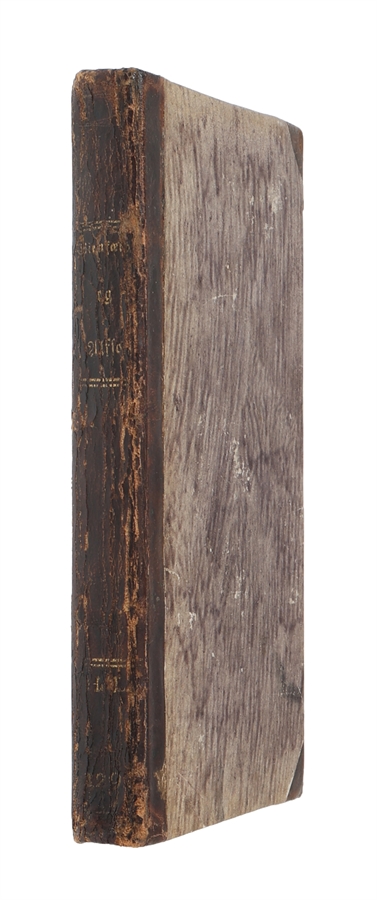
Strictly contemporary brown half calf with boards in a grey/dark grey simple pattern. Quite worn with cracks along the spine but intact. Ex-libris on inside front cover: "Christoffersen" in gothic letters in pencil.
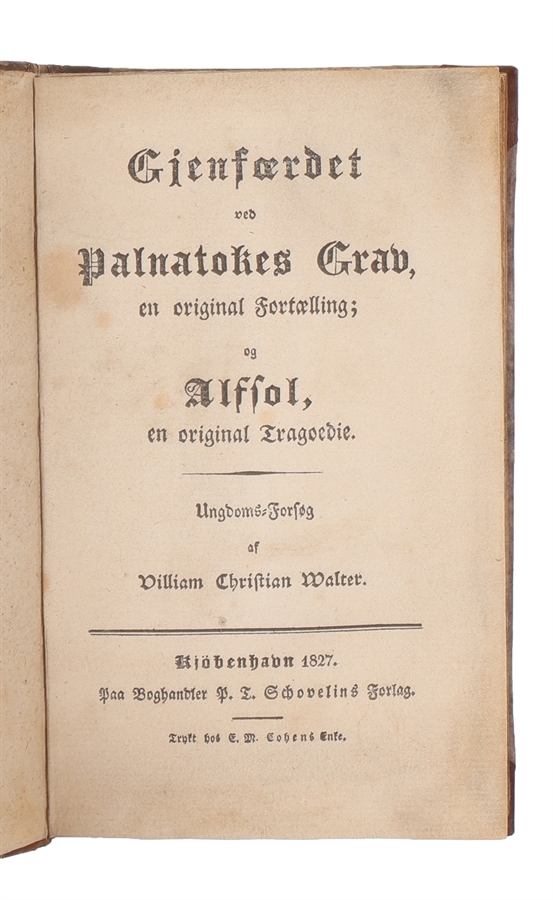
A copy that has been used and completely worn and then later saved by restoration, retaining the old spine and corners, and impressive professional facsimiles made from the copy of the book in the Royal Library in Copenhagen. Apparently, the present copy was a book club copy and bears contemporary annotations to the back free end-paper. When the copy resurfaced around 1970 (after having been stowed away in a box in the town of Jelling for decades), the new owner "saved" it by having it professionally restored, which is extremely well done. The strictly contemporary binding has been restored by the renowned book binder Birgitte Dall (1912-1989). With the help of the Royal Library in Copenhagen Birgitte Dall had truly excellent facsimiles made, printed on old paper, to replace the missing leaves.
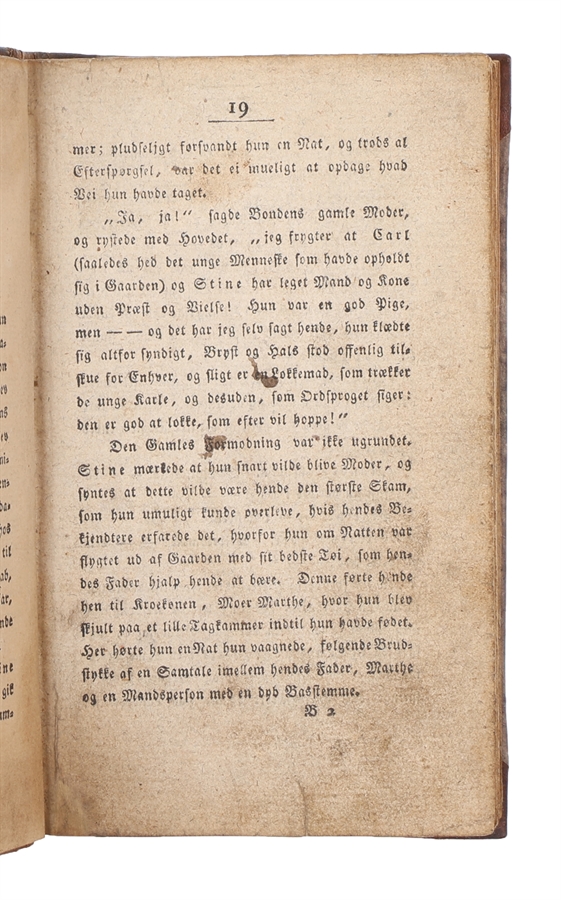
The following pages have been replaced: Title-page + pp. 1-2, 3-4, 13-14, 15-16, 17-18, 177-78, 179 (the last being the contents-leaf, printed on recto only) - in all 8 ff. Pp. 173-74 has been torn down the middle and is missing ab. half; this leaf is present, but a facsimile has also been inserted. Six other leaves have been excellently restored, with no loss of text.
There are six facsimile-leaves: the title-page, made from the title-page of the title-issue of 1827, the contents-leaf, and further four leaves. The remaining leaves are original leaves of the 1822-issue
The extremely rare first printing of Hans Christian Andersen's first book (Ungdoms-Forsøg) – with facsimiles of the title-page, the contents-leaf and a further four leaves. No more than about ten copies of the first issue and the title-issue, which appeared in 1827, are known to exist – only a couple of them are known in private collections, and less than a handful of copies are known outside of Denmark. The present publication, his first book, is of immense importance to Andersen's life and work and is arguably THE most important piece of Anderseniana. One copy of the 1822-issue with an extra 1827-title-page is in a private collection, and the Jean Hersholt-collection has a copy with the title-page and the contents in facsimile (like the present copy, it is coincidental whether these facsimilies are taken from the title-issue or the first issue). Two other copies are in the public Danish collections, in The Royal Library in Copenhagen and the Andersen Museum in Odense. Of the 1827-title-issue, there is a copy in Princeton University Library (formerly from Odense) and one in The Houghton Library. There are four copies in Danish libraries: The Royal Library in Copenhagen, the Andersen Museum in Odense, the Library of State in Aarhus, and Soroe Academy Library. In private collections, the only known copies are limited to about four, including the present. H.C. Andersen made his début as a writer three times during his youth, the first time being in 1822, when he was only 17 years old. Besides the prologue, his “Youthful Attempts” included a novelette (“The Specter at Palnatoke's Grave”) and a 5-act tragedy in blank verse (“Alfsol”): “How immature the tragedy ‘Alfsol’ and the tale of the ghost might seem, they paved the way for him to further education. He was 17 years old, penniless and in need for help, but the main part of the circulation ended up in the paper mill, and for some time the young poet rendered himself guilty with regard to the printer's widow. To this first painful experience one may trace back the ever-recurring motifs in his narratives that all poetry end up in the rubbish bin." (Kofoed, 1999). When Andersen managed to get his book published in 1822, with E.M. Cohen's Widow, almost no copies were sold, nor in the years to follow. In fact, Mrs. Cohen did not manage to sell a single copy of the book, and, in 1827, she sold the entire edition of the remaining copies (300, minus the 17 copies Andersen himself had disposed of) to another publisher, P.T. Schovelin, who printed a new title for the book. The title-page of 1822 and the printed dedication to the Board of the Royal Theatre plus the table of content at the end of the book were removed and substituted by a new title-page followed by a table of contents. The new title was Gjenfærdet ved Palnatokes Grav, en Original Fortælling; og Alfsol, en original Tragoedie. Ungdoms=Forsøg af Villiam Christian Walther (i.e. "The Spectre at Palnatoke's Grave, an original Novel, and Alfsol, an Original Tragedy. Youthful attempts by Villiam Christian Walther"). This title-issue was also unsuccessful, even though he advertised the book on three different occasions. In desperation, he sold it all to a local grocery store, where it ended up as wrapping paper. (Jean Hersholt) In his autobiography, "My Life's Fairy Tale", Andersen tells how he came up with his pseudonym and how he managed to have the book printed: "I had a young friend from my home town, Odense, who worked for a small printer's shop called 'E. M. Cohen's Widow'. He promised me if I could obtain enough subscription he would print the book in his spare time. As I loved William Shakespeare and Walter Scott, and I loved myself too, I had the book published under the pseudonym of William Christian Walter". Walter Scott’s novels were being translated into Danish during these years, and thus, “[…] the young man tried to tie his destiny to two of the most famous poets of European literature, William Shakespeare and Walter Scott.” (Kofoed, 1999). Andersen began approaching everyone in order to get enough subscriptions and money for the printing and miraculously managed to see his first book go to the press: "No shrewd businesswoman, Mrs. Cohen let herself be sold on the idea to publish Andersen's first little book. It was during this time of his life that Andersen evidenced one of his most important faculties – the ability and nerve to ask anyone for anything he desired at any time. Not satisfied with general book buyers, he practically confined his soliciting to the Royal Court, starting with the Crown Princess and working down the list to bishops, professors and educators. His sales campaign was hardly successful, for he disposed of only seventeen copies." (Jean Hersholt). Hans Christian Andersen constitutes the greatest Danish author ever to have lived, arguably the greatest author of children's literature in the world, the founder of the fairy tale-genre and one of the most famous authors of all time. He almost singlehandedly put Denmark on the literary world map and gave to mankind a completely new way of writing and viewing the world. "Very few authors have so endeared themselves to the people of every county in the world as has Hans Christian Andersen. Yet Andersen did not set out to be a teller of fairy tales, but rather to be a serious novelist, a writer of heroic dramas.” (Jean Hersholt). His road to fame was not straightforward and presumably, no one who made the acquaintance of the awkward and poor teenage Hans Christian Andersen would have predicted the role he came to play in the development of world literature. Growing up in a very poor family, the impressions and experiences he received throughout the first 14 years of his life were to be decisive for his literary production: “In the autobiography of his youth, Levnedsbogen (not published till 1926), Andersen emphasised that the way of life in Odense had preserved popular old customs and superstitions unknown in Copenhagen and therefore available to him as a colourful stimulus to his imagination. However, even more decisive were the disturbing social experiences from the lowest ranks of society and his own urge to cast off the trammels of poverty, break with his social inheritance and realise his potential in the only outlet the times provided, the world of art, an urge that became ever more dominant throughout his childhood.” (Mylius) One of the decisive factors that determined the direction of H.C. Andersen’s life was the fact that Odense, as the only other town outside the capital, had a theatre. Besides being exposed to books at home, he also had contact with the theatre in Odense. In Sepember 1819, at the age of 14, Andersen left Odense to seek his fortune at the theatre in Copenhagen. There, “he fought desperately to gain a foothold in the theatre as a ballet-dancer, actor or singer. Finally, when none of these attempts succeeded, he tried his hand as a playwright; this was also in vain but resulted in the director's deciding to send him to school so that something proper might be made of him, and this experience was thus as decisive for his later life and work as the Odense years." (Mylius). It was here, in Copenhagen, during the early theatre years, after he had been cast aside as an actor, cast aside as a dancer, and cast aside as a singer that he wrote his groundbreaking play "Alfsol", which he handed in to the theatre in order to have it accepted for performance. But that too was cast aside, with the explanation that the author lacked all forms of education and had clearly never learned to write properly. As Hersholt puts it, “even at this age he had already had a varied but rather dubious career." (Jean Hersholt). Dean Gutfeld, however, had gotten to know Andersen and saw the potential in the young boy. Therefore, Gutfeld spoke well of the uneducated boy and had asked the theatre director, Collin, to look mercifully at it. "A well-liked speaker, Dean Guffeld was alive then and was the one person that spoke most warmly and enthusiastically about my tragedy, which had now been completed. He sent it with a recommendation to the theatre direction and I was floating between hope and fear." (own translation from Andersen 1942: p. 46). Collin still refused the play, but it was this act of Gutfeld's that made Collin take an interest in Andersen and made him take him under his wings – if any, THE decisive moment in Andesen's life. Collin arranged that, at the expenses of the King, Andersen was sent to Slagelse Latinskole to get proper training and education. In the fall of 1822, Andersen left Copenhagen to go to Slagelse. From then on and throughout the rest of his life, Collin was his benefactor in all aspects of his life. Andersen came to consider him the closest to a father that he had, Collin's home became Andersen's home, and Collin's children his siblings and closest friends throughout his life. As mentioned, the book is exceedingly rare and only a couple of copies are known in private collections. Less than a handful of copies are known outside of Denmark. BFN: 2; Hersholt: 19.
Order-nr.: 63452