
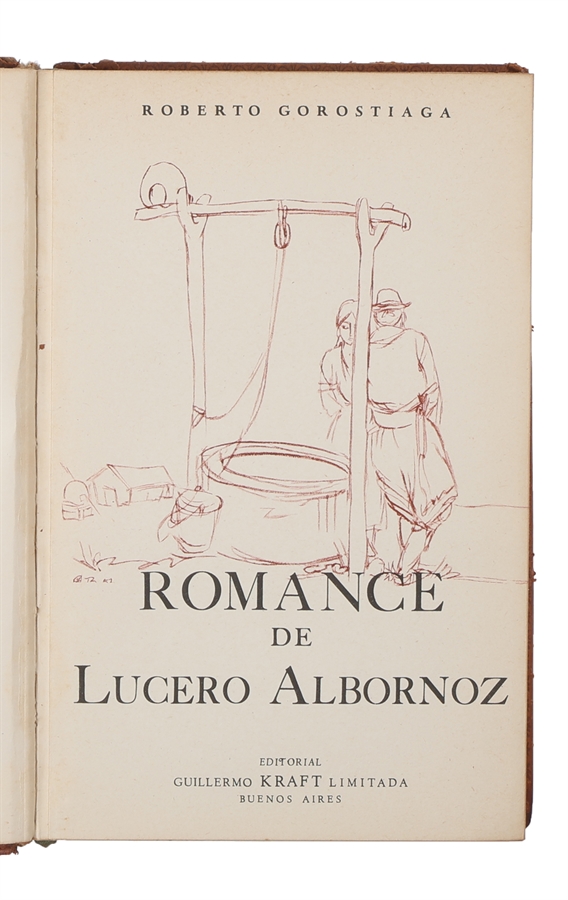
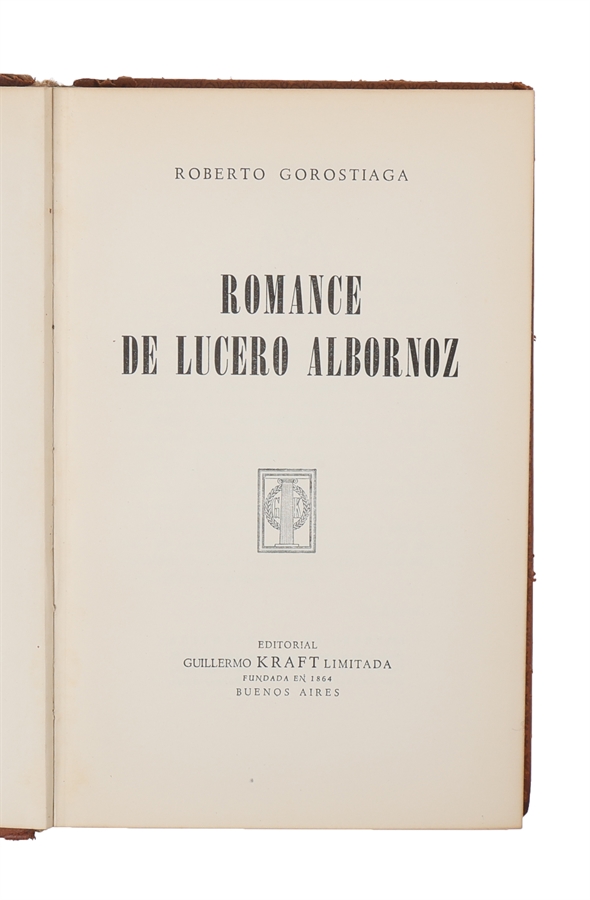
Buenos Aires, Guillermo Kraft Limitada, (1954).
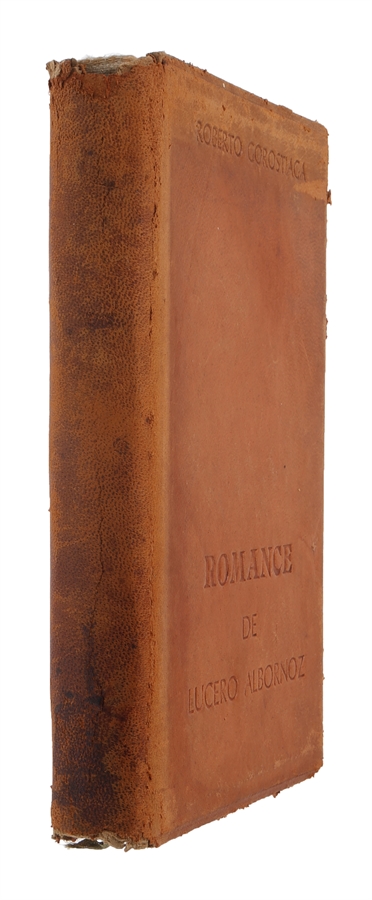
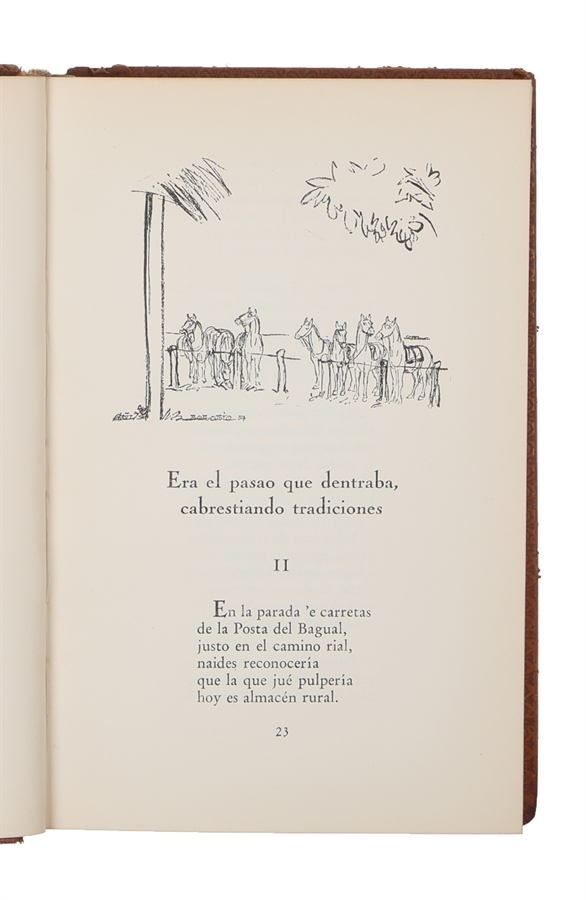
8vo. Bound with the original printed front wrapper in a sturdy, contemporary full calf binding with blindstamped lettering to front board. Inner blindstamped dentelles. Spine worn and capitals missing a bit of leather. General wear to edges. Internally very fresh and clean. Old owner's name to front free end-paper. Illustrated. 274, (1) pp.
First edition, numbered copy (2225) of a scarce collector's book, a romance in verse by Roberto Gorostiaga (1893–1966), an Argentinian civil engineer and poet. Romance de Lucero Albornoz belongs to the genre of gaucho literature: a Spanish American poetic genre that was prevalent in South America in the 19th century, continuing into the early 20th century, also in prosaic work such as novels by Benito Lynch (1885-1951) and Ricardo Güirales (1886-1927). The term gaucho originates from the time of the Spanish colonialisation of the Plata region and was used to denote a class of illegal hunters of cow and horse hides, who in exchange smuggled into the country contraband goods, particularly during the period of 1775-1875 (Nichols 1968: 3-4). With the success that gauchos came to have, and particularly the influence they had in the winning of the independence (i.e. the Argentine war of independence, 1810-1825), and thanks to the gaucho literature, gauchos came to have a positive connotation, and even became the national heroe. According to Nichols (1968), "while the so-called gaucho literature does not portray the real gaucho, it has caused that real gaucho to be forgotten. Only the gaucho of romance lives on" (1968: 4). According to Stavans (2019): "Gauchos were itinerant, horse-riding, mestizo cattle workers who from the late 18th century to the early 20th lived in the pampas, in the territories where Argentina, Uruguay, and Brazil meet. This population developed its own customs, which included dressing in unique fashion, expounding a life of marginalization, courage, and revenge, and telling their adventures through ballads. [...] All discussion of gaucho literature is, implicitly, about identity, nativism, and authenticity. At the core of that discussion is a debate, led by Jorge Luis Borges, on the difference between what is “gaucho” and “gauchesco.” The former is the gaucho’s authentic viewpoint, as told by himself. The latter is an adulterated version delivered by a city dweller on behalf of gauchos." (Stavans 2019) Stavans, Ilan, 'Gaucho Literature' (24 Apr. 2019), in Marcela Echeverri Muñoz (ed.), Oxford Bibliographies in Latin American Studies.
The present work follows the Don Lucero Albornoz, as told by a third person narrator.
Nichols, Madaline Wallis. (1968). The Gaucho: Cattle Hunter, Cavalryman, Ideal of Romance. New York: Gordian Press.
Order-nr.: 63391