
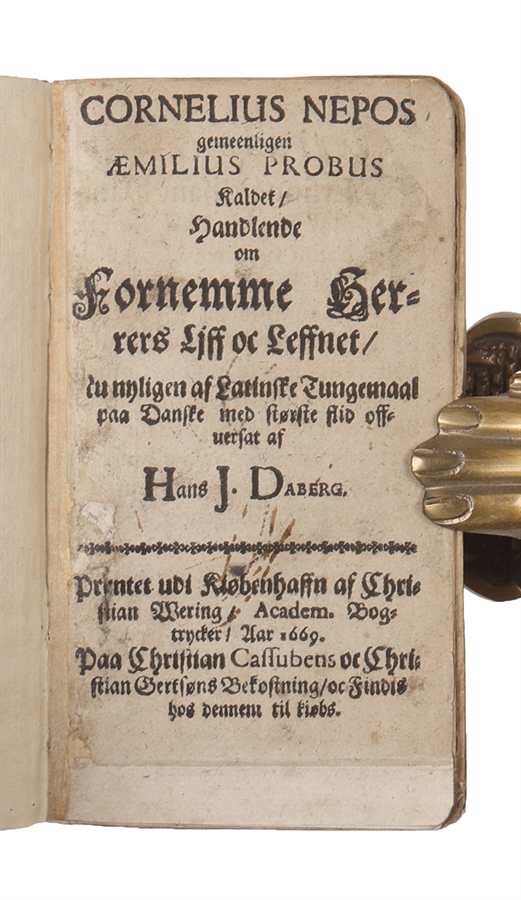
Kiøbenhaffn (Copenhagen), Christian Wering, 1669.
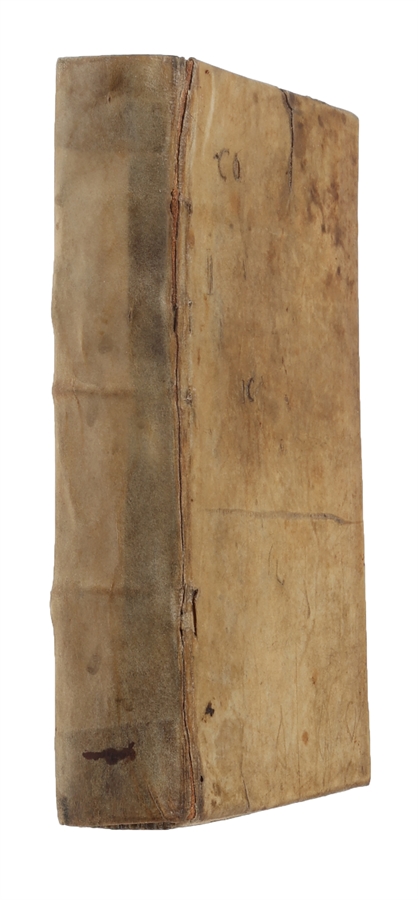
12mo. Inserted into a contemporary full vellum binding (for a block with an originally thicker spine), this with a folding line down the back board, towards the spine and small holes from the original cordsFront hinge restored and a closed tear to top of front board. Binding with a bit of wear,m soilinbg, and small (initial and heart) incisions. A bit of edge wear and text block with rounded edges. Fore edge with incision. First few leaves re-hinged and with a few smaller restorations towards hinge, with tiny loss of a few letters to first leaf. First three leaves restored at lower blank margin, no loss. A2 tightly bound/slightly stuch at previous leaf, so inner margin slightly damaged, but legible. Clean and neat with few ink stains and some wear. Bottom corners of pp. 209-220 damaged, except for the last, where there is loss of a few letters, the marginal corner is blank. Verso of last leaf soiled. Accasional ealy annotations. (8), 256 pp.
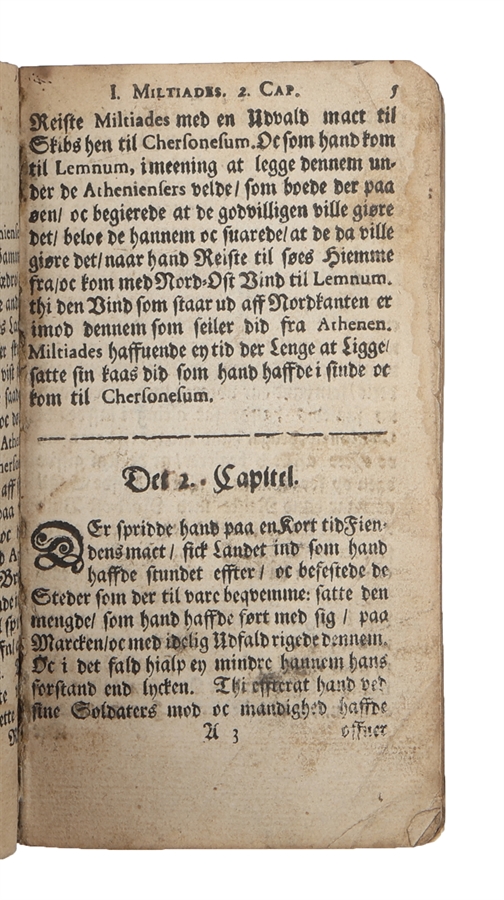
Exceedingly scarce first translation into Danish of Nepos' biographical magnum opus, De viris illustribus, preceding the appearnace of the first English translation by 15 years ("Lives of Illustrious Men: Written in Latin by Corn. Nepos, And Done into English by Several Hands” - 1684). Cornelius Nepos (c. 100-25 BC) was a Roman historian and biographer. He was a correspondent and friend of Cicero and Atticus, and he had poems dedicated to him by Catullus (84-54 BC). One of Nepos' main works consisted of (at least) sixteen books titled De Viris illustribus, where he described the lives of distinguished Romans and foreigners. Only one complete book is thought to survive: “Excellentium imperatorum vitae”. It covers commanders and generals (imperatores). This was translated into Danish by Hans J. Daberg and published in 1669. The Danish edition contains 25 descriptions (chapter XXII is not in the table of contents, but present): Miltiades, Themistocles, Aristides, Pausanias, Cimon, Lysander, Alcibiades, Thrasybulus, Conon, Dion, Iphicrates, Chabrias, Timotheus, Datames, Epaminondas, Pelopidas, Agesilaus, Eumenes, Phocion, Timoleon, Kongerne ("The Kings"), Hamilcar (not mentioned in the table of contents, but present in the text, p. 194), Hannibal, Cato, and Atticus. This book appeared again later, between 347-395 AD, under a different author’s name, namely that of the grammarian Aemilius Probus. The French philologist Dionysius Lambinus (1520-1572) argued in his 1569 edition, on stylistic grounds, that the work belonged to Nepos and not Probus, which is now generally accepted. Baden, Gustav Ludvig (1816) Fortegnelse paa de romerske og græske Klassiker, som haves oversatte i det Danske Sprog Udgivet år og sted. Kjøbenhavn: Joh. Fred. Schultz. https://www.kb.dk/e-mat/dod/130020102420.pdf Britannica Editors (2024, March 28). Cornelius Nepos. Encyclopedia Britannica. https://www.britannica.com/biography/Cornelius-Nepos Batstone, W. W. (1998). Dry Pumice and the Programmatic Language of Catullus 1. Classical Philology, 93(2), 125–135. http://www.jstor.org/stable/270355
Sources and further reading:
Order-nr.: 63554