

Paris, Dondey-Dupré, 1823.
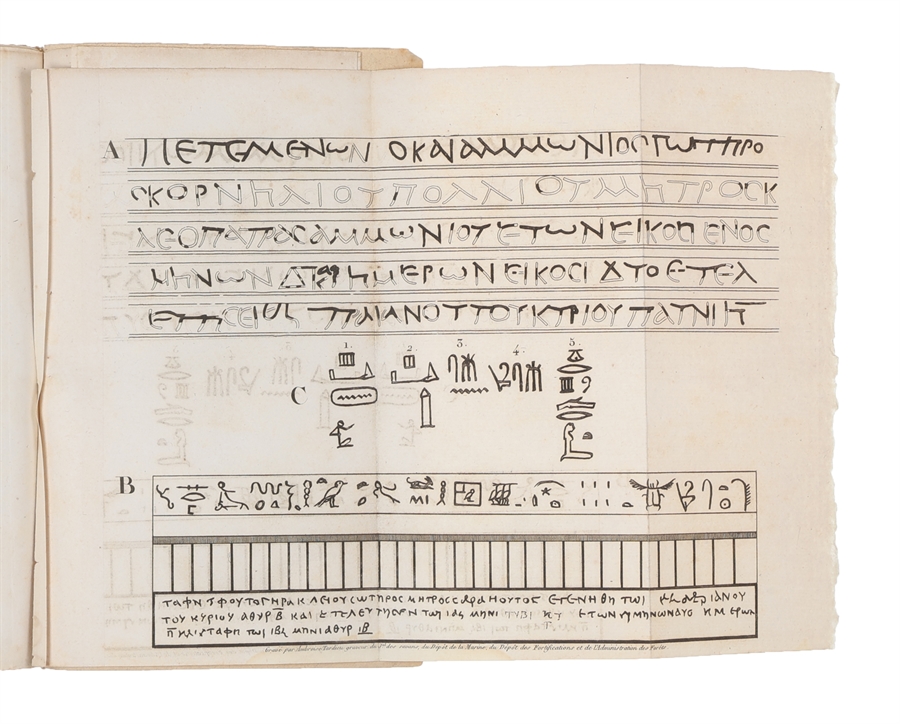
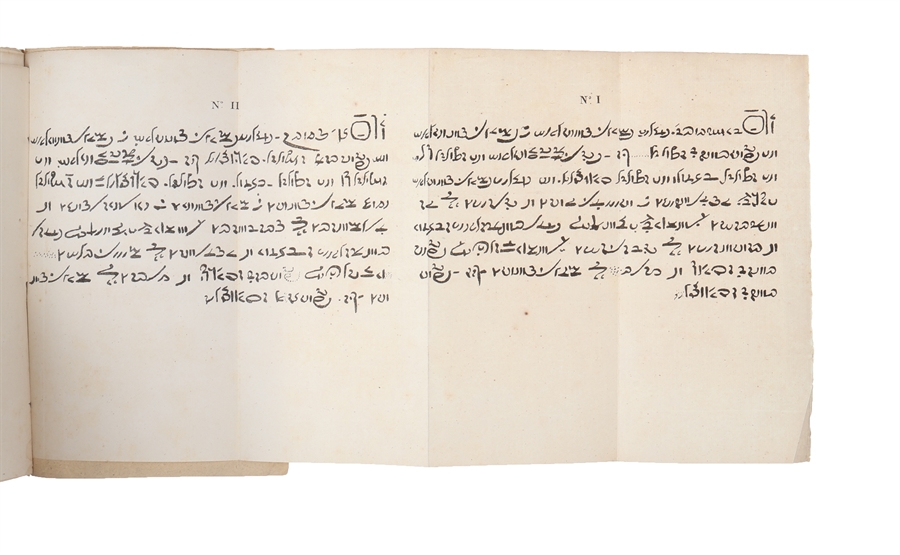
8vo. Uncut in contemporary blank wrappers with contemporary handwritten name to front wrapper. A bit of brownspotting. Pp. (2), 32 pp. + two folded engraved plates.
Scarce first edition, offprint from "Journal Asiatique", of Champollion-Figeac's study of two highly important Egyptian contracts written in Demotic script, dating to the reign of Ptolemy Epiphanes: one from year 4 (200 BC) and one from year 8 (196 BC) of his reign – preceding the Rosetta Stone inscription, from year 9 of the same reign. All three documents contain the names of the same priests and priestesses. These two inscriptions not only provide further highly valuable historical information about the period, they also shed new light on important passages on the Rosetta Stone. The French translation of the two protocols – that is, the standardized opening formula that identified the legal document, the date, and the reigning monarch – and an analogous passage in the Rosetta Stone is found on pages 6-7. Champollion-Figeac explains the following: “[…] the custom adopted in drafting public acts in Egypt during the Ptolemaic period: to mention in their protocol not only the year of the reign and the surname of the reigning sovereign, but also several priests or priestesses, foremost among them the priest of Alexander the Great […] whose name is followed in these contracts by the names of all the Ptolemaic kings who had died since Alexander and were associated with his honors, up to the reigning king. Thus, the protocol in public acts of some importance, and therefore more carefully written, provides the genealogical and chronological series of the Ptolemaic kings, and these documents are very valuable for their history” (p. 3) Champollion-Figeac examines whether this can shed light on “the reign of Ptolemy Epiphanes in particular, and, in general, about the status, in Egypt, of priests in charge of the posthumous cult of the kings and queens who were his ancestors” (pp. 4-5; p. 31). The examined passages help shed light on the two surnames of Ptolemy V – Epiphanes and Eucharist – and the order in which he acquired them: “the comparison of the contracts with the Rosetta Stone inscription proves that he only took that of Epiphanes (illustrious or manifest) upon his accession” (pp. 29-30). Furthermore, his study helps explain, in a new way, two important passages of the Rosetta Stone inscription. Jacques-Joseph Champollion-Figeac (1778-1867), elder brother of Jean-Francois Champollion (decipherer of the Rosetta Stone) was a French librarian and paleographer. He was professor of Greek and a librarian at the University of Grenoble but lost the position for supporting Napoleon during the Hundred Days. He later became the curator of manuscripts at the Bibliothèque Nationale and professor at the École des Chartes (school of paleography), Paris. In 1849, Champollion-Figeac became librarian of the palace at Fontainebleau. (britannica.com) Ptolemy Epiphanes Eucharist, or Ptolemy V Epiphanes, (born c. 210—died 180 BCE) was a Macedonian king of Egypt from 205 BCE. In 196 he promulgated the decree inscribed on the Rosetta Stone, which was deciphered largely by Thomas Young and Jean-François Champollion, the younger brother of Champollion-Figeac. Demotic script is an ancient Egyptian cursive script used in 7th-5th century BCE. By the 5th century it was used throughout Egypt for business and literary purposes but began to be displaced by Greek during the Ptolemaic period (304-30 BCE). See also: Britannica Editors. "Rosetta Stone". Encyclopedia Britannica, 14 Feb. 2026, https://www.britannica.com/topic/Rosetta-Stone. Accessed 26 May 2026.
Order-nr.: 63220