
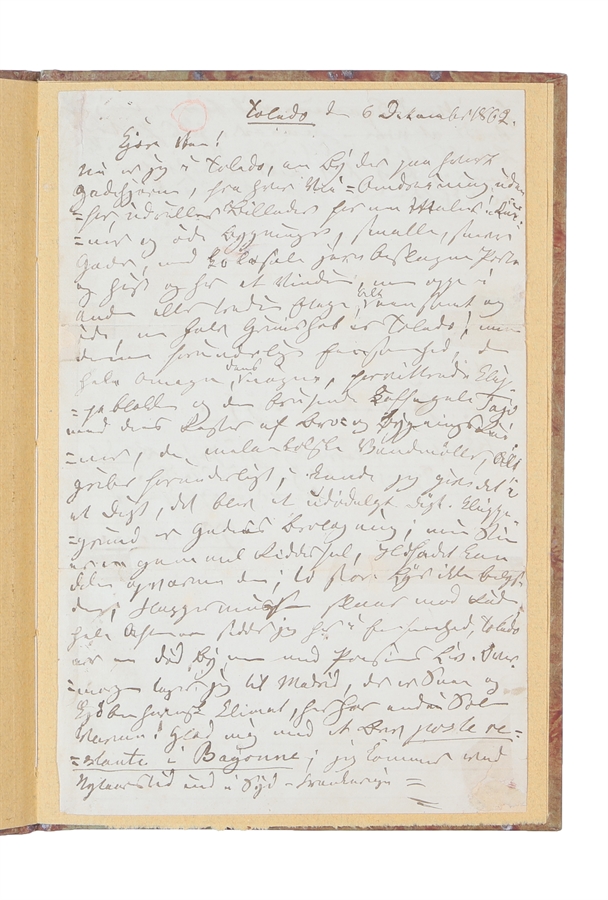
Dated "Toledo den 6 December 1862".
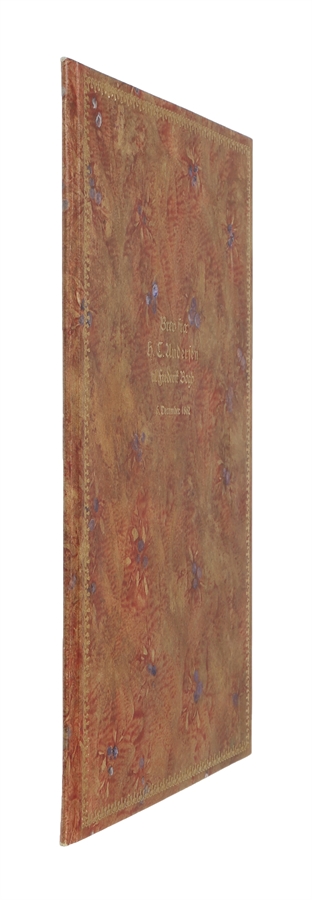
1 ½ pages 8vo. In a beautiful marbled paper binding with gilt ornamental borders to boards and gilt lettering to front board (signed Rigmor Birkedal Kragh). A few marginal restorations, else excellent condition.
A splendid original letter from Toledo, which Andersen paints so clearly as only he can. “Toledo is a dead city, but with the life of poetry”, he writes, after having described in detail, to his dear friend back home, the ruins and the melancholy that is Toledo. The letter is registered in the Andersen letter database. The full contents are: ”Kjære Ven! Nu er jeg i Toledo, en By der paa hvert Gadehjørne, fra hver Vei-Omdreining, udviser, udruller Billeder for en Maler! Ruiner og øde Bygninger, smalle, Snævre Gader, med colosale jærnbeslagne Porte og hist og her et Vindue, men oppe i anden eller tredie Etage, Alt var stenet og øde, en halv Gruushob er Toledo! men denne forunderlige Eensomhed, den hele Omegn, dens nøgne, forvittrede Klippeblokkeog den brusende kaffegule Tajo med dens rester af Bro- og Bygnings Ruiner, de melankolske Vandmøller, Alt griber forunderligt, kunde jeg give det i et Digt, det blev et udødeligt Digt. Klippegrund er Gadens Brolægning; min Stue er en gammel Riddersal, Ildfadet kan ikke opvarme den; to store Lys ikke belyse den; Flaggermusen slaaer mod Ruden; hele Aftenen sidder jeg her i Eensomhed, Toledo er en død By, men med Poesiens Liv. Overmorgen tager jeg til Madrid, der er Snee og kjøbenhavnsk Climat, her har endnu Solen Varme! Glæd mig med et Brev poste restante i Bayonne; jeg kommer ved Nytaarstid ind i Syd-Frankerige her i Nord Spanien vil blive mig for koldt at være i Januar. Hils Pastor Blædelse, hils Jerchaus og alle kjære Venner og bliv selv mellem disse een af de Udholdende. Deres hengivne H.C. Andersen” [Address:] ”Til Hr Frederik Bøgh. Adresse: Velærværdige Hr. pastor Blædel Sognepræst til Garnisonskirken, Garnisonspladsen i Kjøbenhavn” Frederik Bøgh (1836-82) was born into a literary and artistic home North of Copenhagen. His uncle was a priest at Garnisonskirken in Copenhagen, and at the age of nine, Frederik was sent off to a good school in Copenhagen, where he could live with his family. It was here, in Copenhagen and at the vicarage where many famous people of the period often gathered, that he met Hans Christian Andersen, to whom he grew very close. Andersen recognized true potential in Bøgh, who sadly died at the age of 48, after almost a decade of being ill. His last ten years were not good and put a stop to his otherwise promising literary career. Frederik had a keen interest in literature, which only grew stronger through his meetings with the literary nobility of Copenhagen. On his 25th birthday, November 4th 1861, he published a work called Valkyrien. The book was quite well received, but it was published anonymously, and the identity of the author was the object to many a speculation. In his diary, Andersen writes on November 10 1861: “I found out for sure that 'Valkyrien' was by the young Bøgh! It is a particularly promising work.” Andersen is very impressed with the young budding author, and Frederik, of course, is overwhelmed by the kindness of the greatest Danish writer, whom everyone had grown to admire. In a letter on November 18, Frederik writes to his parents: “On this occasion, H.C. Andersen has met me with overwhelming love. He had quite loosely heard that I was said to be the author, and when he had read the book, he immediately sat down to write to the author; but where was he to deliver it [i.e. the letter]? After that he had gone to Collins and said 'I know from a reliable source that it is him – ay, I will run there immediately'. 'You cannot do that', Collin had said, what if it is not true. Think of the uncomfortable position you will put the young man in!' After that, he had wandered back and forth in front of a certain vicarage in Bredgade, without the courage to enter. And yet – next morning he came, but he did not find me home, and I went to him. He received me with the extraordinary cordiality that is so peculiar to him: 'First I must tell you that I do not like these heroic women, who lack all femininity. So, I then began reading the book with great reluctance; but when I had read a bit, I said to myself: “But he is brilliant!”, and the more I read, the more I was overcome by joy. Your book is quite poetical. It is the most important that has appeared since it went quiet [i.e. since the great author Oehlenschläger died in 1850]. All the others have twittered as little birds; but you give more, you give something objectively. I am so very pleased about that; that is wonderful, and now, you will see, the sunshine will come, it will come!' and then he pressed both of my hands so warmly, looked me in the eyes so lovingly, got tears in the eye – and I too. We felt good about each other, and happy and pleased I left him.” The warm bond between Frederik Bøgh and Andersen can be traced back to this moment. And from then on, a close friendship evolves, which is evident from their correspondence. And although the young author showed such great promise, he did not publish another book in his lifetime.
Order-nr.: 63548