
St. Petersburg, Academia Imperialis Scientiarum, 1753.
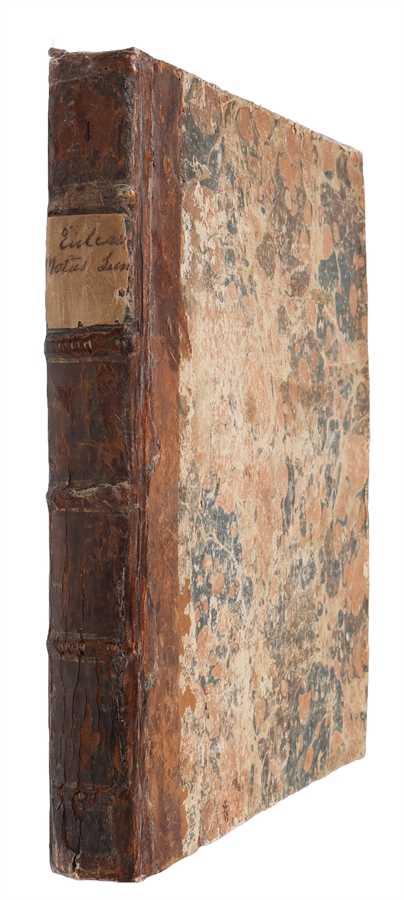
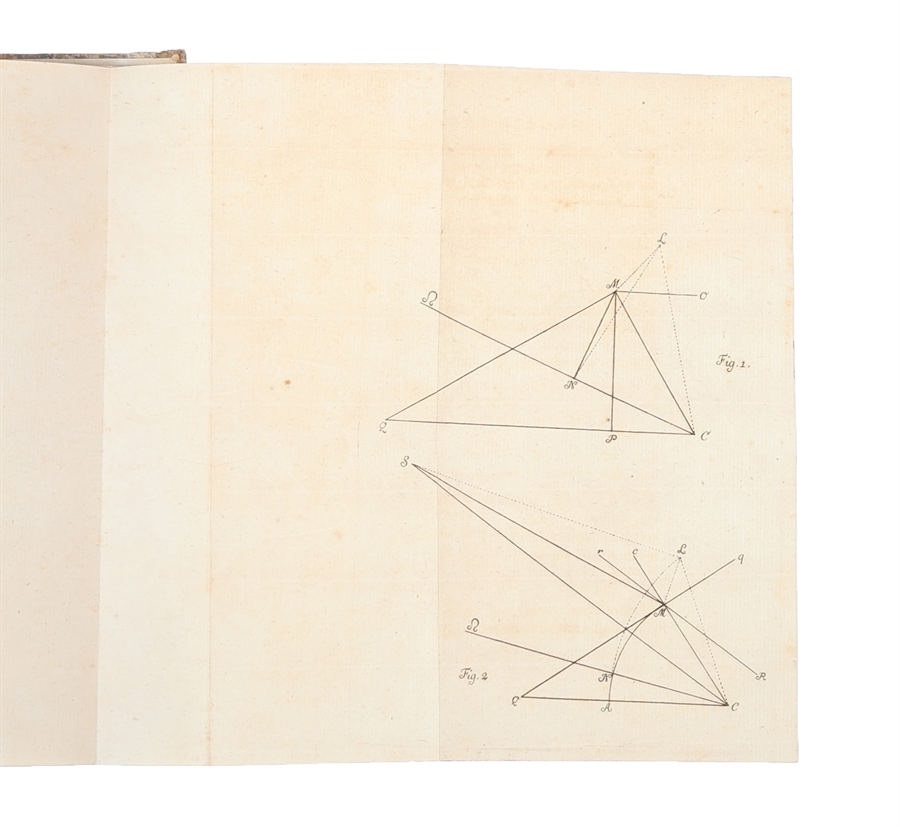
4to. In contemporary half calf with four raised bands. Spine quite worn and partly restored. Paper label with handwritten title on spine. Marbled paper boards with a bit of wear, especially along edges. Vague stain to lower part of title-page. Some pages evenly browned due to paper quality. A fine and clean copy printed on good paper. VIII, 347 pp. + 1 folded plate with two geometric diagrams.
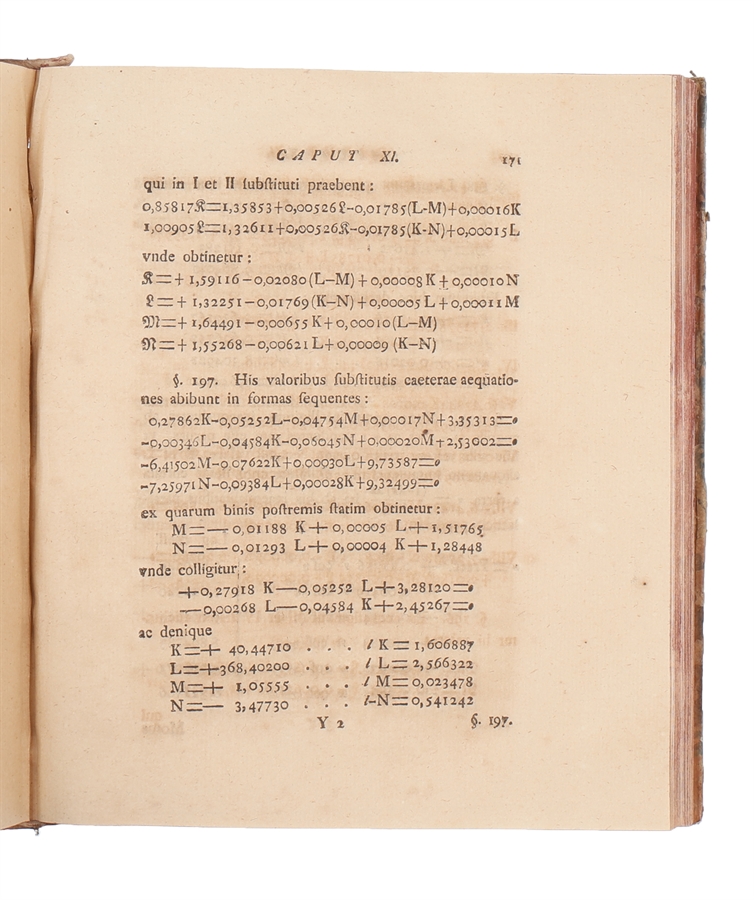
The very rare first edition of Euler’s seminal work on lunar motion, which marks a milestone in celestial mechanics and the application of Newtonian gravitation. Euler developed an original method for approximating the three-body problem and introduced an early form of the general method of variation of elements, anticipating many later advances in orbital mechanics by Lagrange and Laplace. “Based on Newton's universal law of gravitation, Euler first developed his first lunar theory with the aid of his method of variation of orbital parameters. This method is fairly general in the sense that it cannot only be applied to the theory of lunar motion, but also to the planetary motion. Euler published his first lunar theory in his celebrated treatise ‘Theory of lunar motion’ in 1753. He continued his research for almost the next three decades to make significant improvement of his first lunar theory including the lunar orbit, Moon’s position, equations for the Moon’s motion, lunar eclipses and the period of revolution of the Moon.” (Debnath: The Legacy of Leonhard Euler, p. 365). “Astronomy owes to Euler the method of variation of arbitrary constants. By it he attacked the problem of perturbations, explaining, in case of two planets, the secular variations of eccentricities, nodes, etc. He was one of the first to take up with success the theory of the moon’s motion by giving approximate solutions to the ‘problem of three bodies.’ He laid a sound basis for the calculation of tables of the moon.” (Cajori, History of Mathematics, p. 240). In the mid-eighteenth century discrepancies between observation and theory raised doubts about Newton’s law of gravitation: “The observed motions of the planets, particularly of Jupiter and Saturn, as well as the moon, were evidently different from the calculated motions based on Newton’s theory of gravitation. Thus, the calculations of Clairaut and d’Alembert (1745) gave the value of eighteen years for the period of revolution of the lunar perigee, whereas observations showed this value to be nine years. This caused doubts about the validity of Newton’s system as a whole.” (DSB). Clairaut eventually showed that the discrepancy resulted from insufficient mathematical approximations which Euler eventually accepted: “For a long time Euler joined these scientists in thinking that the law of gravitation needed some corrections. In 1749 Clairaut established that the difference between theory and observation was due to the fact that he and others solving the corresponding differential equation had restricted themselves to the first approximation. When he calculated the second approximation, it was satisfactorily in accordance with the observed data. Euler’s theory provided the basis for Tobias Mayer’s lunar tables which greatly improved how to measure the longitude at sea. “The first Euler lunar theory had an important practical consequence: T. Mayer, an astronomer from Göttingen, compiled, according to its formulas, lunar tables (1755) that enabled the calculation of the position of the moon and thus the longitude of a ship with an exactness previously unknown in navigation. The British Parliament had announced as early as 1714 a large cash prize for the method of determination of longitude at sea with error not to exceed half a degree, and smaller prizes for less exact methods. The prize was not awarded until 1765; £3,000 went to Mayer’s widow and £300 to Euler for his preliminary theoretical work.” (Ibid). Enestrom 187: "Durch die gekronte Preisschrift Clairauts [Theorie de la lune], uber die Euler ein Gutachten der Akademie ubersandte, veranlasst worden" Poggendorff I, 690.
Furthermore, his theory also provided the mathematical foundation for Tobias Mayer’s lunar tables which enabled unprecedented accuracy in determining longitude at sea and contributed to the solution of one of the most pressing practical problems of 18th-century science.
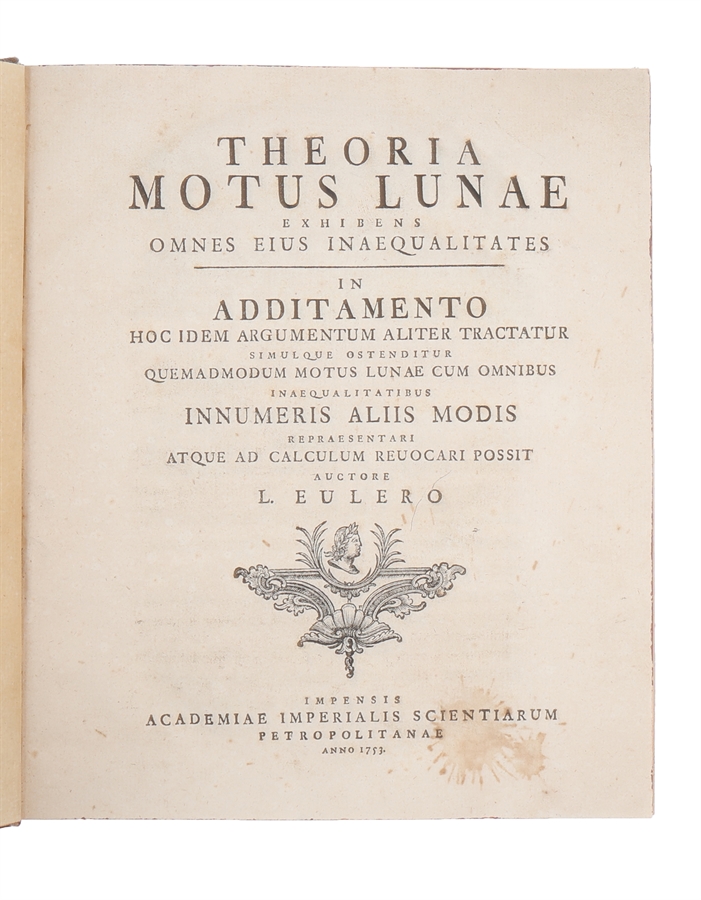
Euler did not at once agree. To put his doubts at rest, he advised the St. Petersburg Academy to announce a competition on the subject. Euler soon determined that Clairaut was right, and on Euler’s recommendation his composition received the prize of the Academy (1752). Euler was still not completely satisfied, however. In 1751 he had written his own Theoria motus lunae exhibens omnes ejus inaequalitates (published in 1753), in which he elaborated an original method of approximate solution to the three-body problem, the so-called first Euler lunar theory. In the appendix he described another method which was the earliest form of the general method of variation of elements. Euler’s numerical results also conformed to Newton’s theory of gravitation.” (Ibid.)
Sotheran, Suppl. II, 3098.
Honeyman 1068.
Order-nr.: 63633