
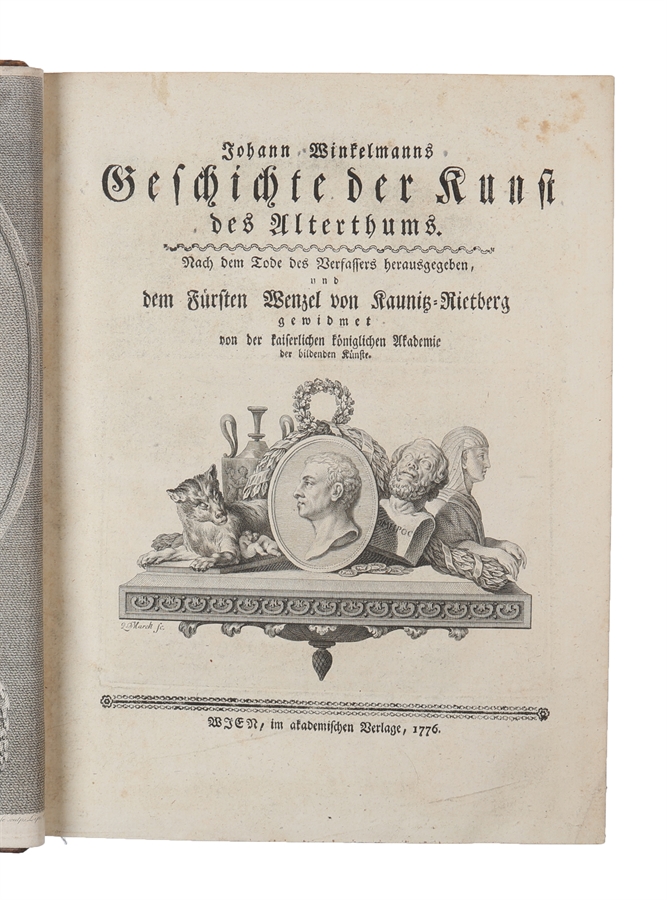
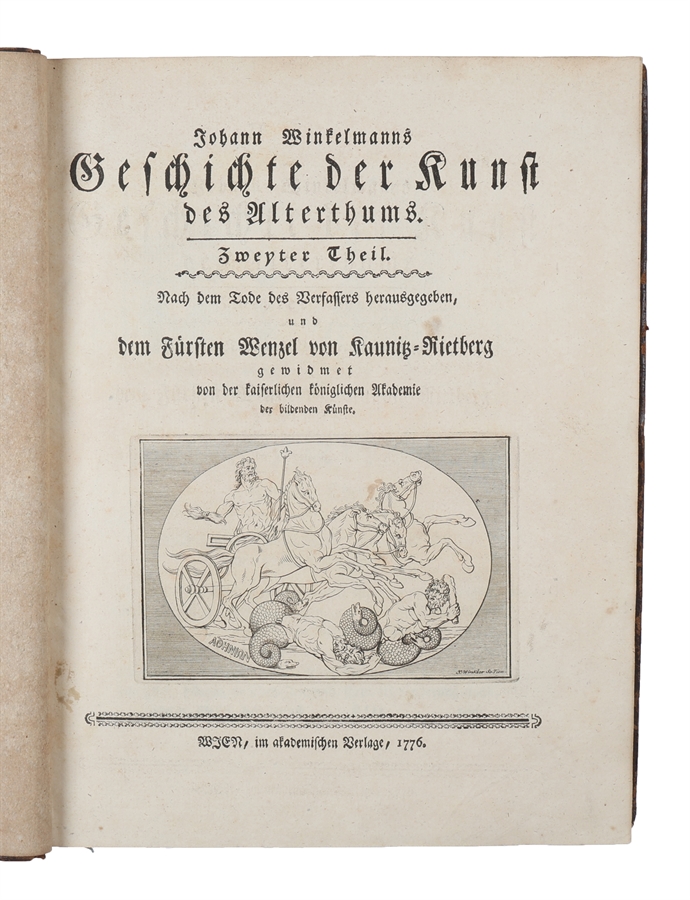
Wien, im Akademischen Verlage, 1776.
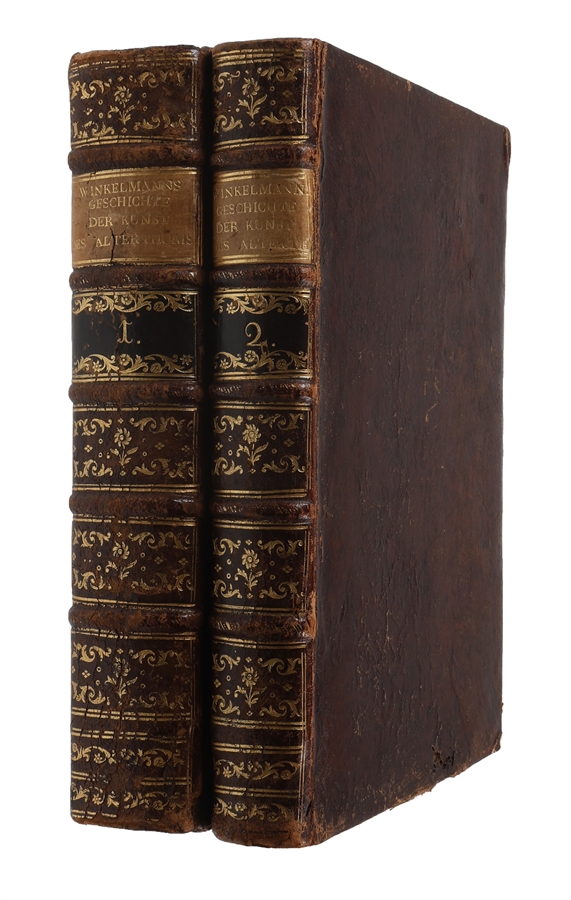
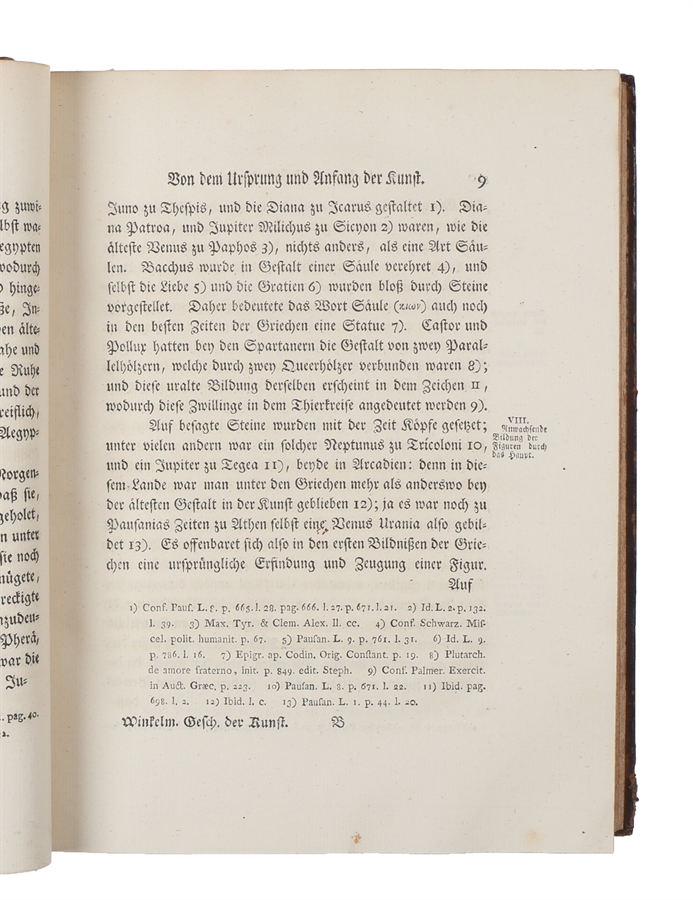
4to. Two volumes uniformly bound in two contemporary full sprinkled calf bindings with five raised bands and gilt lettering and ornamentation to spine. Bindings with light wear and and some scratches. Spine-ends with minor loss of leather. Ex-libris to verso of front boards and previous owner's name in contemporary hand to front free end-papers. Internally very fine and clean. Printed on good paper. (14), LXXII, 618 pp. + frontispiece; (3), 620-881, (54) pp. Blank leaves bound in the back.
First edition of Winckelmann’s seminal history of ancient art, one of the foundational works of modern art history and classical archaeology. In the present work Winckelmann established a systematic, historically based approach to the study of ancient art, separating different periods and styles and placing emphasis on the development of Greek sculpture. His famous conception of Greek art as embodying “noble simplicity and quiet grandeur” profoundly influenced the formation of Neoclassicism and generations of artists, historians and archaeologists. ”His general Geschichte der Kunst des Altertums (1764; “History of the Art of Antiquity”) is virtually the first work to define in ancient art an organic development of growth, maturity, and decline; to include such cultural and technical factors as climate, freedom, and craftsmanship in explaining the art of a people; or to attempt a definition of ideal beauty. This work inaugurated the division of ancient art into periods—a pre-Phidian (or archaic), the high or sublime style of the great Greek sculptors Phidias and Polyclitus of the 5th century bc, the elegant or beautiful style of the sculptor Praxiteles and the painter Apelles (both flourishing in Greece in the 4th century bc), and the imitative period, corresponding to the Greek-tinctured Hellenistic and the Roman—that have passed into the common parlance of Greek art history. But his fame rests chiefly upon his descriptions of individual works of art, combining meticulous, firsthand observation with a warm and spontaneous style. His remarks on the Laocoön, the Apollo Belvedere, the Niobids, and the Belvedere Torso have become landmarks alike in the history of German literature and art criticism. The study of art history as a distinct discipline and of archaeology as a humane science may be said to date from Winckelmann.” (Britannica) Winckelmann’s work marked an important change from earlier studies of antiquity. Rather than simply describing ancient monuments he aimed to show how art and artistic styles had developed over time. His study of Greek art, based partly on the collections in Rome and his close study of ancient sculpture, made the the present work one of the key works in the development of art history as an academic discipline.
Order-nr.: 63591