
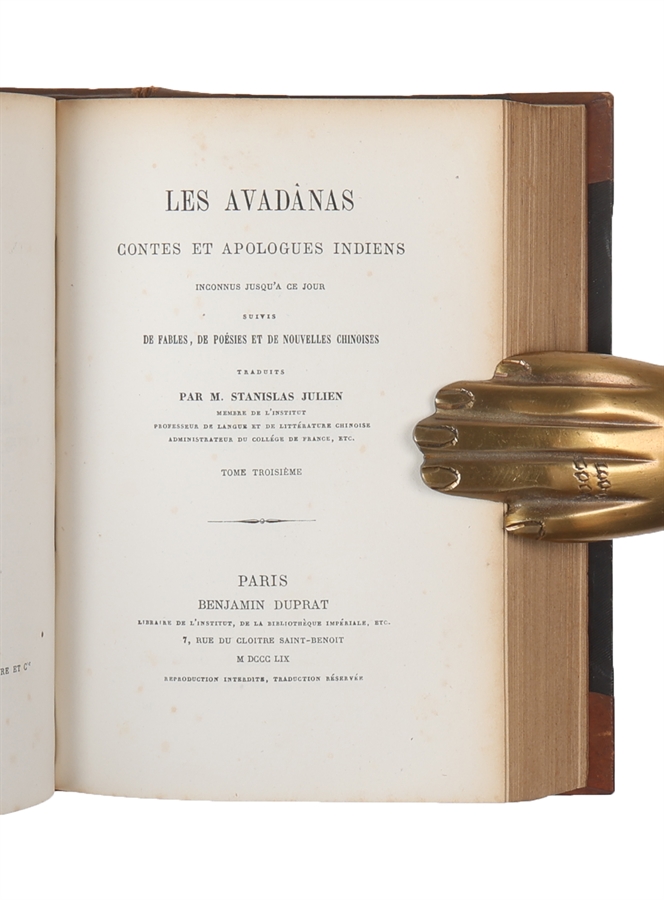
Paris, Duprat, 1859.
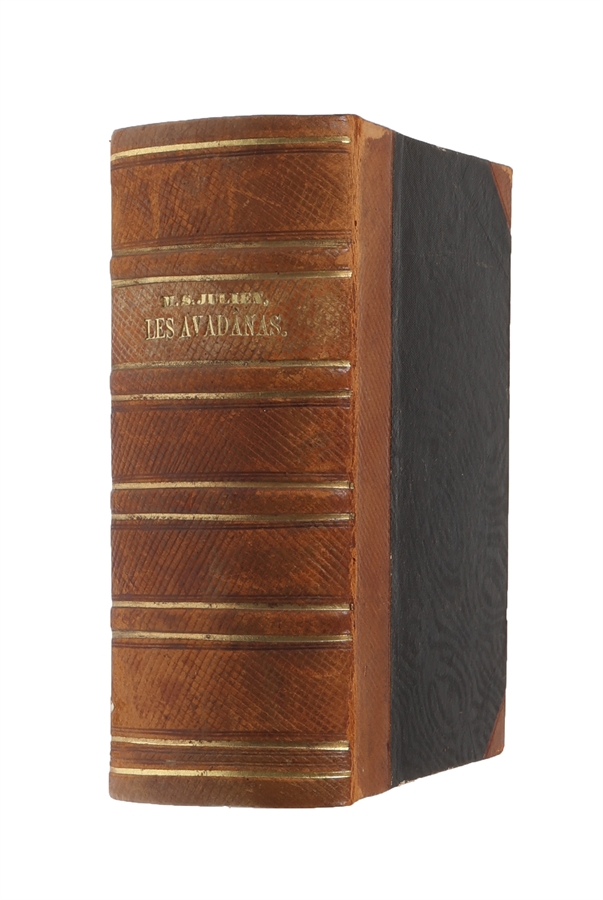
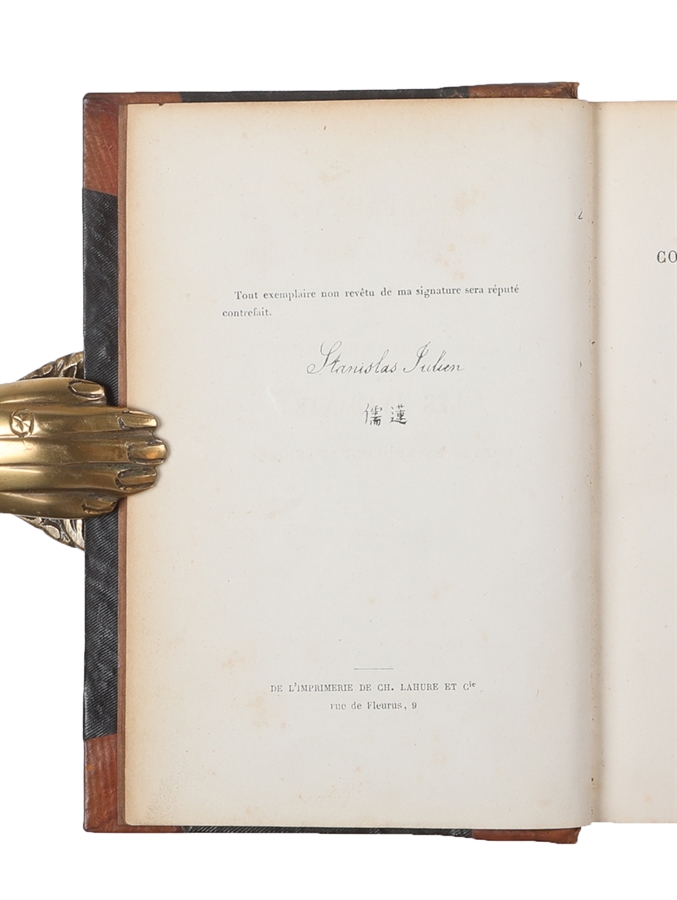
Small 8vo. All three volumes bound together in one very nice contemporary brown diced half calf with raised bands, gilt lines, and gilt title to spine. Slight wear to extremities, and with a bit of wear, but overall very nice. Tight and fresh. Also internally very nice, clean, and fresh, with a bit of light brownspotting to some leaves. Printed on good, heavy paper. XX, 240; VIII, 251, (1); (2), 272 pp. All half-titles present, including the first, which has Julien's printed endorsement-signature (in Roman letters as well as Chinese characters), ensuring that it is not one of the counterfeit-editions.
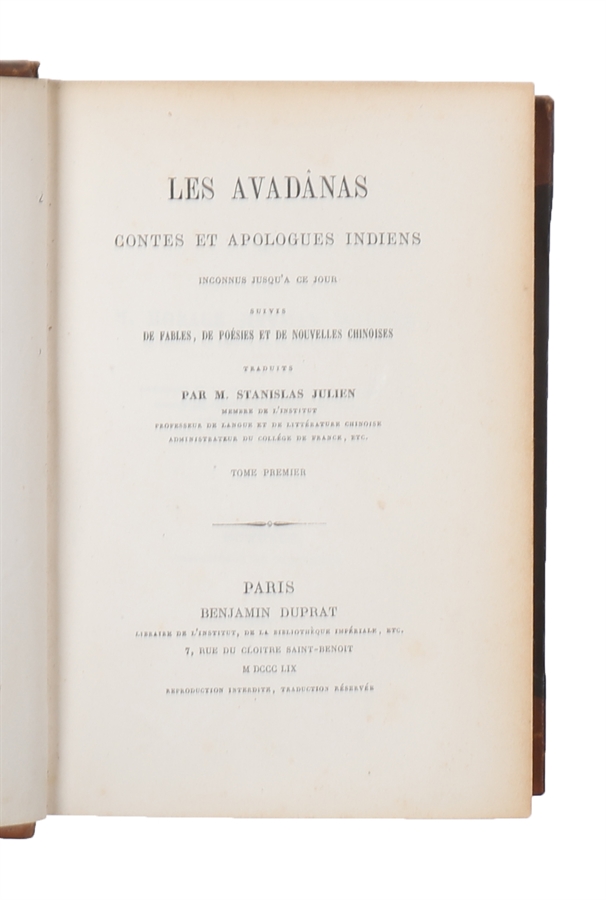
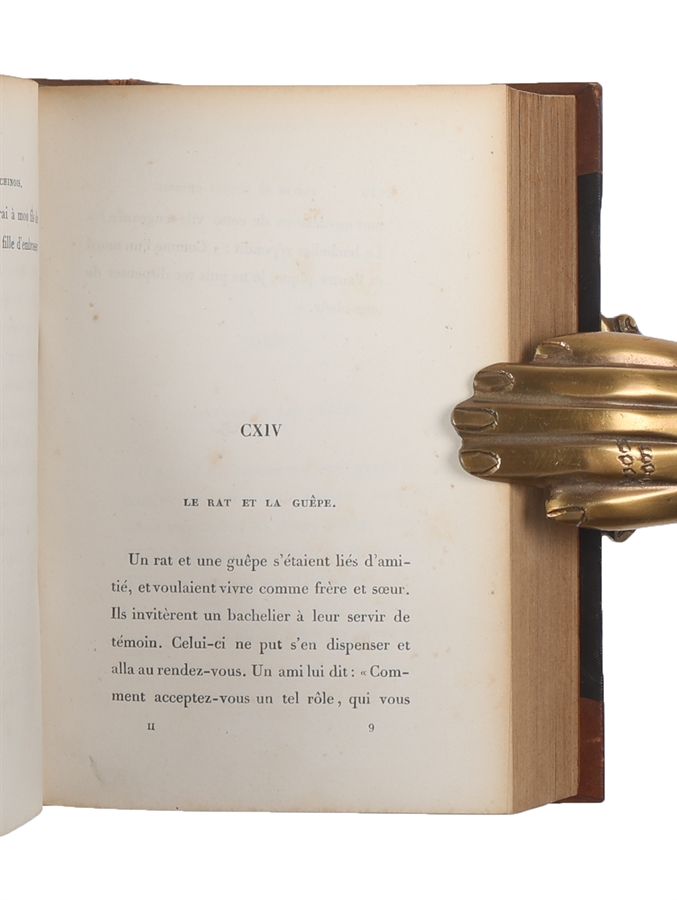
Exceedingly scarce first edition of Julien’s seminal translation of Avadanas, the canonical Buddhist tales of past virtuous deeds, events, and lives, constituting the first translations into any European language of more than 100 of these seminal tales. Stanislas Julien (1797-1873) was one of the most respected French sinologists and the leading European scholar of China during the 19th century. His publications revolutionized the study of Buddhism in the West and made accessible for the first time many of the foundational Buddhist works. This first edition of “Les Avadânas: Contes et Apologues Indiens Inconnus Jusqu’a ce jour” (The Avadanas, Indian Tales and Fables, Hitherto Unknown) from 1859 includes three volumes of tales and fables translated by Julien from Chinese translations of Sanskrit texts and some from Chinese originals: 112 Indian fables (Vols. 1-2) and 14 original Chinese tales, 4 Chinese poetical texts, and 3 short stories. Julien explains in the preface: “I found, in a Chinese Encyclopedia, the Indian Tales and Fables that I offer to the public today […].” (p. (VII)) “Among the twelve sections of Buddhist books, there is one called Pi-yu, ‘Comparisons or Similarities’, in Sanskrit Avâdanas. Moreover, all the pieces that follow are taken either from Indian collections bearing precisely the same name, or from Buddhist works composed in Sanskrit, where they appear under the same title." (pp. (VII) - VIII). Julien lists his sources (pp. VIII-XII), stating that the 200 works are preserved in the large collection of Buddhist booksprinted in Péking, in Chinese, Manchu, Mongolian, and Tibetan and adds that these are also particularly valuable, seeing that today it would probably be impossible to find most of the original Sanskrit texts. Additionally, “with the exception of three or four” the tales in the present volume “are not found in the collections of Indian tales and fables printed to date in various languages.” (pp. XII-XIV). "One will find at the end of this volume several pieces of original character, which will provide in advance an idea of the taste and spirit that prevail in purely Chinese fables. I have added to this an interesting explanation of these poems and new Chinese (tales).” (pp. XV-XVI).
Order-nr.: 63172