

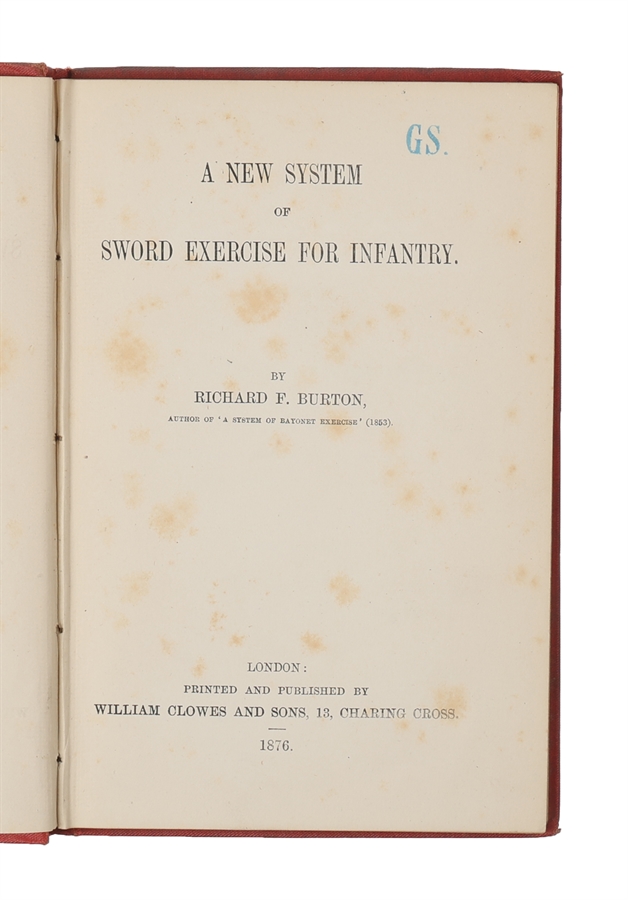
London, William Clowes and Sons, 1876.
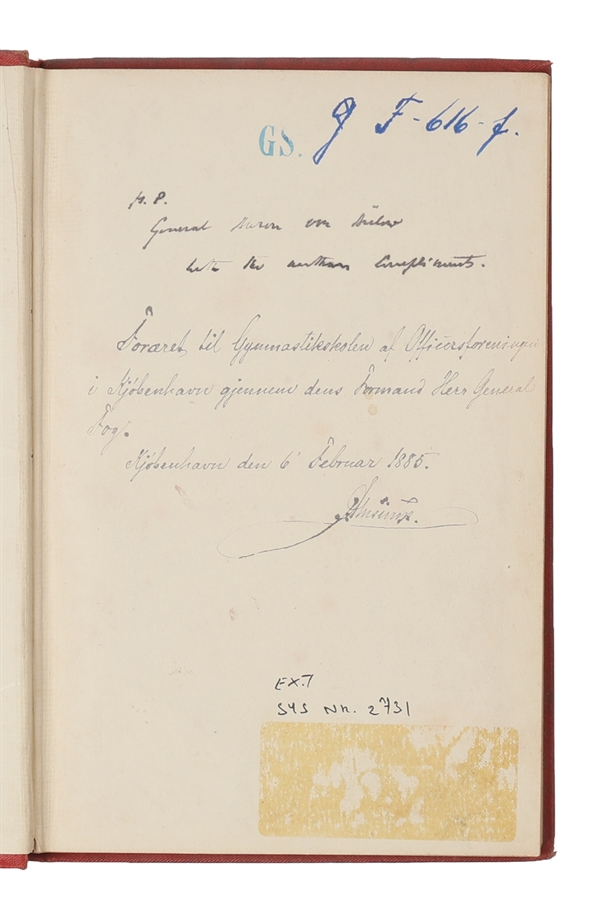
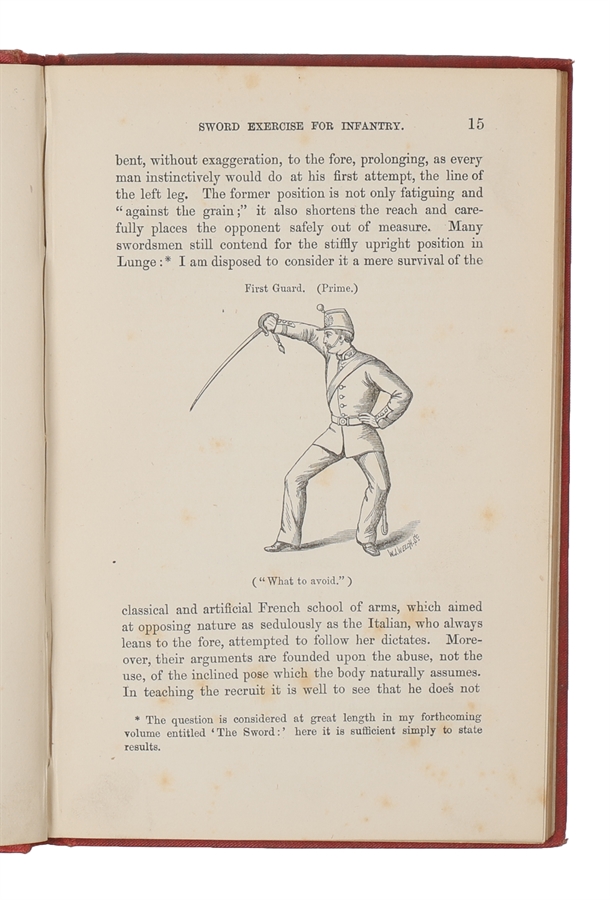
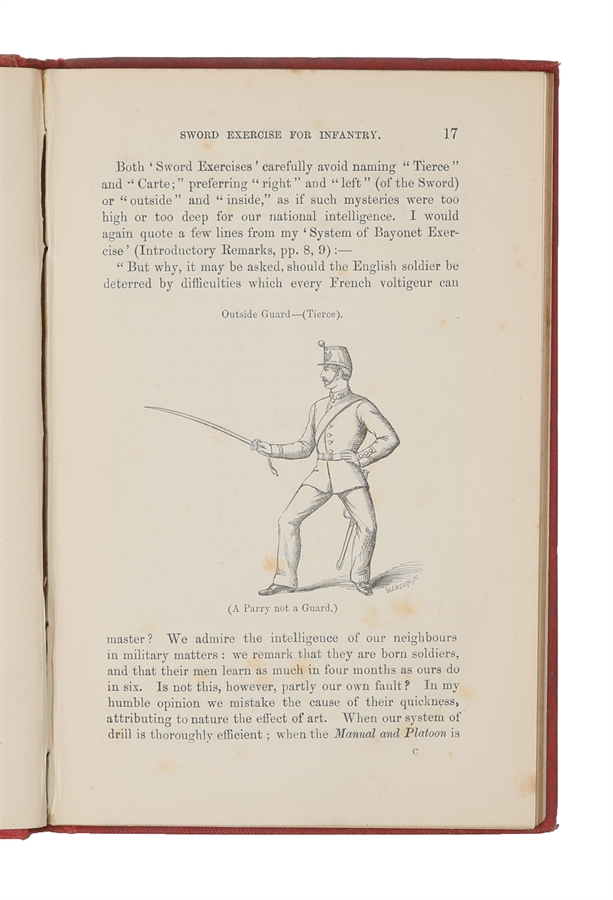
Small 8vo. Original full red cloth. Gilt lettering to front board. A small paperlabel at top of spine. A small stamp on top of title-page (GS). A bit of discoloration and spotting to front board. Faint scattered brownspots, mainly to the first leaves. Inscribed (by the author) to front free end-paper and with a note stating that the book was gifted to the School of Gymnastics by General Fog in 1885. On foot of the same leaf some discoloration from a paperlabel. Frontispiece. 59 pp., textillustrations.
Extremely scarce first edition, presentation-copy, of Sir Richard Burton's (1821-1890) new system for sword exercise. Inscribed to front free end-paper: "H.P./ General Baron von Bülow/ with the authors compliments." Bülow is probably the Danish Genreral-Major Otto Chr. Severin August von Bülow (1812-95) or it could be General-Lieutnant Carl Ernst Johan Bülow (1814-1890) who was a member of the Danish legation to the English Court from 1865 to 1880. Burton was an English Orientalist, explorer, polyglot, writer and translator. He wrote over 40 books, including annotated translations of the Portuguese poet-explorer Camões, "with whom he felt a deep sense of kinship" (Brodie), and famously, not without controversy, an unexpurgated translation of The Arabian Nights as well as of the Kamasutra, printed privately: "Taking it upon himself to introduce to the West the sexual wisdom of the ancient Eastern manuals on the art of love, he risked prosecution and imprisonment to translate and print secretly a translation of the Kamasutra" (see Brodie). When it came to sword fighting, according to Richards (1880), it was "observed of Captain Burton, that as horseman, swordsman, and marksman, no soldier of his day could surpass, and few equalled him" (1880: 5). In 1853, he published A Complete System of Bayonet Exercise, which, according to Penzer (1923), formed "one of the most important works on the bayonet ever published, and to it can be traced the change in the systems of bayonet drill adopted in most European countries. [...] Large numbers of it were purchased by foreign army authorities (particularly German)." (1923: 42)
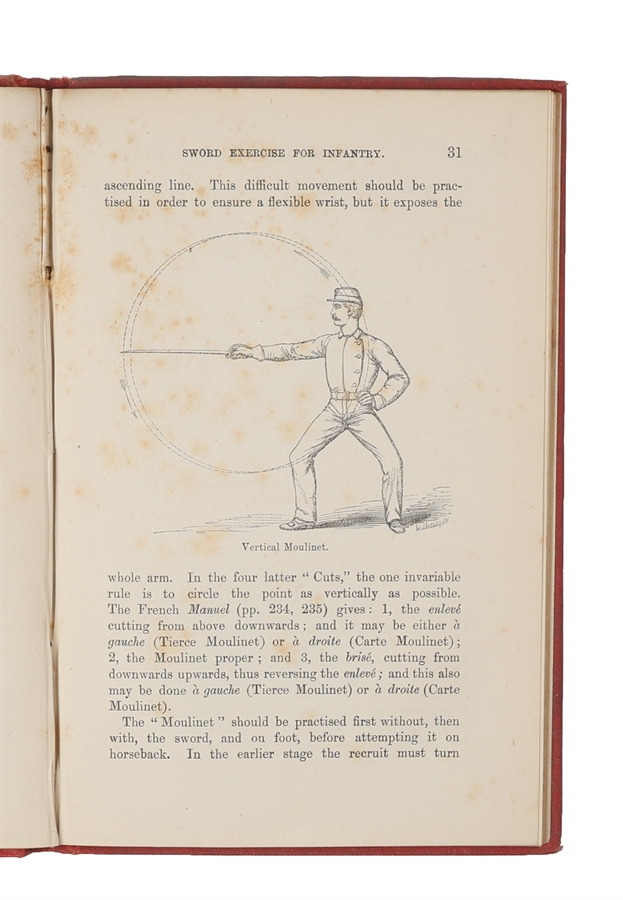
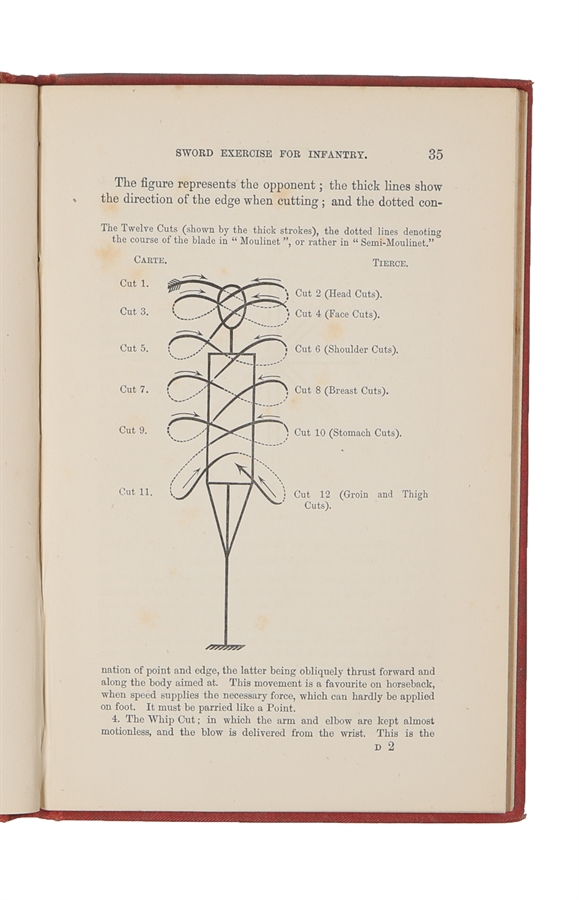
In the Introductory Remarks of the present work, Burton explains: "Whilst the last half century has witnessed an immense improvement in the projectile weapons of the civilized world, the theory and practice of the sabre or cutting arm have remained in statu quo ante; indeed, if there has been any change it is for the worse. The two systems authorized in the British army are completely behind their time [...] I have now finished with the ungrateful task of criticizing, and I proceed to propose a system which it is hoped will be as severely criticized by others. It is only candid to state that its pretensions are high, that it contains two distinct novelties, the Manchette System and the Reverse or Back-cut; and finally, that it aspires to be the first Treatise in which the broadsword is scientifically taken in hand." (pp. 11-20) Penzer p.93: 'very rare'.
Sources and further reading: Brodie, F.M. (2026, March 15). Sir Richard Burton. Encyclopedia Britannica. https://www.britannica.com/biography/Richard-Burton-British-scholar-and-explorer Burton, Isabel. (1893). The life of Captain Sir Richard F. Burton. London: Chapman and Hall. Penzer, Norman M. (1923). An annotated bibliography of Sir Richard Francis Burton, K. C. M. G. London: Philpot. Richards, Alfred Bate. (1880). A Short Sketch of the Career of Captain Richard F. Burton. London and Belfast: William Mullan and son.
Order-nr.: 59271