
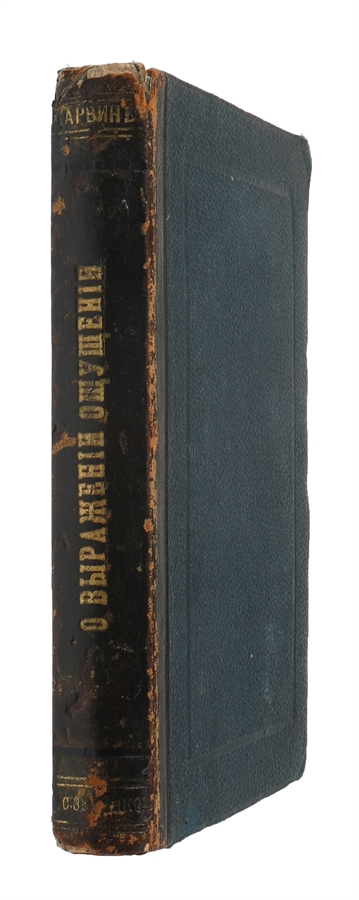
![O Vyranzenii oscuscenij u celoveka i zivotnych [i.e. Russian: "The Expression of the Emotions of Man and Animals"].](/images/fancy/63400b.jpg)
![O Vyranzenii oscuscenij u celoveka i zivotnych [i.e. Russian: "The Expression of the Emotions of Man and Animals"].](/images/fancy/63400c.jpg)
![O Vyranzenii oscuscenij u celoveka i zivotnych [i.e. Russian: "The Expression of the Emotions of Man and Animals"].](/images/fancy/63400d.jpg)
St Petersburg, Suscinskiy, 1872.
8vo. In contemporary half calf. Spine with wear. title-page brownspotted and back end-paper with annotations and stamps, otherwise a fine copy. (2), (I)-III, (3), 335 pp. + with 18 plates of engravings (21 numbered) and 7 heliotype plates.
First Russian, and first overall, translation of Darwin’s "The Expression of the Emotions of Man and Animals", being published the same year as the English original (The original being published in November 1872, the Russian translation in December 1872). The work was 'translated from the proofs sent by the author' by Vladimir Kovalevsky (1842-83), Russian biologist and the founder of evolutionary palaeontology. His own scientific works were printed between 1873 and 1877, and according to Henry Osborn (Osborn, H. The rise of Mammalia in North America // Proc. Amer. Assoc. Sci. 1894. vol. 42, pp. 189-227) they ''dare away'' all traditional and dry European paleontology. That was mainly because Kovalevsky was a devoted Darwinist and adapted Darwin's ideas to palaeontology. Luis Dollo, the Belgian palaeontologist, a contemporary of Kovalevsky's, described him thus: ''No palaeontologist embodies so perfectly our epoch, as the brilliant and miserable Vladimir Kovalevsky, friend and guest of the immortal Charles Darwin''. Indeed, Kovalevsky was a friend of Darwin's and they corresponded extensively. When visiting Darwin in 1877, the Russian botanist, Timiryazev, asked Darwin about his views on Russian science and Darwin surprised him with an answer that Vladimir Kovalevsky (little known at the time) was the bright hope of palaeontology. Freeman 1206.
The Expression of the Emotions "is an important member of the evolutionary set, and it was written, in part at least, as a confutation of the idea that the facial muscles of expression in man were a special endowment." (Freeman p. 142). Darwin concluded that "the chief expressiv actions exhibited by man and by the lower animals are now innate or inherited."
Order-nr.: 63400