

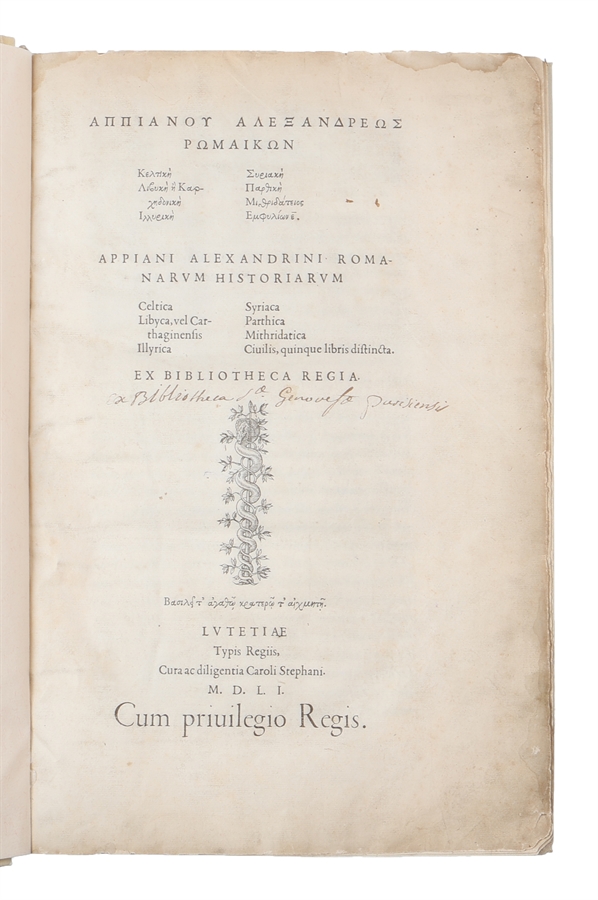
Paris, Carolus Stephanus (Charles Estienne), 1551.
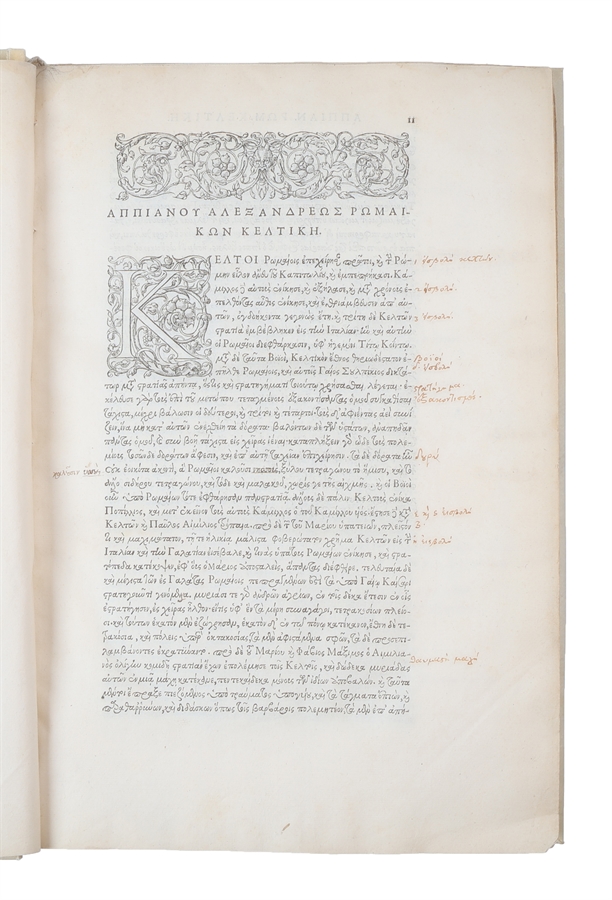
Folio. Recent full vellum. Boards slightly warped. small marginal holes to last four leaves. Title-page a little dusty and with marginal damp staining. Last leaf soiled and restored at margins, no loss. Several marginal notes in Greek, brown ink. Foliated and grotesque Greek initials and matching headpieces (by Geofreoy Tory). Handwritten ex library-entry to title-page (Bibliotheca Genovese, Paris). Device B2 on title. 393, (1) pp. One leaf missing (pp. 113-14), supplied in neat handwritten facsimile.
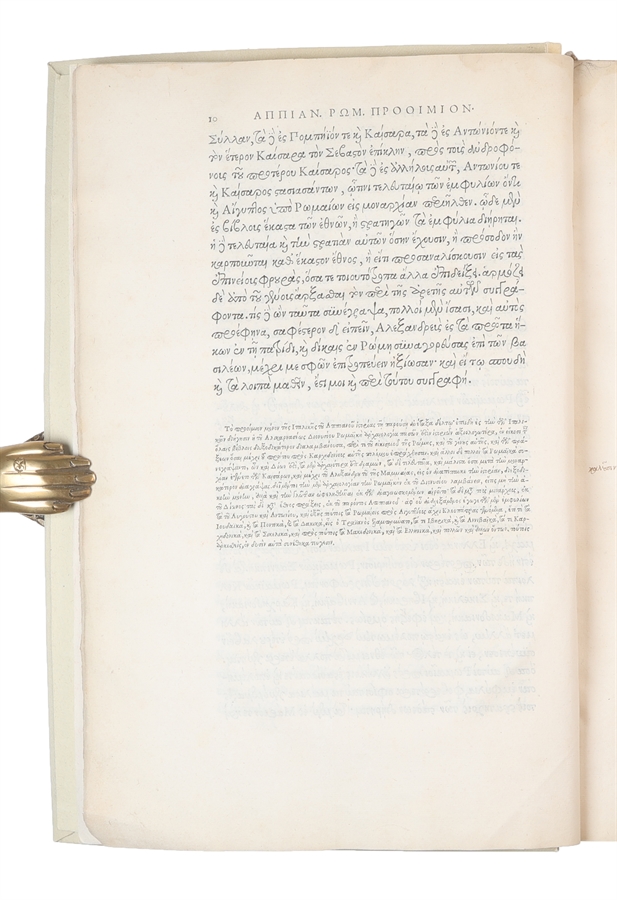
Editio princeps of Appian's Roman History, being also the first work to appear under Charles Estienne's own imprint. The work was commenced by his brother Robert I and completed and printed by Charles. This remarkable edition is particularly famous for its magnificet types - it uses all three sizes of the Royal Greek types (grec du roi), and is claimed to be the first classical (i.e. non-biblical) text printed in all three sizes (see for example pp. 10-11). These typefaces were developed between 1541 and 1550 by the French punchutter Garamond for the French king. Garamond's work was overseen by Robert I Estienne – the first printer to be granted permission to use these types by the French King. Appian (c.95 – c. 165 A.D) was a Greek historian born in Alexandria. He moved to Rome as an advocate, and, through the influence of a friend, gained the honorary position of a procurator under the emperor Antoninus Pius (138–161). This enabled him to devote his time to writing his Roman History, in 24 volumes, some of which were lost and some survived only as fragments (Brodersen, 2022).
In the second edition, published by Henri Estienne in 1592, "Estienne boasts that Appian owes his survival entirely to the Estienne family: first and foremost to his father [Robert I] and to his uncle Charles, for issuing the first edition, and then to himself for his discovery and publication of the two additional works included [...]" (Schreiber, p. 181). The second eddtion is considered the first complete edition of Appians' work, as two texts were only discovered after the publication editio princeps and published separately in 1557.
Schreiber, Fred. P. (1982). The Estiennes: an Annotated Catalogue of 300 Highlights of Their Various Presses. E.K. Schreiber: New York.
Order-nr.: 63241